Your AI Portraits in a Regulated World: What You Need to Know About Rights, Labels & Laws
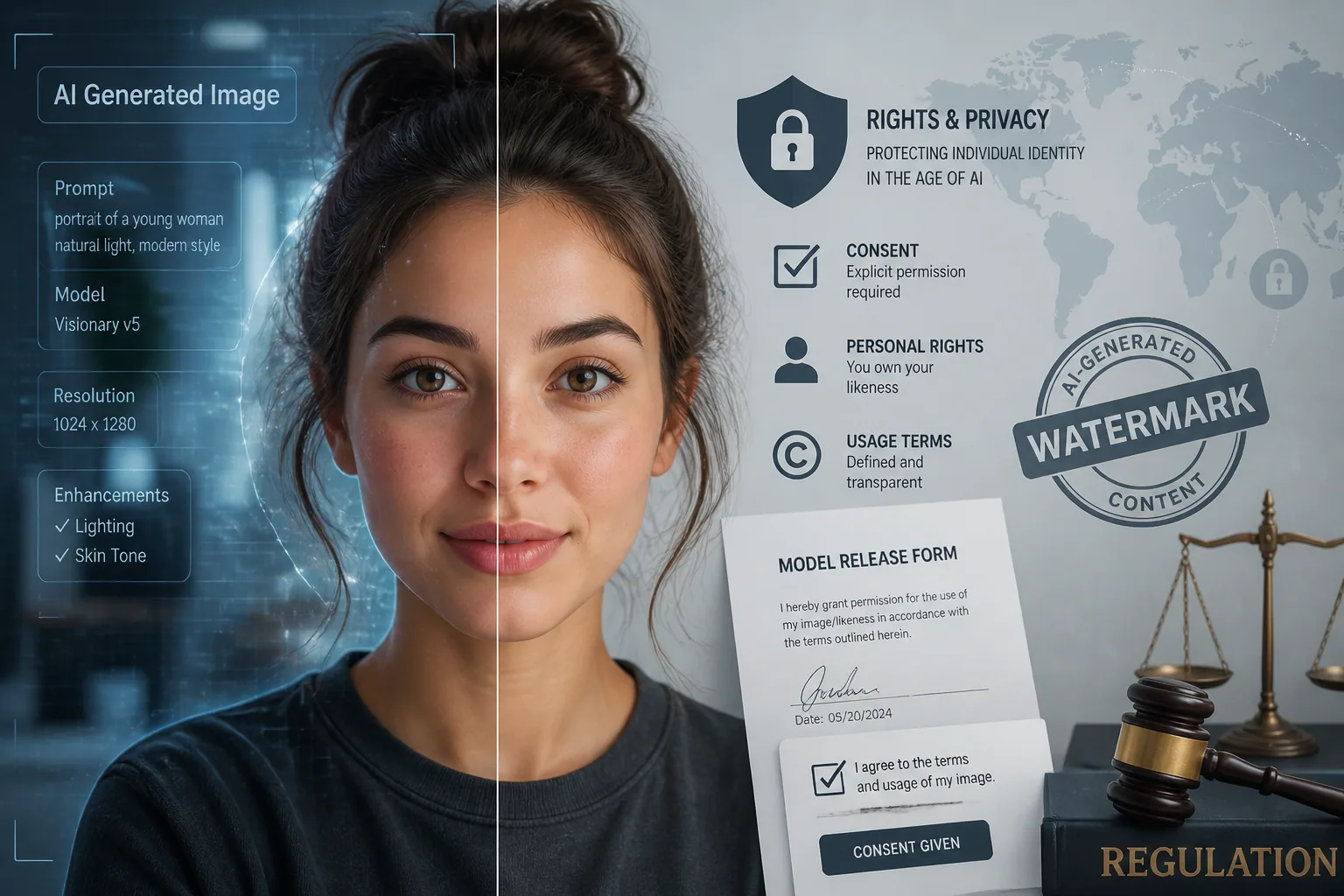
AI portraits and AI selfies have gone from novelty to everyday content. People use them for profile photos, creator branding, wedding announcements, campaign assets, and playful social posts. But the more realistic these images become, the more they start to overlap with laws about identity, disclosure, consent, and platform responsibility. That is why an AI portrait is no longer just a fun edit. In many situations, it is synthetic media that may need labels, permissions, and careful handling.
If you are creating portraits for yourself, for a client, or for an audience, the rules are changing quickly across the U.S., EU, and China. Some laws focus on transparency. Others focus on likeness rights and unauthorized use of a person’s face or voice. And behind all of it, app terms of service can affect what a platform can do with your uploads. Understanding these basics now can help you share AI portraits more safely and avoid problems later.
Why AI Portraits Are Becoming a Legal Issue
The core issue is simple: an AI portrait can look like a real photograph of a real person, even when it was generated or heavily altered by software. That creates confusion for viewers, and sometimes risk for the person pictured. A realistic AI selfie can be mistaken for a genuine image, a paid endorsement, or a real-life event. In that gap between appearance and reality, laws are starting to step in.
This matters for everyday users too, not just celebrities or major brands. If you upload your face into an app, the result may be a synthetic version of you that can be shared, copied, or stored in ways you did not fully expect. If someone else uses your face without consent, the issue can become even more serious. That is why regulators are increasingly focused on labels, provenance, and consent, not just the final image itself.
The New Rules: What’s Changing in the U.S., EU, and China
The EU is moving most aggressively on transparency. Under Article 50 of Regulation (EU) 2024/1689, known as the AI Act, providers and deployers of synthetic content must clearly disclose that the content was generated or manipulated by AI starting 2 August 2026. The rule applies broadly to synthetic images, video, audio, and text, which makes it highly relevant for AI portraits and selfies. The EU also requires machine-readable marking, which is intended to help automated systems detect AI-generated content more reliably. See: https://truescreen.io/insights/ai-act-article-50-labelling-synthetic-content-august-2026/ and https://compliance-kit.eu/en/knowledge/transparency-art-50-eu-ai-act
The EU rules also treat deepfakes seriously. Under Article 50, realistic synthetic persons or scenes must be clearly labeled as artificial, even if there was no intent to mislead and even if a real person is not depicted. That is a big shift, because it means the obligation is tied to the synthetic nature of the media itself, not only to fraud or deception. The potential penalties are also significant, with fines reported up to €15 million or 3 percent of global annual turnover.
China already has strict rules in place through the Deep Synthesis Regulations, effective since January 2023. These rules require visible or machine-readable watermarking for AI-generated content, consent from the person depicted before using their likeness, and platform-level obligations around licensing and liability. Recent guidance also emphasizes that using a person’s facial image, voice, or artistic persona without formal written authorization is illegal, even when the use is described as non-commercial or fan-made. See: https://www.detectdeepfakes.com/laws/cn and https://www.globaltimes.cn/page/202604/1358125.shtml
The U.S. is more fragmented, but the direction is clear. The Supreme Court has declined to hear a case asking whether AI-created images can be copyrighted, which effectively reinforces the view that purely AI-generated images without enough human authorship are not copyrightable. At the same time, states are moving in different ways. Tennessee’s ELVIS Act protects against unauthorized use of a person’s likeness or voice, New York has enacted laws requiring disclosure when synthetic performers are used in advertising and expanding rights around deceased personalities, and the proposed NO FAKES Act would create a federal framework for digital replicas. A useful overview is available here: https://www.congress.gov/crs-product/LSB11052
Non-Consensual AI Images and the Rising Risk of Liability
One of the biggest concerns around AI portraits is non-consensual imagery. If someone takes your photos and generates a synthetic version of you without permission, that can create reputational harm, emotional distress, or commercial misuse. In some jurisdictions, it may also trigger legal claims related to likeness rights, privacy, or publicity rights. The more realistic and shareable the image is, the greater the risk.
The problem does not disappear if the image is labeled as AI. In China, for example, the rules still require consent from the person depicted before using their likeness. In the U.S., many state laws focus on the unauthorized commercial use of someone’s name, image, or voice. That means even a technically impressive portrait can become a liability if it is used in ads, endorsements, or brand content without permission.
For creators and influencers, this is especially important. A portrait generated from your face may feel personal and harmless, but if someone else reposts it to promote a product or service, the legal meaning changes quickly. The safe assumption is that realistic AI portraits can carry real-world legal consequences when they involve an identifiable person.
Do You Own Your AI Selfie? Understanding Likeness and Usage Rights
Ownership is one of the most confusing parts of AI portraits. In the U.S., copyright law generally protects original human authorship, so a purely AI-generated image may not be copyrighted in the same way as a photo or illustration made by a person. But that does not answer the full question of who controls the face, likeness, or input images used to create it.
If you upload your own selfies into an AI app, you are usually not giving up your identity outright, but you may be agreeing to a set of usage rights in the platform terms. Those terms may let the app store, process, modify, or reuse your input in ways that go far beyond what users expect. That is why the practical answer to “Do I own my AI selfie?” is often: partly, but only within the boundaries of the app’s rules and local law.
The right of publicity is the concept to know here. In U.S. law, it generally protects a person’s name, voice, image, or likeness from unauthorized commercial use. Congress has summarized this area as a set of state-law protections that can create civil liability when someone uses another person’s identity without consent. That means your face is not just a file. In the wrong context, it is a legally protected identity asset.
What App Terms of Service May Let Platforms Do With Your Face
This is where many users get surprised. When you upload photos into an AI portrait app, the terms of service may require you to grant a license to use, store, reproduce, modify, or analyze your content. Sometimes the license is broad, and sometimes it is tied to improving the service. Either way, the terms matter because they can shape what the company can do with your face and the outputs derived from it.
That does not automatically mean every app will misuse your content. But it does mean you should read the permissions closely before uploading your best selfies or client images. Look for language about retention, training, sublicensing, public display, and whether deleted files are really deleted. If the terms are vague, that is a warning sign, especially if the platform is not transparent about storage or reuse.
This is also where product choice matters. If you want to experiment with portraits while keeping a closer eye on your content, a tool like Selfie AI: AI Photo Generator can be a practical option to review because it lets you create a personalized AI model from uploaded selfies and emphasizes secure processing and user control: https://findthe.app/selfie-ai-0xi7wd
AI Labels, Watermarks, and Why Provenance Now Matters
Labels are becoming a standard part of synthetic media policy. The idea is not just to tell viewers “this is AI,” but to make the information durable and machine-readable when possible. That matters because social platforms, search engines, and moderation tools increasingly need a way to detect whether an image was generated or altered. A simple caption can be removed or overlooked. A watermark or provenance marker is harder to lose.
In the EU, Article 50 specifically points toward machine-readable marking. In China, visible or machine-readable watermarking is already part of the framework for AI-generated content. For creators, that means the best practice is shifting away from hidden edits and toward transparent disclosure. Even if a platform does not force a label today, the direction of regulation is clearly toward provenance.
This is especially relevant for realistic portraits. A polished AI headshot can look like a studio photograph, which makes it more likely to be mistaken for an authentic image. Clear labeling helps viewers understand what they are seeing and helps you avoid accidental misrepresentation, especially if the portrait is used in professional or commercial settings.
What C2PA Means for Creators and Everyday Users
C2PA, short for the Coalition for Content Provenance and Authenticity, is one of the main technical standards being discussed for content provenance. The point is to attach tamper-resistant metadata to content so that people and platforms can trace how an image was created or modified. In practical terms, it is a way to preserve a record of authenticity through the file’s life cycle.
For AI portraits, that could mean future apps and platforms showing where an image came from, whether it was generated, and whether it was edited later. This is useful not only for journalists and professionals, but also for casual users who want to prove that a certain image is AI-generated, or that a real photo has not been altered beyond recognition. Compliance-focused summaries of the EU AI Act increasingly treat C2PA-style provenance as the likely machine-readable approach for synthetic content.
If you are creating portraits for social media, portfolios, or client work, provenance is worth paying attention to now. It is not just a technical feature. It is becoming part of the trust layer around digital images.
When and How to Disclose That a Portrait Was AI-Generated
A good rule is simple: if a reasonable viewer might think the portrait is a real photograph, disclose that it was AI-generated or AI-assisted. The safest place to do that is in the post caption, the image description, or both. If you are posting for a brand, campaign, or commercial purpose, disclosure becomes even more important because the risk of misleading people is higher.
Your disclosure does not need to be complicated. Clear language works best. Phrases like “AI-generated portrait,” “created with AI,” or “synthetic image” are usually enough to signal what the viewer is seeing. If the image is partly AI and partly edited, say so plainly. The goal is not to over-explain, but to make the media understandable.
Also remember that disclosure rules can differ by jurisdiction and platform. What is acceptable in one country may not be enough in another. When in doubt, label the image and keep the wording honest and visible.
Smart Habits for Safer Sharing: Files, Permissions, and Privacy
A few small habits can reduce risk a lot. First, keep original files separate from exported AI images. That helps you preserve proof of authorship and avoid accidental overwriting. Second, review app permissions before uploading. If the app asks for access to your full camera roll, contacts, or location, think carefully about whether that is necessary for making portraits.
Third, check retention settings and deletion options. If you stop using a service, make sure you understand whether your selfies, models, and generated outputs are deleted or simply hidden. Fourth, be cautious with images of other people. A photo of a friend, partner, child, or client may require more than just a casual upload. If the person is identifiable, consent matters much more than convenience.
Finally, avoid reusing AI portraits in places where they could be mistaken for official identity documents, news images, or endorsements. The more serious the context, the more important it is to keep a clear boundary between synthetic visuals and real-world proof.
How to Choose AI Portrait Apps That Respect Your Rights
Not all apps handle rights in the same way. A good AI portrait app should be reasonably clear about how it uses uploads, whether it trains on your content, how long it keeps files, and what control you have over deletion. It should also be transparent about whether outputs include visible watermarks or provenance metadata, especially if it is marketed for social posting or professional use.
Look for privacy policies and terms that are easy to read, not buried in vague language. If an app says you “maintain full control,” see whether that is actually reflected in the permissions and deletion settings. If it offers custom prompts or personalized models, ask yourself whether those models can be reused later or exported elsewhere. The safest services are usually the ones that do not surprise you.
It can also help to choose tools that make it easy to label synthetic content and manage your files responsibly. For users who want creative flexibility without losing track of their content, the best app is usually the one that is explicit about ownership, storage, and disclosure from the start.
A Simple Compliance Checklist for Posting AI Portraits in 2026
Before posting an AI portrait, run through a quick checklist. Is the image synthetic or heavily modified? If yes, label it clearly. Does the image show a real person, even if that person is you? If yes, make sure you have the right to use that likeness and that no one else’s rights are involved. Are you posting in a commercial, branded, or promotional context? If yes, be extra careful with disclosure and permissions.
Next, check the platform settings. Confirm whether the app or social network attaches watermarks, metadata, or provenance information. Review whether your original files are stored securely. Confirm whether any person featured in the image has given consent. If the content could plausibly be mistaken for authentic photography, add a plain-language disclosure in the caption.
The goal is not to stop creating. It is to keep creating without accidentally stepping into avoidable legal or ethical trouble.
How to Stay Updated as AI Media Laws Keep Evolving
This area is changing fast, and the rules you rely on today may not be the same in a year. The best approach is to treat AI portraits as a living compliance topic. Check updates from regulators, read app policy changes, and watch for new state, national, or platform-specific requirements. The EU’s transparency rules, China’s watermarking and consent rules, and the growing patchwork of U.S. publicity and disclosure laws are all signs that synthetic media is moving into a more regulated phase.
If you regularly post AI portraits, make legal transparency part of your workflow. Save original files, keep proof of consent when needed, label synthetic content clearly, and choose tools that respect your control over uploads. That way, you can keep enjoying AI creativity while staying on the safer side of the rules as they continue to develop.