Why AI Selfies Make It Hard to Trust What You See and How to Keep It Real
AI selfies are everywhere right now because they solve a very human problem: we want to look polished, interesting, and a little more magical than an ordinary camera roll usually allows. With a few uploads, an app can turn a basic portrait into a glam shot, a beach scene, a fantasy character, or a business headshot. The results can be fun, flattering, and often surprisingly convincing. But that is also exactly why they can feel unsettling. When an image looks almost real, yet not fully real, our brains do not always register it as simple entertainment. They register it as a question.
That question matters more than ever because AI portrait tools are getting better quickly, and our instincts are not always keeping up. In many cases, people cannot reliably tell synthetic faces from real ones. In other words, the issue is not only that AI selfies can look fake. Sometimes the problem is that they look real enough to make trust harder, not easier.
Why AI Selfies Are Everywhere Right Now
The rise of AI selfies is not hard to understand. Social platforms reward striking visuals, creators need fresh content constantly, and casual users want results that feel expressive without requiring professional editing skills. AI portrait apps make it easy to create images that fit almost any identity or mood. A single selfie can become a professional headshot, a cinematic fantasy portrait, or a themed post for a holiday or event.
This appeal comes from convenience, novelty, and control. Instead of spending money on a photo shoot or learning advanced editing software, people can generate content in minutes. The technology also flatters users by giving them versions of themselves that are more stylized, more dramatic, and sometimes more idealized than a normal camera would capture. That combination is powerful, especially in an online culture where attention is earned visually.
Still, the popularity of AI selfies has a side effect: the more often we see synthetic portraits, the more normal they start to feel. And once they become normal, the line between enhancement and fabrication gets blurrier for everyone.
Why Some AI Portraits Feel Impressive Then Instantly Unsettling
A strong AI portrait often creates a very specific reaction. At first glance, it looks impressive. The lighting seems cinematic, the skin looks smooth, the face is well balanced, and the overall image feels high-end. Then, a second later, something feels off. Maybe the eyes are too glossy, the hands are slightly strange, the hair blends oddly into the background, or the skin texture looks airbrushed in a way that no real camera usually would. That tiny mismatch can be enough to make the image feel unsettling.
This is one reason AI portraits can land in the uncanny valley. According to National Geographic’s explanation of the phenomenon, mismatched facial features and slight proportional errors can trigger discomfort when something appears almost human but not quite right. https://www.nationalgeographic.com/science/article/ai-uncanny-valley The issue is not always obvious distortion. Often it is the subtle tension between realism and imperfection that makes the image feel uncanny.
Neuroscience research has also suggested that near-human artificial faces are processed differently by the brain than real faces, with regions such as the amygdala responding in ways associated with alertness or unease. In plain terms, the brain seems to notice when a face is almost believable but still slightly wrong. That is why some AI selfies feel polished and impressive in one moment, then strangely hollow in the next.
The Psychology of Authenticity and the Creepy Effect
People do not judge faces only with their eyes. They judge them with expectations. A photo that claims to show a real person is usually assumed to follow the rules of real photography: natural skin texture, believable light, coherent shadows, and small imperfections that make the face feel lived-in. When an AI image breaks those expectations, even in minor ways, it can feel creepy because authenticity has been violated.
This is why a selfie can be technically beautiful and still feel emotionally wrong. A face that is too symmetrical, too smooth, or too evenly lit may seem attractive at first, but if it lacks the irregularities we associate with real people, viewers may perceive it as artificial. The reaction is not just about realism. It is about trust. We expect a portrait to reflect a person, not merely a polished simulation of one.
There is also a social layer to the discomfort. People often use selfies to communicate identity, mood, status, or credibility. When an AI image becomes overly polished, viewers may wonder whether they are seeing a true representation or a strategic performance. That hesitation can make the image feel less human, even when it is visually spectacular.
How People Judge Real vs. Fake Faces and Why We Often Get It Wrong
Research suggests that most people are not very good at identifying synthetic faces. In one study using AI-generated images from the StyleGAN algorithm, the majority of participants had hit ratios below 50 percent, meaning they were more likely to think AI-generated faces were real than correctly identify them as synthetic. Source: PMC https://pmc.ncbi.nlm.nih.gov/articles/PMC12489049/
That matters because our confidence is often higher than our accuracy. We may feel like we can spot a fake face instantly, but in practice we are frequently guessing. Another report, discussing research published in Royal Society Open Science, found that even expert super recognizers, people exceptionally skilled at remembering faces, were at chance levels when trying to distinguish AI-generated faces from real ones. Typical participants did worse, landing around 30 percent correct. A brief five-minute training session on common rendering errors, however, improved accuracy significantly. Source: LiveScience https://www.livescience.com/health/psychology/ai-is-getting-better-and-better-at-generating-faces-but-you-can-train-to-spot-the-fakes
This creates an important tension. On one hand, viewers may distrust AI selfies because they feel unnatural. On the other hand, people often misidentify them anyway. The result is a weird kind of social uncertainty where some fake faces are too obvious, some are almost impossible to spot, and many fall somewhere in between. That uncertainty can make both creators and viewers more cautious, or more suspicious, depending on the context.
What Recent Research Says About Portrait Realism and Viewer Bias
One of the most interesting findings in this area is that people do not simply detect AI portraits by looking for one obvious flaw. They use a mix of cues, many of them subconscious. Eye shape, skin texture, face proportions, and overall photographic coherence all influence judgment. But the weighting of those cues is inconsistent, which means different viewers can look at the same portrait and disagree strongly about whether it is real.
The eye region seems especially important. A recent paper titled Eyes don’t lie: Unmasking fake faces with ocular clues reported that ocular geometry, including pupil size, iris color, and alignment, could distinguish GAN or diffusion-model generated faces from real ones with very high accuracy in controlled conditions, with AUC around 99 percent. In more natural settings, that accuracy dropped to about 67 percent. Source: ScienceDirect https://www.sciencedirect.com/science/article/pii/S0379073826001088
That drop is important. It shows that lab conditions are not the same as the messy reality of social media. On a feed, people scroll quickly, images are compressed, filters are added, and context is thin. So even when a trained system or a trained human can spot a tell in a controlled test, the same image may pass casually online. For viewers, that means skepticism is healthy. For creators, it means that realism is not just about sharpness or resolution. It is about consistency across the whole face and scene.
When Enhancement Stops Feeling Like You
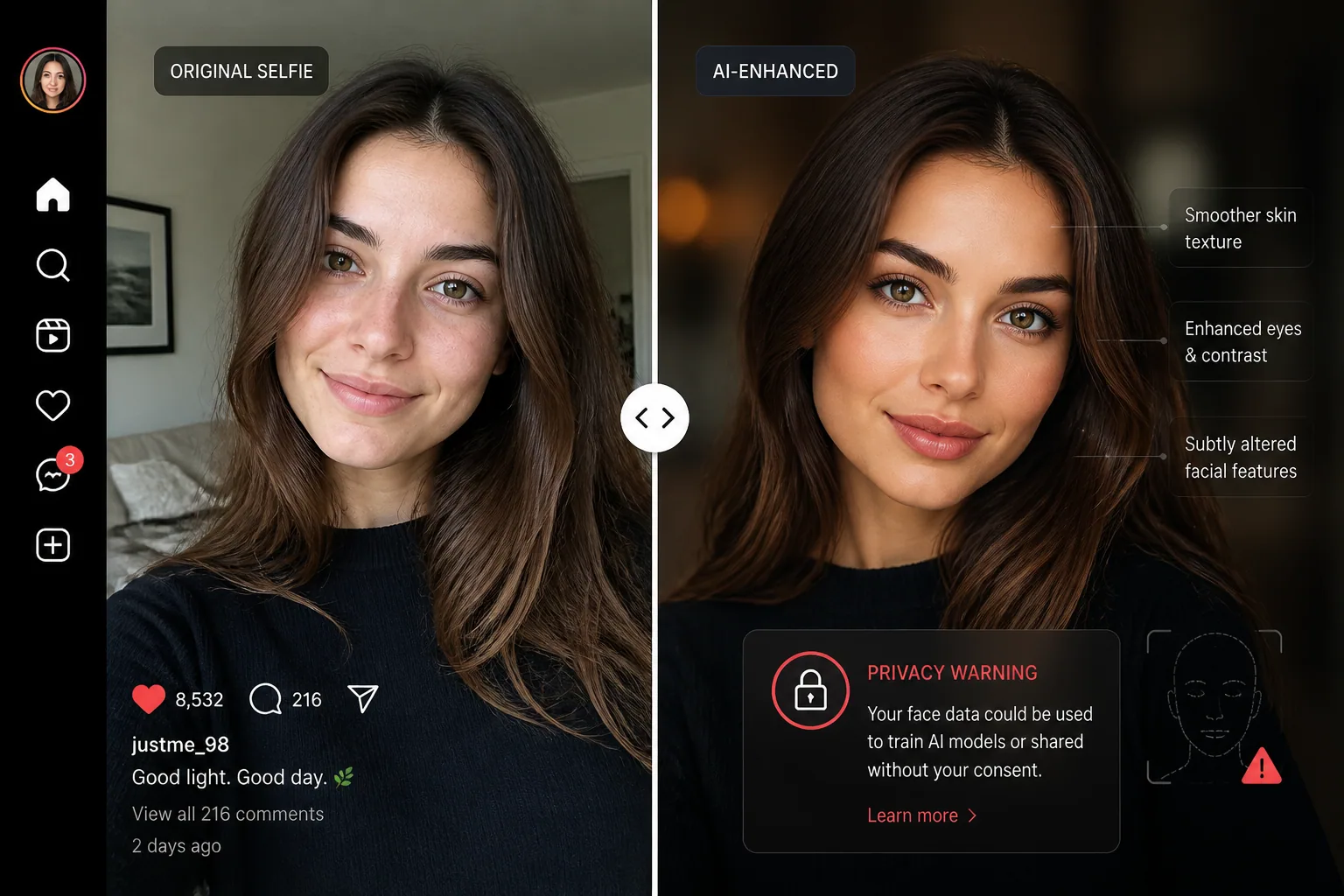
There is a point at which editing stops feeling like enhancement and starts feeling like substitution. That point is personal, but it usually appears when an image no longer looks like an improved version of the person who uploaded it. Instead, it becomes a different person wearing their likeness. That can happen through extreme smoothing, altered bone structure, changed eye shape, or a face that is so stylized it no longer feels anchored to the original.
For many users, this is where AI selfies become emotionally complicated. A portrait can be flattering and still feel disconnected from identity. That disconnect matters because selfies are not just images. They are social signals. Friends, followers, and clients may use them to infer your age, style, mood, professionalism, or trustworthiness. If the image feels too detached from the real person, it can undermine exactly the credibility it was meant to build.
The most believable AI portraits usually preserve a sense of identity. The face should still look like you, not merely a prettier version of someone else. Small imperfections, familiar facial proportions, and natural expressions often make a stronger impression than overly dramatic retouching. In many cases, restraint is what makes an AI image more convincing.
The Hidden Privacy Risks in AI Selfies and Stylized Portraits
The trust issue is not only visual. It is also about data. When you upload selfies to an AI app, you may be sharing more than a face. You may also be exposing biometric traits, metadata, and other information that can be stored, analyzed, or repurposed in ways that are not always obvious.
Some AI-enabled beauty and selfie apps have faced scrutiny for collecting sensitive biometric data such as facial geometry and skin tone, and for sharing or selling that data without clear consent. Reports have linked such practices to potential violations of laws like Illinois’ Biometric Information Privacy Act. Sources: OECD.ai https://oecd.ai/en/incidents/2022-02-16-5c35 and Alibaba Product Insights https://www.alibaba.com/product-insights/are-ai-face-swapping-apps-violating-biometric-privacy-laws-in-states-like-illinois-and-texas.html
There have also been legal challenges involving popular apps. In the case of Lensa’s Magic Avatar feature, a complaint alleged that users’ facial geometry was collected, stored, and used without adequate disclosure, in violation of BIPA. Source: ClassAction.org https://www.classaction.org/news/lensa-apps-magic-avatar-feature-illegally-captures-user-facial-geometry-class-action-claims
This is the part of the conversation many users underestimate. A fun portrait generator may still be a data collection tool. If you upload your face, the app may learn from it, process it, keep copies of it, or use it according to terms you have not fully read. Even if the image results look harmless, the underlying data can be valuable. And when biometric information is involved, the stakes are much higher than a normal photo upload.
How Fingerprints Facial Data and Your Likeness Can Be Exposed
One especially surprising risk is that certain selfies can reveal more than your face. Selfies showing the peace sign, for example, can expose fingerprint ridge detail if taken at close enough range, roughly 1.5 to 3 meters according to experts cited by Tom’s Guide and SOFX. AI tools can further sharpen those ridges, creating the possibility that fingerprints could be reconstructed and used to spoof biometric systems. Source: Tom’s Guide https://www.tomsguide.com/ai/that-peace-sign-you-do-in-your-selfies-could-let-ai-steal-your-fingerprints-for-scammers-heres-how
That example illustrates a broader point. The problem is not only that AI can make a portrait look more polished. It can also make hidden detail more legible. A hand gesture, background reflection, or high-resolution crop may reveal information a user never intended to share. Combined with facial likeness, these details can be exploited for impersonation, identity theft, or social engineering.
So when we talk about stylized portraits, we should not think only about aesthetics. We should think about what the image contains, what it reveals, and how easily that information could be reused. A face is already a biometric identifier. In the wrong context, it can become much more than a picture.
What to Check Before Uploading Photos to an AI Selfie App
Before uploading any photos, it is worth checking the app’s data policy carefully. Look for how long images are stored, whether uploads are used for training, whether they are shared with partners, and whether you can request deletion. These details often matter more than the marketing claims on the homepage.
Some companies do publish clearer retention rules. For example, Artia states that uploaded selfies are purged from its servers within 72 hours and that it does not use images for advertising, profiling, or AI model training. Source: https://getartia.app/face-data That kind of policy is still the exception rather than the rule, which is why it stands out. If an app does not clearly explain retention and usage, assume the data may live longer and travel further than you expect.
A good pre-upload checklist includes a few simple questions. Does the app need access to your contacts or camera roll? Can you use it without signing into linked accounts? Is there a clear deletion path? Does the company explain whether your face helps train the model? If the answer to any of these is unclear, treat that as a warning sign.
How to Make AI Selfies Look Better Without Looking Fake
If your goal is a believable AI portrait, the best strategy is usually not more enhancement, but better restraint. Choose styles that preserve your bone structure, facial proportions, and expression. Overly dramatic beauty filters, extreme makeup effects, and surreal lighting can make the image more eye-catching, but they also increase the chance that viewers will feel something is off.
A more realistic result usually comes from keeping skin texture natural, avoiding exaggerated symmetry, and matching the portrait style to the original photo. If the input selfie is casual, the output should not suddenly look like a luxury fashion campaign unless that contrast is intentional. You want the image to feel like an extension of you, not a costume that replaces you.
This is also where tools like Selfie AI: AI Photo Generator can be useful if you want polished results while still exploring styles that feel personal rather than overprocessed. The app turns ordinary selfies into AI-generated portraits and animated videos across different scenarios, including business portraits, vacation scenes, wedding looks, and custom prompts. Used thoughtfully, it can help you experiment with realism, as long as you stay selective about what you upload and how much of your identity you want to expose.
Smart Sharing Habits Where How and With Whom to Post
Even a convincing AI selfie should not automatically be shared everywhere. Different platforms and audiences carry different expectations. A fun fantasy portrait may work on a public social feed but feel inappropriate on a professional profile. A polished headshot may be acceptable for branding, but if it strays too far from your actual appearance, it can confuse people who meet you in real life.
It also helps to think in layers. Public posts should generally be the most conservative in terms of face alteration and data exposure. Private shares can be more experimental, but only with people you trust. If an image includes fingerprints, badges, location clues, or other sensitive details, avoid posting it broadly. The more people who can see the image, the more chances there are for misuse, screenshotting, and reposting.
One useful habit is to ask whether the image tells the truth you want it to tell. If you are sharing a creative transformation, say so. If you are using an AI portrait for branding, make sure it still resembles you enough to avoid confusion. Transparency does not kill creativity. It makes the creativity easier to trust.
Keeping It Real A Practical Checklist for Authentic Safer AI Selfies
If you want to use AI selfies without losing credibility or privacy, keep a few rules in mind. First, preserve the core of your identity. A good AI portrait should still feel like your face, not a generic ideal. Second, avoid overediting to the point where texture, proportions, and expression disappear. Third, check the app’s data policy before uploading anything. Fourth, be careful with images that show hands, fingerprints, reflections, documents, or other sensitive details.
It also helps to remember that most people are not reliably spotting fake faces at a glance. Research shows that viewers often misclassify AI-generated faces as real, and even face experts can struggle without training. That means the burden is not just on viewers to detect synthetic images. It is also on creators to use them responsibly and clearly.
In the end, the goal is not to reject AI selfies altogether. It is to use them in a way that respects both perception and privacy. If you keep the image believable, disclose it when needed, limit what you upload, and choose apps with clearer data practices, you can enjoy the creative side of AI without turning your face into a risk you did not mean to take.