When AI Portraits Go Viral: Navigating Memes, Trends & the Risk of Misrepresentation
AI portraits are spreading faster than many people expect, and not just because they look impressive. They are easy to share, easy to remix, and often emotionally charged enough to make people stop scrolling. A polished portrait can trigger curiosity, amusement, admiration, or skepticism in a matter of seconds. That combination makes AI-generated faces unusually powerful on social platforms, where visual novelty and strong reactions tend to win.
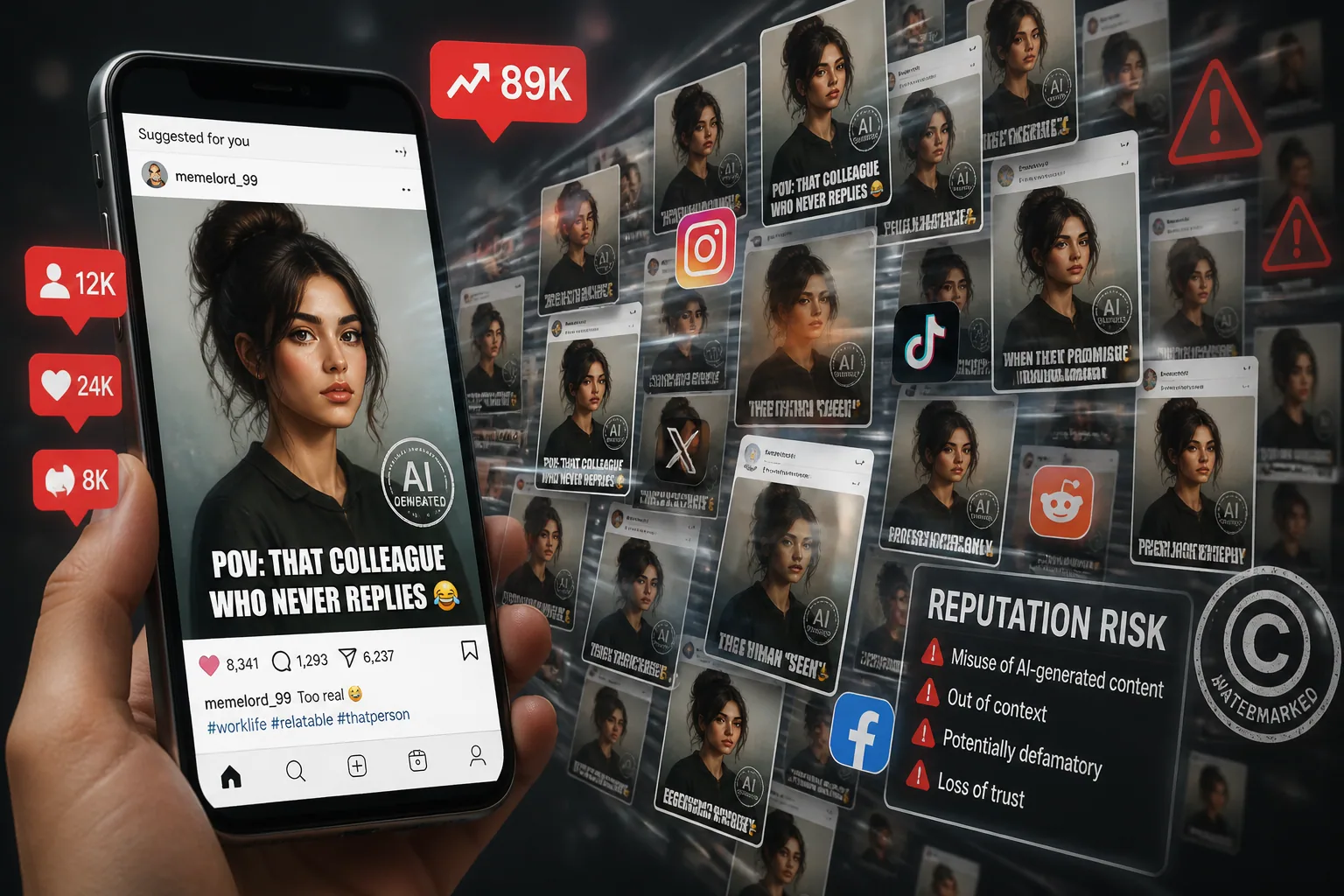
But the same traits that make AI portraits viral also make them risky. A portrait that begins as a personal creative experiment can quickly become a meme, a trend asset, or a misleading image detached from the person who made it. Once an image leaves its original context, it can be copied, captioned, cropped, re-posted, and reinterpreted in ways that the original creator never intended. If you post AI portraits, or if you appear in them, it helps to understand both the appeal and the consequences.
Why AI Portraits Spread Faster Than Expected
One reason AI portraits spread so quickly is simple: people are still not especially good at spotting them. In a large experiment involving about 287,000 evaluations by more than 12,500 participants, humans correctly differentiated between real photographs and AI-generated or modified images a bit more than 62% of the time, which is only modestly above random guessing. That means a large share of viewers remain uncertain when they see a convincing portrait online, especially if it is framed in a familiar social media style. Source: https://arxiv.org/abs/2507.18640
Portraits are particularly vulnerable because faces carry instant social meaning. We look for identity, status, beauty, mood, age, and authenticity almost automatically. When an AI image gets those cues mostly right, it can feel believable long enough for people to engage before they question it. Separate research focused on portraits found that over 45% of AI-generated human portraits were mistaken for real photos by viewers, even though only 25% of the images in the test were actually human-made. Source: https://pmc.ncbi.nlm.nih.gov/articles/PMC12295870/
Virality also rewards ambiguity. If an image is surreal, flattering, funny, or just slightly uncanny, people often share it to ask others what they think. That act of checking with friends, followers, or comment sections pushes the image further. The result is a loop where uncertainty becomes fuel. The more people wonder whether a portrait is real, the more visible it becomes.
The Visual Traits That Make an AI Portrait Meme-Worthy
AI portraits often become meme-worthy because they sit in a sweet spot between polished and weird. The lighting may be cinematic, the skin may look airbrushed, the background may be gorgeous, and the pose may feel theatrical. Yet there may also be tiny inconsistencies in fingers, jewelry, teeth, reflections, or textures. Those small flaws invite commentary and remixing. People love content that feels almost perfect but not quite.
Another reason these portraits travel well is that they can be instantly adapted into new jokes or social contexts. A dramatic portrait can be turned into a reaction image. A glamorous one can become a parody of influencer culture. A historical or fantasy portrait can be used to exaggerate someone’s online persona. Once a portrait has a strong visual identity, it becomes easy for other people to project a narrative onto it.
This is where the research on unsafe and repurposed outputs matters. In one large study, roughly 14.56% of images produced by generative models were classified as unsafe, including violent, hateful, sexually explicit, or disturbing content. The same research found that using DreamBooth, 24% of generated images tied to specific individuals or groups could be used as hateful meme variants. Source: https://arxiv.org/abs/2305.13873
That does not mean every viral portrait turns malicious. It does mean that once an image is aesthetically appealing and easy to manipulate, it can also become easy to weaponize. The more recognizable the face, the more efficiently a meme can borrow its emotional power.
How Virality Turns Personal Images Into Public Trend Assets
When an AI portrait goes viral, the original subject often loses control over meaning. What was once personal branding, self-expression, or a playful experiment can become a public object. Users start remixing the image into edits, captions, and trend formats. The portrait becomes a template rather than a personal artifact.
That shift matters because online audiences rarely preserve context. A photo posted as a stylistic experiment may later be reposted alongside a misleading story. A face generated for fun may be used as a shorthand for wealth, vanity, political identity, or sexualized attention. The image itself may not have changed, but its interpretation can shift dramatically as it moves across communities.
This is also where reputational harm begins. People tend to assume that portraits reflect something true about a person’s identity, taste, class, or behavior. If an AI portrait is edited to look provocative, fake-professional, or suggestive, viewers may attach those assumptions to the real person behind it. In social media environments, perception often matters more than origin. That is why a portrait can start telling the wrong story long before anyone verifies where it came from.
Real-World Examples of Unintended Sharing and Misuse
The misuse of AI-generated likenesses is no longer hypothetical. Legal and news reports have documented cases where synthetic images were created and shared to harass, exploit, or deceive. In one high-profile case, a man was charged with cyberstalking after allegedly creating AI-generated nude images of a real person and sharing them through fake social media profiles. Source: https://www.justice.gov/usao-ndga/pr/new-york-man-faces-federal-cyberstalking-charge-after-posting-ai-generated-nude-images
There have also been broader allegations tied to AI systems producing fake sexually explicit images and videos of minors without watermarking or disclosure. Those examples show how quickly synthetic portraits and deepfake-style content can cross from novelty into abuse. Even when the original use seems harmless, the same underlying image pipeline can be repurposed for humiliation, fraud, or impersonation. Source: https://www.nolo.com/legal-encyclopedia/ai-deepfake-nude-images-can-you-sue.html
This is one reason creators should think beyond the immediate post. A portrait shared to celebrate a style, a mood, or an aesthetic can be copied into a context that is entirely different from the original intent. Once a synthetic image is public, it may be hard to prove where it started, who edited it, or whether it was altered after posting.
The Ethics of Remixing Someone’s AI-Generated Likeness
Ethically, the key issue is consent. If someone made an AI portrait of themselves and shared it, others may feel tempted to remix it because the image is already synthetic. But synthetic does not automatically mean free to use. The likeness still points to a real person, and that person may not consent to re-captioning, sexualization, mockery, political framing, or commercial reuse.
There is also a fairness question. Many people post AI portraits to explore identity, style, or creativity. Turning those images into memes without permission can erase the creator’s agency and flatten a personal experiment into public entertainment. Even when the remix is intended as humor, it can still feel invasive if the image is tied to an identifiable person.
The law is still catching up here, but ethical norms should not wait for legislation. A good rule is to ask whether you would feel comfortable if the image were edited and spread with a narrative you did not choose. If the answer is no, then the same standard probably applies to others.
Reputation Risk: When a Portrait Starts Telling the Wrong Story
A viral portrait can reshape reputation in subtle ways. If the image is especially glamorous, people may assume vanity or inauthenticity. If it looks hypersexualized, viewers may attach sexual assumptions to the person behind it. If it looks overly polished, they may think the person is dishonest or trying to pass AI off as reality. None of those assumptions need to be true for them to spread.
The danger is amplified because people often see the image before they see the explanation. A caption or disclaimer may be overlooked, while the portrait itself leaves a strong first impression. If the image is reposted out of context, that first impression can harden into a public narrative. In practice, a portrait can become a shorthand for someone’s identity whether they want it to or not.
This is why managing the story around your image matters as much as publishing the image itself. If you are using AI portraits for personal branding, it helps to post them alongside clear context, avoid overclaiming realism, and be careful about the scenarios you choose. If you are a viewer, it helps to resist assuming that a polished face equals a truthful story.
What Watermarks, Metadata, and Protective Cues Can Actually Do
Protective signals can help, but they are not perfect. Watermarks make it easier for viewers to identify an image as synthetic or branded, especially when the image starts circulating in screenshots or reposts. Metadata can preserve provenance information such as creation date, source, or editing history, although metadata is often stripped when images are downloaded or re-uploaded.
These tools are useful because detection is imperfect. NewsGuard’s audit of five major AI image detection tools found that authentic photos were falsely labeled as AI-generated 13.33% of the time overall, and one tool reached an error rate as high as 40%. Source: https://www.newsguardtech.com/special-reports/leading-ai-image-detection-tools-mislead-online-users-often-declaring-authentic-content-fake/
That means no single technical cue should be treated as a final answer. Watermarks, captions, and metadata work best together, and only when they are supported by responsible posting habits. If you want to reduce confusion, make the synthetic nature of the image visible before it is shared widely. If you want to reduce misuse, avoid posting versions that can be easily cropped, removed, or recontextualized.
If you are using a tool like Selfie AI: AI Photo Generator, it is especially smart to think about how the final portrait will look after reposting, because the more polished and realistic the result, the more likely it is to be mistaken for a real image or repurposed as one. The product can be found here: https://findthe.app/selfie-ai-0xi7wd
What the Law May Cover and Where It Still Falls Short
Legal protection depends heavily on jurisdiction, identity, and how the image is used. In some cases, portrait rights, publicity rights, privacy rights, defamation law, harassment law, or copyright claims may apply. A notable precedent is Lohan v. Take-Two, where the court held that digital images can count as portraits under New York law, but only when they are recognizably based on a real person. Source: https://law.justia.com/cases/new-york/court-of-appeals/2018/24.html
That recognizability standard matters. If a synthetic portrait is clearly tied to a real individual, there may be stronger claims if it is used commercially or in a misleading way. But if the image is generic or only loosely inspired by a person, legal remedies may be weaker. The challenge is that AI generation can create likenesses that are visually convincing without being obviously attributable, which makes enforcement difficult.
Proposed legislation such as the NO FAKES Act would create clearer rights of publicity and liability rules around AI-generated likenesses, including possible safe harbors. Source: https://en.wikipedia.org/wiki/No_Fakes_Act
Even so, law usually moves slower than social platforms. Images can spread globally in minutes, while takedown requests, legal claims, and platform responses can take much longer. That is why preventive habits matter so much. Once an AI portrait is widely copied, the practical ability to contain it may be limited even if the legal basis for objection is strong.
How to Respond When Your AI Portrait Escapes Your Control
If your portrait starts circulating beyond your control, the first step is to document everything. Save URLs, screenshots, timestamps, usernames, and any captions or edits attached to the image. This creates a record of where the image appeared and how it was presented. If the image is used in a harmful or misleading way, that evidence may help with platform reports or legal consultation later.
Next, identify the platform-specific tools available to you. Many services allow reporting for impersonation, harassment, nudity, copyright violations, privacy violations, or manipulated media. If the image includes your face, name, or identifiable details, be precise about the harm. Generic complaints are less effective than clear statements about why the content is misleading or abusive.
If the image is tied to your identity, consider posting a calm clarification from your own account. Do not overreact in a way that amplifies the post unnecessarily, but do give your audience a trusted source of context. In some cases, a simple statement that the image is AI-generated and unauthorized may reduce confusion more effectively than extended debate.
If the harm is serious, especially in cases involving nudity, impersonation, threats, or stalking, contact legal counsel or law enforcement promptly. The cyberstalking case mentioned earlier shows that synthetic images can be part of real harassment campaigns, not just online jokes. Source: https://www.justice.gov/usao-ndga/pr/new-york-man-faces-federal-cyberstalking-charge-after-posting-ai-generated-nude-images
Best Practices for Creators and Users Before Posting AI Portraits
The best time to manage risk is before you post. Start by deciding what you want the image to do. Is it for fun, branding, experimentation, or social engagement? The clearer your goal, the easier it is to choose an appropriate style, caption, and disclosure. If you want realism, understand that realism increases both engagement and misidentification risk. If you want safety, lean into obvious stylization and visible disclosure.
Keep sensitive inputs to a minimum. Some viral portrait trends encourage users to upload prompts or personal details that reveal too much about their identity, routines, or appearance. That can create cybersecurity and fraud risk. As reported in coverage of certain AI caricature trends, prompts like “create a caricature using everything you know about me” may expose personal information in ways users do not fully anticipate. Source: https://indianexpress.com/article/technology/artificial-intelligence/ai-caricature-trend-personal-data-fraud-risk-explained-10570136/
Use protective cues consistently. Add a watermark if the image is meant to remain identifiable as synthetic. Keep metadata when possible. Avoid posting the cleanest high-resolution version if you do not want easy reuse. Be careful with portraits that show children, public figures, private individuals, or anyone who has not clearly consented to the image being generated or shared.
Finally, think like a future audience member. Ask how the image might look in a screenshot, a meme template, a cropped repost, or a search result. A good AI portrait is not only visually impressive. It is also resilient in context. If it cannot survive being detached from its caption without creating confusion or harm, it probably should not be posted without extra safeguards.
AI portraits are not inherently dangerous, but they are unusually easy to misread, remix, and misuse. That is what makes them so powerful online and so tricky to manage. If you treat them as both creative assets and reputational objects, you will make better decisions about when to post, how to label, and how to respond if the image takes on a life of its own.