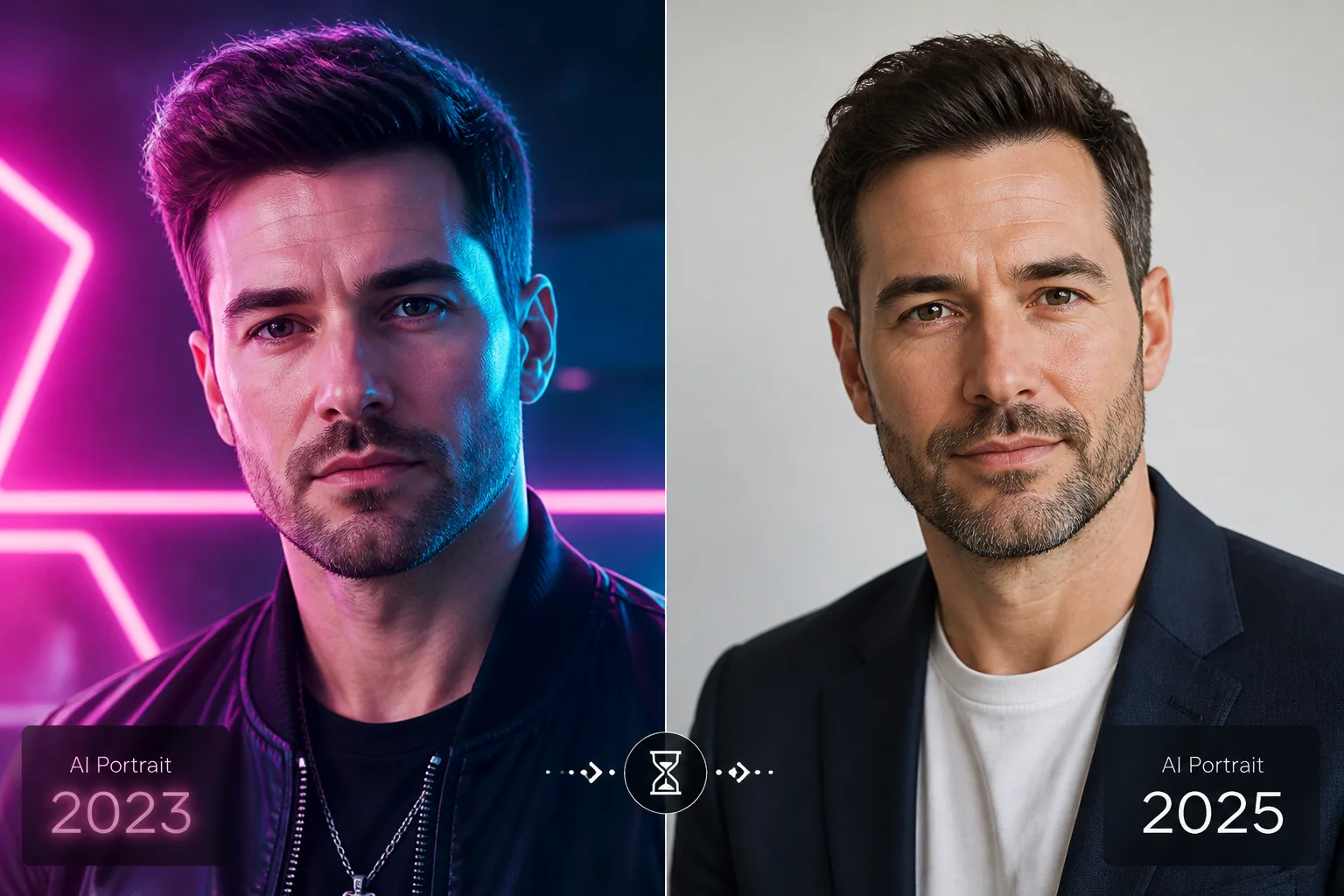
When AI Portraits “Aged Out”: How to Make Your Selfies Stay Fresh Over Years
Some AI portraits look amazing the day you generate them, then feel strangely old a year or two later. Not because your face changed, but because the image is full of visual cues that belong to a very specific moment in style. If you want portraits that still feel polished years from now, the goal is not to chase every new trend. It is to make choices that are calmer, cleaner, and more identity-driven, so the image keeps working as your personal visual brand evolves.
That matters especially for professionals, creators, and anyone who wants a lasting online presence. A timeless portrait should still look like you later, even if your hairstyle, facial hair, or skin have shifted. Research on facial identity across the lifespan shows that people retain lifelong idiosyncratic information, like bone structure and other stable features, even as changeable traits evolve over time. In other words, your best long-term portraits are the ones built around the parts of you that do not go out of style: https://www.sciencedirect.com/science/article/pii/S0010028519302506
Why Some AI Portraits Start Looking Dated So Fast
AI portraits age badly when they lean too hard into whatever looks impressive right now. That can mean glossy skin that has been smoothed beyond realism, saturated color grading, dramatic lighting effects, or backgrounds that scream a very specific trend. These choices may feel modern at first, but they often become easy to place in time once the visual fad passes.
There is also a bigger reason. Portraits are not only about your face. They are also about styling, framing, color, posture, and atmosphere. A large-scale dataset called Faces Through Time, which included roughly 1000 portraits per decade since the 1880s, showed that hairstyles, makeup styles, and other visual cues shift enough to act like era markers. The face can remain recognizable, but the surrounding styling can make the image feel like it belongs to a particular decade: https://onlinelibrary.wiley.com/doi/full/10.1111/cgf.14761
That is why some AI portraits age well while others feel trapped in a short-lived visual trend. The best images are usually not the flashiest ones. They are the ones that feel restrained, balanced, and believable.
The Visual Trends That Age AI Selfies the Worst
The fastest way to make an AI portrait look dated is to overload it with trendy styling. Heavy editing is a big one. Overdone filters, artificially crisp skin, high contrast color grades, and overly cinematic treatment can all make an image feel more like a visual experiment than a portrait you would still want to use years later.
Another common culprit is a fashionable palette. Neon accents, extreme teal-and-orange grading, highly muted beige-on-beige minimalism, or hyper-specific seasonal tones can all date an image faster than you expect. The same is true for gimmicky backgrounds. A floating hologram effect, a futuristic office with obvious trend cues, or a novelty scene that seems clever today may feel very obviously of its era later on.
Fashion cues are equally important. If your outfit looks like it came from one narrow trend cycle, the portrait inherits that timestamp. Wardrobe, jewelry, grooming, and even the way the collar sits can all contribute to the feeling that the image was generated in a certain year instead of being broadly usable.
The same principle shows up in portrait photography advice as well. Timeless portraits tend to use subtle retouching, clean color, soft lighting, and natural skin tones rather than high-impact effects. One useful reminder from photography-focused guidance is that images age poorly when the editing becomes the main subject instead of the person: https://www.kiddfielteau.com/blog/2026/2/17/what-makes-a-timeless-portrait
What Timeless Portraits Get Right
A timeless portrait usually feels calmer than a trendy one. It gives the face room to breathe. It does not try to prove how advanced the AI is. Instead, it creates a clean, confident image that could have been taken yesterday or five years from now.
The strongest timeless portraits usually share a few qualities. They rely on recognizable identity features rather than exaggerated beautification. They use a balanced composition. They avoid novelty for novelty’s sake. And they preserve the feeling of a real person rather than an over-produced character render.
That does not mean boring. It means durable. A portrait with authentic expression, soft control of light, and natural styling can carry a lot more long-term value than an image that only works because it is tied to a current aesthetic. Kindred Photography makes a similar point when it says natural expression matters most, because genuine emotion ages better than stiff posing or forced perfection: https://kindredphotography.ca/what-makes-a-portrait-feel-timeless/
There is also an interesting consistency here with broader visual culture. Research on fashion imagery across more than 30 years found that while details change, certain aesthetic logics, like minimalism, balance, and composition, remain durable over time. That is a useful lens for AI portraits too. The more your image depends on those durable logics, the longer it will stay relevant: https://www.sciencedirect.com/science/article/pii/S0304422X16000024
How to Choose Styles, Colors, and Composition That Last
If you want portraits that stay fresh over years, start with style choices that are intentionally understated. Pick compositions that feel centered and calm. Avoid extreme crops unless there is a specific reason for them. Keep the face readable, the shoulders natural, and the pose simple enough that the image does not feel like a fashion stunt.
Color is one of the biggest long-term decisions. Neutral and earth-tone clothing, especially browns, greys, whites, and blacks, typically ages better because those tones are less tied to a specific season or fashion cycle. That advice shows up in portrait photography guidance for a reason. Neutral colors tend to support the subject rather than compete with them: https://www.creativebloq.com/how-to/portrait-photography-tips
If you want even more longevity, monochrome can be a smart choice. Black and white portraits tend to be less vulnerable to shifting color trends because they remove one of the biggest sources of timestamping. Reduced-color palettes can also work well if you want a softer, more editorial feel without locking the image into a heavily stylized look. As one portrait perspective notes, monochrome often ages better than color treatments that follow short-lived taste cycles: https://erickimphotography.com/blog/2017/08/02/how-to-make-a-timeless-portrait/
Composition matters too. Keep the framing clean. Let the face remain the focal point. Avoid clutter, weird symmetry tricks, and backgrounds that distract from the person. In practice, the best long-term compositions often feel almost invisible, because the viewer is focused on presence rather than production.
Clothing, Backgrounds, and Lighting Choices That Signal Longevity
Wardrobe is one of the easiest ways to accidentally date an AI portrait. Logos, highly specific silhouettes, seasonal streetwear, novelty accessories, and ultra-trendy fabrics can all make the image feel like a snapshot from a very particular moment. For long-term use, classic clothing is usually safer. Think fitted basics, structured tops, simple jackets, clean collars, and textures that feel elevated without being loud.
Backgrounds should follow the same principle. A neutral studio backdrop, a softly blurred interior, or a simple outdoor environment usually holds up better than a location with obvious trend markers. If the scene itself is the gimmick, the image will probably age like a gimmick.
Lighting is another major factor. Soft, directional light tends to age better than harsh or overly stylized lighting effects. When light is controlled and flattering, it supports natural skin tones and produces a portrait that feels stable instead of trendy. Creative Bloq emphasizes soft, spread-out lighting for flattering skin and fewer shadows that can make an image feel dated: https://www.creativebloq.com/how-to/portrait-photography-tips
Simple lighting also helps AI portraits look more believable. The more the light behaves like something you would see in a real portrait session, the more likely the image is to remain usable across years and changing aesthetic tastes.
Why You Should Regularly Refresh Your Selfie Inputs and Prompts
A long-lasting AI portrait is not just about style. It is also about accuracy. If your appearance changes, your model should change with it. This is one of the most overlooked parts of keeping AI portraits fresh.
Haircuts change. Facial hair changes. Weight shifts. Skin condition changes. Even small changes can make older source selfies less representative of how you look now. The ScienceDirect research on facial identity across the lifespan notes that deliberate changes like hairstyle or mustache, along with natural aging, can affect how identity is perceived. That is why periodic refreshes matter: https://www.sciencedirect.com/science/article/pii/S0010028519302506
Prompts matter too. If your prompt is locked into an outdated style, the output can drift into an image of who you used to be rather than who you are now. Refreshing prompts lets you update both the look and the tone. It is a small maintenance task, but it makes a big difference if you want your portrait library to remain current instead of stale.
A good habit is to review your source selfies every so often and replace anything that no longer reflects your current appearance. This is especially important if you use portraits for business profiles, creator bios, or public-facing platforms where recognizability matters.
How Changes in Hair, Weight, Skin, and Age Affect Model Accuracy
AI models do a better job when they can learn stable identity features, but they still rely on the inputs you give them. If your old selfies show a different haircut, a different beard length, or a different face shape than your current look, the generated portraits may feel slightly off even when they are technically attractive.
Hair is often the most obvious issue. A new part, color, length, or style can change the silhouette of the face enough to alter recognition. Facial hair can do the same. A clean shave versus a full beard can make the same person appear like a different model if the source images are not updated.
Weight changes affect the face too, especially around the jawline, cheeks, and neck. Skin also changes with age, stress, environment, and routine. If you keep using source selfies from a very different period in your life, the AI may produce portraits that look polished but subtly incorrect. That mismatch is one of the main reasons some portraits stop feeling like usable personal branding assets and start feeling like old references.
The best approach is simple. Treat your personal model like something that evolves with you. Refresh it when your look changes enough that an outsider might notice. That keeps the portraits flattering and familiar at the same time.
3-to-5-Year Comparisons: What Aged Well and What Didn’t
When you compare AI portraits from three to five years ago with newer outputs, the difference is usually not the quality of the face alone. It is the surrounding language of the image. Older portraits often reveal their age through color choices, styling, and visual effects that were popular at the time.
What usually aged well? Clean compositions. Natural expressions. Neutral clothing. Soft studio-style lighting. Balanced contrast. Images where the portrait feels anchored in the person rather than the trend. Those elements tend to remain useful because they do not depend on a temporary visual mood.
What usually did not age well? Heavy skin smoothing. Obvious AI polish. Extreme saturation or stylized grading. Fashion that clearly belongs to one short window of time. Backgrounds with novelty themes. Highly posed expressions that feel more like performance than personality. These images can still be interesting, but they often read as older once the aesthetic language shifts.
This is where the idea of identity-preserving transformation becomes useful. The Faces Through Time research suggests that portraits can retain identity across decades when the focus is on timeless features instead of era-specific styling. So when you review older AI portraits, ask whether the image is anchored in your identity or in the moment it was generated. That question usually tells you everything you need to know.
A Simple Checklist for Future-Proofing Your AI Portraits
Before you generate your next portrait, run through a simple checklist. It will save you from creating something that looks impressive today but awkward later.
Use a neutral or earth-tone wardrobe whenever possible. Keep backgrounds simple and uncluttered. Choose soft, controlled lighting rather than dramatic effects. Avoid overediting, oversharpening, and unnatural skin smoothing. Favor natural expression over stiff posing. Keep color grading subtle. And make sure your source selfies actually match your current appearance.
If you want a practical tool for trying different looks without sacrificing quality, Selfie AI: AI Photo Generator can help you create portraits that range from professional business styles to more customized scenarios, while still letting you build from your own selfies and keep control of the result: https://findthe.app/selfie-ai-0xi7wd
The key is not to use the most dramatic option every time. Use the option that gives you the widest useful life.
When to Update a Portrait Versus Keep It as an Heirloom
Not every older portrait needs to be replaced. Some images actually become part of your visual history. If a portrait still looks like you, still feels polished, and is not tied to a dated trend, it can remain useful for a long time.
You should update a portrait when it no longer resembles your current appearance, when the styling feels clearly out of date, or when the image depends on a trend that has already faded. You can keep it when it still communicates your identity well and the overall look remains clean and timeless.
Think of your portraits in two categories. One category is active use: website headers, profiles, speaker bios, and professional images that should stay current. The other is heirloom value: portraits that capture a version of you from a particular chapter, but are not meant to represent you everywhere. Both are valuable, but they serve different purposes.
That is the real long-term strategy. Do not just ask whether an AI portrait looks good now. Ask whether it will still feel like a good representation of you later. If the answer is yes, you have probably made timeless choices.