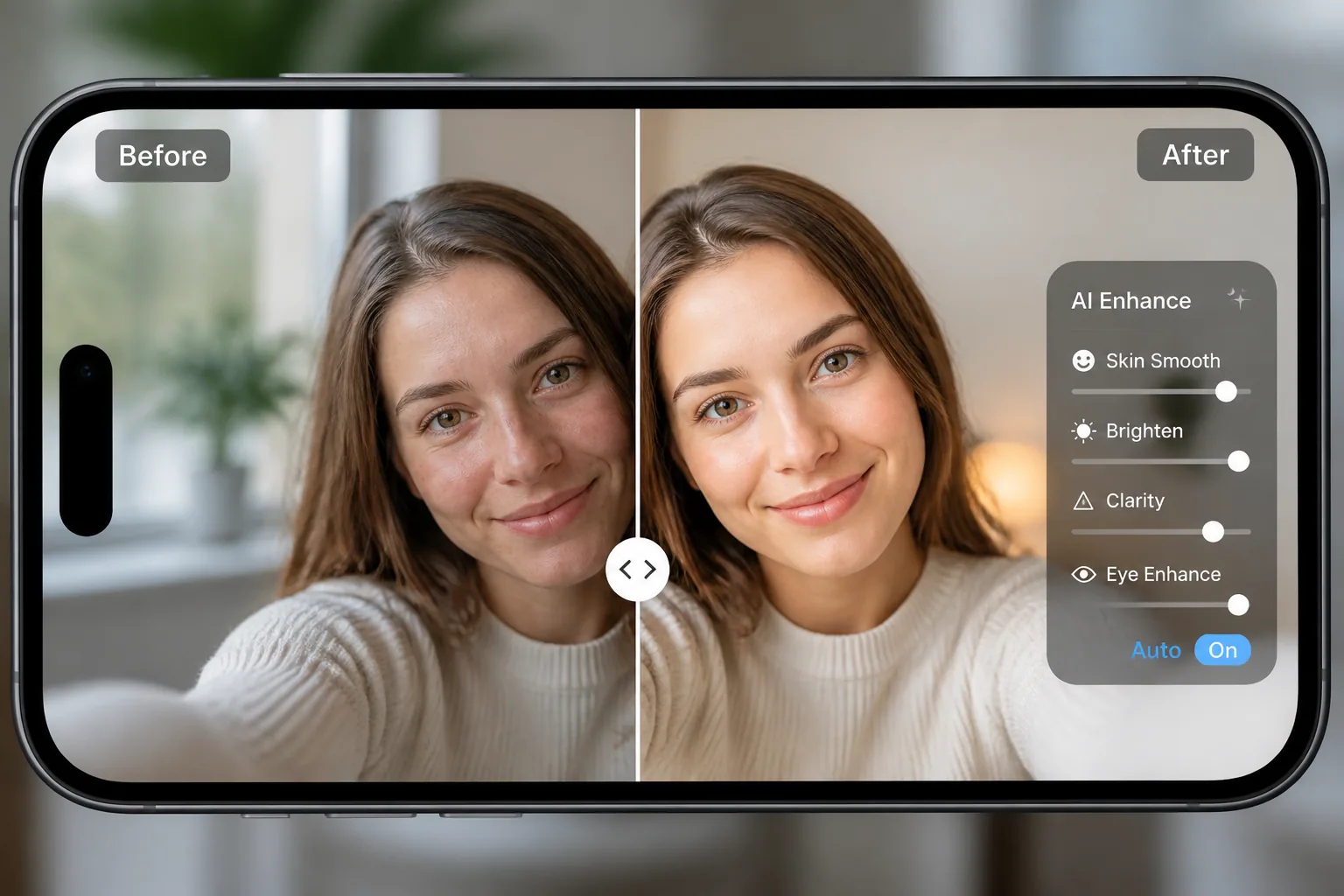
When AI Edits Subtly: How Tiny Photo Enhancements Can Shape Self-Identity
AI photo tools have changed the way people see themselves online. The biggest shift is not always the dramatic face swap or obvious makeover. More often, it is the quiet stuff: a little skin smoothing, a slightly brighter smile, a more balanced jawline, a corrected shadow, or a face that is just a bit more symmetrical than the one in the mirror. These changes can feel harmless because they are so small, yet repeated exposure to them can shape what feels normal, attractive, and even believable. That is why subtle AI selfie edits matter more than many people think.
The issue is not only about image quality. It is also about identity, confidence, consent, and the standards people internalize over time. When an app consistently improves your face before you even notice it, the app is not just editing a photo. It may also be nudging how you judge yourself.
Why Subtle AI Selfie Edits Matter More Than We Think
Most conversations about AI images focus on obvious manipulation. But stealth edits are often more powerful precisely because they are easy to miss. If a photo looks nearly the same as you do in real life, you are more likely to trust it. That trust matters because subtle enhancement can quietly become your new baseline for comparison.
Research suggests the effects can be immediate and delayed at the same time. A survey of 165 Instagram and TikTok users aged 18 to 30 found that AI beauty filters increased perceived beauty and confidence in the short term, but were associated with lower self-esteem and mental well-being over time https://assajournal.com/index.php/36/article/view/1411 In other words, the edits may feel uplifting in the moment while still nudging self-image in a more fragile direction later.
That tension is what makes subtle AI editing so important. It can be validating without being transparent, flattering without being neutral, and influential without feeling dramatic.
What Counts as a Stealth Edit in Modern Photo Apps
A stealth edit is any automatic adjustment that changes a person’s appearance in a way that is not immediately obvious or clearly disclosed. In modern photo apps, that often includes skin smoothing, blemish reduction, face slimming, eye brightening, teeth whitening, lighting correction, and face shape balancing. Sometimes the app also adjusts the image to match an internal idea of beauty, not just to improve technical quality.
The key feature of a stealth edit is subtlety. The photo still looks like you, which is exactly why it can be so persuasive. You do not see an alternate person. You see a more polished version of your own face, and that can make the enhancement feel natural or even objective.
Some tools also blur the line between photography and beautification by making “improvements” part of the default output. That means the user may never opt in to the edit at all. They simply open the camera, take a selfie, and receive a version of themselves that has already been adjusted.
How AI Enhancements Work Behind the Scenes
Behind most beauty tools is a combination of face detection, landmark mapping, image segmentation, and learned style preferences. The app identifies facial features such as the eyes, nose, mouth, jawline, cheeks, and skin texture, then applies edits selectively rather than across the whole image. This lets the tool preserve the overall identity of the face while smoothing away details it considers less desirable.
That is also why the results can feel invisible. Instead of changing your face into something obvious, the app often preserves your “recognizability” while shifting texture, light, contrast, or proportions just enough to create a more flattering impression.
This has consequences beyond aesthetics. Research into facial biometrics found that even subtle beautification filters can disrupt automated tasks such as age estimation, weight estimation, and heart-rate estimation, significantly lowering accuracy in soft-biometric measurements https://www.eurecom.org/en/publication/7825 So these are not harmless cosmetic tweaks only. They can also alter how both humans and machines interpret your face.
Default Settings, Auto-Detection, and Invisible Changes
The most important place to look for stealth edits is not the settings menu you intentionally open. It is the default behavior you never question. Many apps now rely on auto-detection to decide where the face is, what needs correction, and how much enhancement should be applied. If the default is on, the app may beautify first and ask questions later.
That creates a consent problem. If a user does not know the enhancement is active, they cannot meaningfully choose whether they want it. Investigative reporting has noted that some AI tools automatically apply skin smoothing, facial balancing, and lighting correction without obvious disclosure, which can slowly recalibrate what users think they should look like https://www.marieclaire.co.uk/life/ai-edited-my-face-without-asking
The issue is not simply that the app edits faces. It is that repeated, quiet adjustment can become normalized. Over time, the enhanced version may begin to feel like the proper version, while the original face starts to feel unfinished.
How Repeated Micro-Edits Can Affect Self-Perception
Small changes are often more psychologically powerful than large ones because they are easier to absorb. If every selfie is lightly softened, slightly narrowed, or gently brightened, users begin to see a stable pattern: this is the face that gets saved, shared, liked, and admired. The brain learns from repetition.
A psychological experiment on photo manipulation found that spending more time editing one’s own image, even subtly, decreased self-concept clarity, meaning people became less certain about their identity and beliefs https://digitalcommons.usf.edu/etd/8195/ That is a striking finding because it suggests the danger is not only dissatisfaction with appearance. It is also uncertainty about who you are when your image is constantly revised.
The effect can be cumulative. A user may not feel harmed by one softened selfie. But a stream of tiny corrections can quietly train the mind to expect a version of the self that is more polished than reality.
The Link Between Polished Selfies, Self-Esteem, and Body Image
Beauty filters do more than make photos prettier. They can change the psychological lens through which people evaluate their own face and body. In a study of 468 social media users, frequent use of AI beauty filters was strongly correlated with lower appearance self-esteem, more negative body image, and greater fear of negative evaluation. The study also found that body surveillance, or constant monitoring of appearance, amplified those effects https://www.ablesci.com/scholar/paper?id=85pl5gn1E
Another comparative study involving young female students found that exposure to beautifying face filters led to a measurable drop in body satisfaction, especially among participants with lower self-esteem. Interestingly, uglifying filters did not create the same significant changes https://www.sciencedirect.com/science/article/pii/S0747563224002115 That suggests the psychological impact is not simply about seeing any altered self. It is about seeing a version that is more idealized than real life.
This matters because social media rarely presents one edited image in isolation. It presents a loop of comparison, feedback, and self-monitoring. If your own filtered image starts to feel like the standard, your unfiltered face can begin to seem less acceptable, even though nothing about your actual face has changed.
Consent, Disclosure, and the Ethics of Automatic Retouching
Ethically, the most important question is whether users know what the app is doing. Consent is not just about clicking “agree” on a terms page. It is about understanding that an image may be altered, how it will be altered, and whether those edits are reversible or disclosed to viewers.
This becomes even more serious when automatic retouching is hidden behind seemingly neutral tools. If a photo app is marketed as a simple camera or generator but routinely changes facial features, users may not realize they are participating in a beauty-shaping system rather than a capture-only system.
The legal landscape is also tightening. Reports on non-consensual AI image manipulation note that in many jurisdictions such editing can violate biometric and data protection rules, and that the EU GDPR prohibits processing biometric data without informed consent https://www.iccsafe.org/wp-content/uploads/Undressai.pdf Even when the edit is not sexual or malicious, the same principles of transparency and permission still matter.
Privacy Questions Around Face Data and Personalization
AI selfie tools often rely on face data that is more sensitive than many users realize. To personalize results, an app may analyze facial structure, expressions, age cues, and other biometric markers. That can improve output, but it also raises privacy concerns about storage, reuse, and model training.
Users should ask simple but important questions. Is the face data stored? Is it used to train future models? Can it be deleted? Is the processing local or cloud-based? If the app promises personalization, what exactly is being personalized, and for whom?
The more personalized the tool becomes, the more important transparency becomes. People may be comfortable with a one-time enhancement, but less comfortable with a system that builds a biometric profile from repeated use.
How to Spot and Manage AI Edits in Your Favorite Apps
If you want more control, start by checking for any default beauty mode, face retouch toggle, auto-enhance option, or live filter setting. Many apps hide the strongest behavior behind simple labels like “natural,” “smart,” or “improve.” Those words sound harmless, but they can still mean face reshaping or skin editing.
A good habit is to compare the original and edited image side by side before posting. If the app does not offer a clear before-and-after preview, that is a warning sign. Also look for settings that let you reduce the intensity of smoothing, disable automatic correction, or save an unedited copy.
If the app is especially opaque, consider whether it deserves your trust. The best beauty tools make their edits visible, adjustable, and reversible. The worst ones make them feel inevitable.
Features Users Should Look For Before Posting a Photo
Before you share a selfie, it helps to check for a few practical features. First, look for a manual enhancement slider rather than a fixed default. Second, see whether the app offers a “no retouch” or “original” version. Third, confirm whether faces are being automatically detected and altered in the background. Fourth, check whether the platform labels AI-generated or AI-enhanced content.
These features are especially important if you use the app often. A single edited image may not matter much, but a steady habit of posting only enhanced versions can shift your sense of what is normal for you. The more control you have, the less likely the app is to define your appearance for you.
Best Practices for Apps, Platforms, and Content Creators
For designers and creators, responsible AI editing starts with disclosure. If an app changes a face, users should know when, how, and by how much. Defaults should favor minimal intervention, not maximal beautification. Enhancement should be opt-in, not hidden.
Platforms can also help by labeling altered content more clearly and giving creators a way to disclose edits without penalty. Content creators, in turn, can be more transparent about how much editing is involved, especially when posting tutorials, ads, or comparison content that may influence followers’ self-image.
The goal is not to ban all photo enhancement. It is to make sure enhancement is understandable. AI can be creative, useful, and expressive without quietly reshaping beauty norms in the background.
How to Keep Control of Your Image in the Age of AI
The simplest way to keep control is to slow the process down. Turn off automatic beautification where possible. Review app permissions. Save original files. Ask whether a filter is helping the image or replacing your face with a more approved version of it. And if a tool always seems to make you look better in a way that feels slightly unreal, pay attention to that feeling.
There are also creative tools that let you explore identity without pretending to be invisible. For example, Selfie AI: AI Photo Generator lets you turn selfies into stylized portraits and animated videos, with custom prompts, high-definition results, and secure processing while you maintain control of your content https://findthe.app/selfie-ai-0xi7wd. Used openly, that kind of tool can be expressive rather than deceptive, which is an important distinction.
In the end, the biggest challenge is not whether AI can edit a face. It is whether the editing is visible, consented to, and psychologically honest. When the changes are tiny, the effects can be huge. That is why users, designers, and platforms all need to treat subtle AI enhancement as more than a cosmetic feature. It is part of how identity is being shaped in the digital age.