The Hidden Value of AI Portraits: How Creators Can Monetize Without Losing Authenticity
AI portraits are no longer just a novelty. They have become a real commercial category with buyers, budgets, and repeat demand. For photographers, influencers, and digital artists, that opens up an important opportunity: you can turn AI-generated portraits into income without flattening your identity into the same glossy, overused look everyone else is selling.
The market is moving quickly. HeadshotPhoto’s State of Professional Headshots 2026 estimates the AI headshot market at roughly US$350 to 500 million in 2025, with projections approaching US$640 million by 2028. It also notes that adoption among professionals jumped from about 8% in 2021 to around 58% in 2025, showing that AI portraits are becoming mainstream, not niche. At the same time, traditional professional headshot photography in the U.S. is still estimated at US$1.8 to 2.8 billion in 2026, which means there is room for both AI and human-led services to coexist. Source: https://www.headshotphoto.io/blogs/state-of-professional-headshots-2026
That combination matters. When a category grows this fast, creators who can package quality, style, and trust well are usually the ones who win. The goal is not to make portraits that look like everyone else’s. The goal is to make portraits that feel valuable, recognizable, and safe to buy.
Why AI Portraits Have Real Market Value Right Now
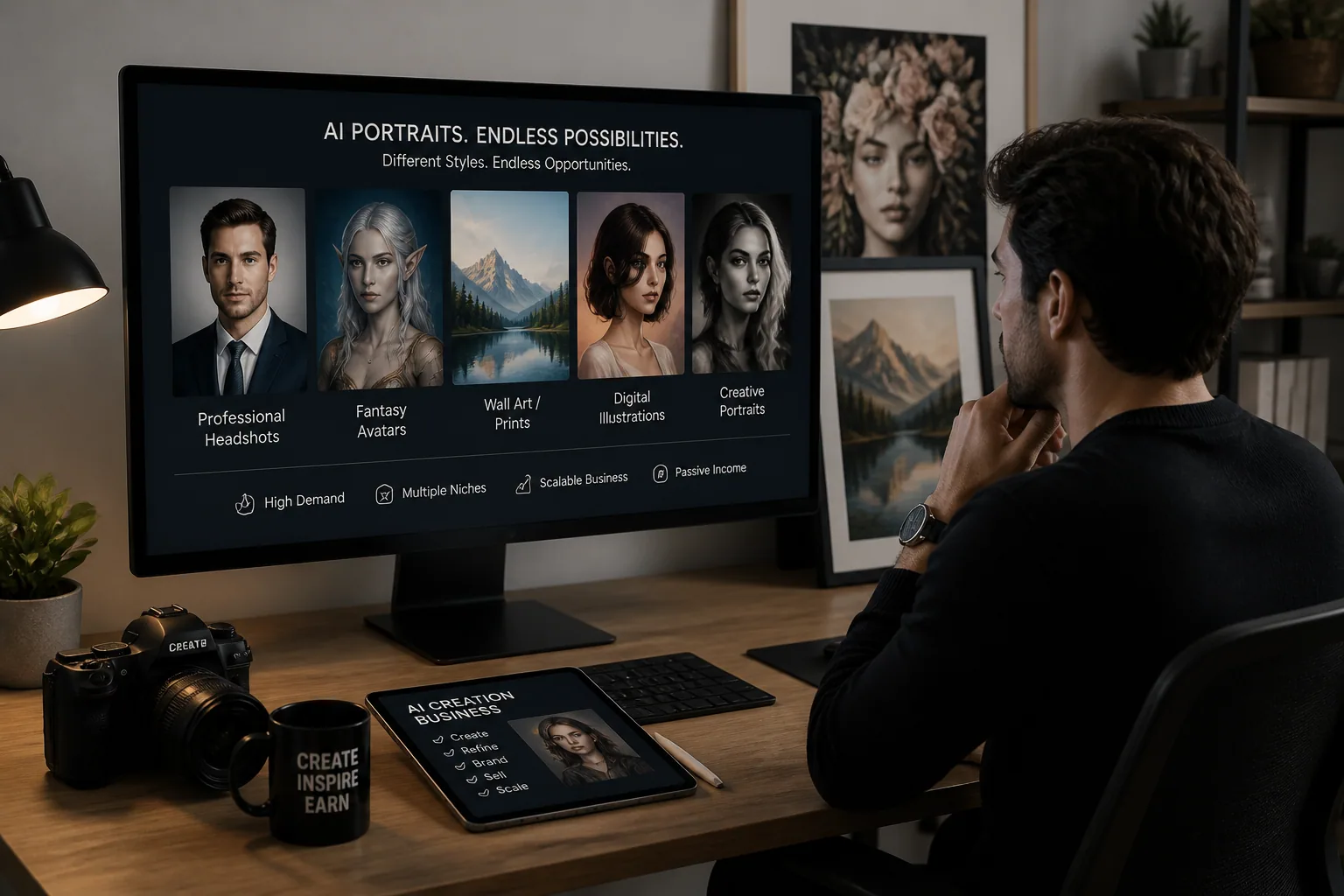
AI portraits have value because they solve a practical problem. People need polished visuals quickly, and they want options that look expensive without always paying for a full traditional shoot. Professionals want headshots for LinkedIn, company bios, speaker pages, and personal websites. Creators want avatars, profile images, and branded visuals that help them stand out. Fans want personalized art prints and themed pieces that feel made for them. Brands want scalable visuals for campaigns, social content, and merchandising.
The buying behavior is already there. Headshot clients surveyed by PPA report an average budget of US$1,540 and an average actual spend of US$1,866 for professional headshot photography, which shows that people will pay for a result that feels credible and useful. PPA also reports that print products and related merchandise account for almost 30% of total revenue for portrait photographers, which is a useful clue for AI creators too: the image itself is only part of the product. Source: https://www.ppa.com/articles/what-todays-headshot-clients-really-want-insights-from-ppas-headshot-photography-research
The same logic appears in creator economics. In the 2025 Apatero AI Creator Survey, 48% of creators said they earn no income from AI-generated work, but among those who do monetize, the median income is US$200 per month, the mean is about US$1,450 per month, and the top 10% earn US$5,000 or more monthly. The biggest revenue sources are freelance client work, stock image sales, print-on-demand, and subscriptions. That means AI portraits can be profitable, but only when they are treated like a business asset rather than a one-off experiment. Source: https://www.apatero.com/blog/ai-creator-survey-results-2025
The AI Portrait Products People Are Actually Buying
Not every AI portrait format sells equally well. The strongest products usually have a clear use case, a simple buying decision, and an obvious payoff for the customer.
Professional headshots
This is the most obvious market, and it is still growing fast. People want business-ready portraits for LinkedIn, resumes, speaker pages, startup bios, and team directories. The appeal is speed, convenience, and consistency. For creators, the opportunity is to offer options that look polished and brand-safe rather than overly stylized.
Digital avatars and profile visuals
Influencers, streamers, founders, and online coaches often need a visual identity that works across platforms. AI-generated avatars can serve as a recognizable face for brand consistency, especially when someone does not want to post personal photos constantly. The key here is individuality. If the portrait looks like a generic AI face, it will not strengthen the brand.
Themed art prints and collectibles
This is where AI portraits become more creative and more emotional. Think fantasy versions of a subject, vintage eras, editorial looks, seasonal scenes, or personalized gift art. Print-on-demand is especially attractive here because it is booming, with projections showing the industry exceeding US$11 billion in 2026 and growing at more than 23% annually. Printway’s research highlights custom apparel and home decor as major drivers, along with photo-based products, mugs, jewelry, and phone cases. Source: https://printway.io/en/blogs/top-selling-print-on-demand-products
Branded creator visuals
Creators increasingly need reusable content for thumbnails, banners, lead magnets, merch, newsletters, and social campaigns. AI portraits can become part of a larger visual system. This is one of the best uses for AI because the same portrait style can be adapted across many touchpoints while preserving a consistent identity.
Best Business Models for Selling AI-Generated Portraits
There is no single monetization model that fits every creator. The best approach depends on your audience, your style, and how much customization you are willing to handle.
Commissions are the simplest starting point. You create portraits for an individual client, usually with specific goals such as a headshot, avatar, or themed personal artwork. Commission work often allows for premium pricing because it is tailored, and buyers are paying for your judgment, not just the file.
Print sales are a strong option if your style is visually distinctive. You can sell digital downloads, posters, framed prints, or POD items. This model works best when the portrait feels collectible or giftable. The upside is that a single concept can sell repeatedly if it resonates emotionally.
Licensing is more relevant for creators who produce portrait assets for businesses, agencies, and content teams. In this model, the client pays for usage rights rather than full ownership. Licensing works especially well for branded visuals, promotional images, and campaign-specific portrait sets.
Subscriptions can work if you create portraits regularly and your audience expects a steady stream of new styles or drops. For example, a monthly membership might include a set number of portrait generations, seasonal themes, or commercial-use assets. This model is useful when you have a community that wants ongoing access rather than one-time purchases.
Marketplace listings are useful for scale. Stock platforms, creator marketplaces, and digital product shops let you package portraits for discovery. This is often lower-touch than custom work, although it can be more competitive and price-sensitive. The Apatero survey suggests stock image sales and subscriptions are already meaningful revenue lines for AI creators, so they are worth testing. Source: https://www.apatero.com/blog/ai-creator-survey-results-2025
Where to Sell: Marketplaces, Social Platforms, and Direct Offers
The best place to sell AI portraits is usually not one place. It is a mix of discovery, trust, and conversion channels.
Marketplaces are where people browse for ideas. They help you get in front of buyers who are already shopping for visual assets or custom artwork. This is good for testing what styles convert, but marketplaces can also push creators toward price competition, so you need a clear angle.
Social platforms are where your style becomes the product. Instagram, TikTok, Pinterest, and YouTube are ideal for showing transformations, before-and-after results, and short process clips. People often buy when they understand your aesthetic and trust your taste. In AI portrait sales, visibility is important, but recognizable visual identity is what turns attention into orders.
Direct offers are usually the highest-margin path. This means selling through your own site, a simple booking page, email list, or DM funnel. Direct sales let you control pricing, packaging, and brand presentation. They also make it easier to explain usage rights and set expectations around revisions, delivery, and disclosure.
If you want a simple way to test demand, you can also use consumer-facing tools like Selfie AI: AI Photo Generator, which lets people create personalized AI portraits in styles ranging from professional business portraits to superhero scenes and historical looks. It can be a practical example of how fast people respond to customizable portrait experiences. You can explore it here: https://findthe.app/selfie-ai-0xi7wd
How to Price Your AI Portraits and Package Your Styles
Pricing AI portraits is less about what the image took you to create and more about what the buyer receives. A good price reflects utility, uniqueness, speed, rights, and brand value.
For headshots, you can offer tiered packages. A basic package might include a small set of polished looks for individual use. A premium package could add more options, retouching, commercial usage rights, or a branded background set. For businesses, team packages and company-wide visual kits are often easier to sell than single-image purchases.
For themed art prints, package by theme rather than by output. Buyers understand collections better than random singles. For example, you could create a vintage hero series, a vacation fantasy series, or a luxury editorial series. Each collection should feel like a coherent aesthetic, which helps justify a higher price.
For creator visuals, sell systems rather than isolated portraits. A bundle can include profile images, banner art, thumbnail assets, and matching story templates. This kind of packaging makes your offer more practical, and practical offers usually convert better.
One useful rule is to align your pricing with usage. Personal use should cost less than commercial use. Exclusive rights should cost more than non-exclusive rights. Full buyout should cost the most. If you do not separate those clearly, you may undercharge while giving away value you could have kept.
How to Stand Out Without Copying Trendy, Generic Looks
The AI portrait space gets crowded fast because people can imitate a trend with just a few prompts. That is exactly why originality matters more than ever.
The easiest trap is to chase the same glossy skin, neon lighting, cinematic blur, and hyper-polished fashion look everyone else is using. Those trends can attract attention briefly, but they quickly become interchangeable. Once that happens, buyers stop seeing you as a creator with a point of view and start seeing you as a template operator.
To stand out, build a recognizable visual signature. That could mean a consistent color palette, a specific mood, recurring subject framing, a niche like entrepreneur portraits or heritage-inspired art, or a storytelling approach that makes each portrait feel like part of a world. Distinctiveness is often the difference between a one-time sale and a repeat customer.
You should also think like an editor. Not every generated image deserves to be published. Curate hard, remove weak outputs, and only show work that feels aligned with your brand values. If you publish everything, your best work gets diluted by average work.
Preserving Authenticity While Creating Commercial Work
Authenticity is not the enemy of monetization. In fact, it is what makes monetization sustainable. People do not just buy images. They buy trust, taste, and the feeling that the work reflects a real person behind it.
If you are a photographer, your authenticity may come from portrait direction, lighting choices, and how you interpret identity. If you are a digital artist, it may come from worldbuilding, color language, or surreal composition. If you are an influencer, it may come from how your AI portraits extend your existing voice rather than replacing it.
One practical way to stay authentic is to use AI as an amplifier, not a substitute. Keep the parts of the process that define your style. Choose the prompts, select the references, edit the results, and decide what stays on brand. That human layer is what gives the final work meaning.
This matters because buyers can feel when a portrait is made for the market instead of made for a person. The most successful creators usually protect some creative friction. That is what keeps the work from becoming a commodity.
Legal and Ethical Rules Every AI Portrait Creator Should Know
The legal landscape for AI portraits is changing quickly, so creators need to stay careful. In the United States, copyright generally requires human authorship. The U.S. Copyright Office guidance and the Congressional Research Service both make clear that works created autonomously by AI without meaningful human creative control are not eligible for copyright, while AI-assisted works may be protected only to the extent of the human creator’s expressive contributions. Source: https://www.copyright.gov/ai/?_bhlid=dd7219fa885b79044d1af64793d7590881bcf01b
That means documentation matters. Keep notes on your creative process, including prompts, edits, selections, and compositing decisions. If your work includes AI-generated sections, disclosure can help reduce confusion and protect your credibility.
Consent is critical when a real person’s likeness is involved. ArentFox Schiff’s report on AI avatars emphasizes that written consent is essential when using someone’s likeness in an AI-generated avatar, and that right of publicity claims can arise if a likeness is used without permission or resembles a real individual too closely. Source: https://www.afslaw.com/perspectives/alerts/the-business-ai-avatars-key-legal-risks-and-best-practices
Disclosure expectations are also tightening globally. The EU AI Act, beginning August 2, 2026, requires certain providers and deployers to inform people when they are exposed to content generated or manipulated by AI, and synthetic content may need machine-readable marking. Even where a law does not explicitly force disclosure, transparency is increasingly the safer commercial choice. Source: https://digital-strategy.ec.europa.eu/en/policies/guidelines-transparency-ai-generated-content
For commercial clients, contracts should clearly define usage rights, revisions, data provenance, consent, and whether the portrait is exclusive or non-exclusive. Lowenstein’s analysis of generative AI business considerations also points to the growing importance of disclosure and contract clarity in advertising, influencer content, and brand work. Source: https://www.lowenstein.com/media/kkegrx4l/iab_generativeai_whitepaper_june2024.pdf
Building a Long-Term Brand Around Your AI Portrait Style
The most durable AI portrait businesses do not sell random images. They sell a point of view. That point of view is what turns a creator into a brand.
Start by defining what your portraits are known for. Are they sleek corporate headshots, dreamlike personal avatars, fashion-forward editorial pieces, or collectible themed art? The more precise your positioning, the easier it is to market your work and attract the right buyers.
Next, create repeatable systems. Use a consistent naming structure for your collections, a recognizable presentation format, and a clear buyer journey. If customers can quickly understand what they are getting and why it is different, they are more likely to buy again.
It also helps to think in terms of trust assets. Testimonials, clear examples, transparent usage terms, and visible process cues all make your brand feel safer. In an AI category where skepticism is common, trust can become a competitive advantage.
Over time, you can expand from single portraits into a broader ecosystem: presets, prompt libraries, membership access, brand kits, licensing deals, and seasonal releases. This is how an AI portrait style becomes a business rather than a trend.
Final Thoughts: Make Your AI Portraits Profitable and Personal
AI portraits have real market value because they sit at the intersection of identity, convenience, and visual storytelling. People are buying headshots, avatars, themed prints, branded visuals, and custom portrait collections because they want something that feels useful and personal at the same time.
If you want to monetize successfully, focus on three things: a clear offer, a distinctive style, and a transparent process. The offer tells people what they are buying. The style tells them why it matters. The process tells them they can trust you.
When you do that well, AI portraits stop being a gimmick and start becoming a real creative business. And the creators who win in this space will not be the ones who copy the most trends. They will be the ones who make AI feel unmistakably like their own voice.