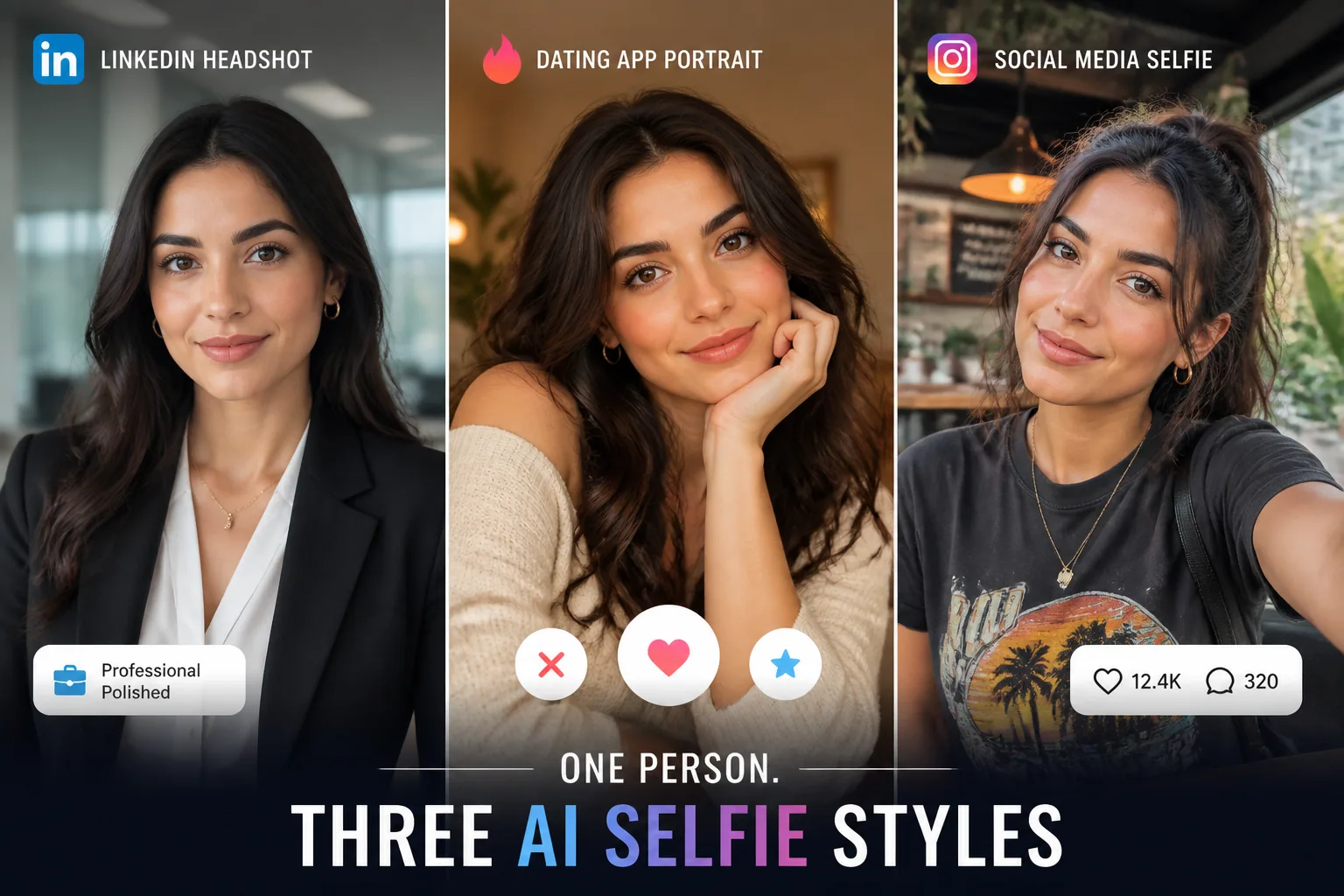
Style Meets Substance: How to Make AI Selfies That Actually Work for Dating, Jobs, and Social Media
A great AI selfie is not just about looking polished. It is about sending the right signal to the right audience. The image that works on a dating app will not always work on LinkedIn, and the portrait that feels effortless on Instagram can look too casual for a job application. That is why the best AI selfies are intentional. They are designed around context, not just aesthetics.
The big mistake people make is assuming one strong portrait can do everything. In reality, profile pictures are interpreted extremely fast. Research summarized in dating and profile-picture studies suggests first impressions can form in about 100 milliseconds, and on dating apps the first photo can drive 80 to 90 percent of the viewer’s decision before they even read the bio. On LinkedIn, the stakes are different but just as real: profiles with a professional headshot are 14x more likely to be viewed and 36x more likely to receive messages, while profiles with any photo get 21x more views and 9x more connection requests than blank avatars. Those numbers show why context matters. Source: https://salesso.com/blog/linkedin-headshot-statistics/ and https://www.proshoot.co/blog/ai-headshot-statistics
Why One Great AI Selfie Doesn’t Work Everywhere
People do not evaluate profile photos in a vacuum. They evaluate them against expectations. A recruiter wants competence, clarity, and trust. A dating app viewer wants warmth, attraction, and authenticity. A social follower wants personality, style, and consistency with your brand. When one image tries to satisfy all three, it often fails at all three.
This is where AI selfies can be especially useful. Because you can control clothing, lighting, pose, expression, and background, you can tailor the same base likeness to very different goals. The trick is to stop asking, “What looks best?” and start asking, “What does this platform reward?”
That platform-specific thinking also matters because people are sensitive to mismatch. If your LinkedIn headshot looks like a dating app glam shot, it can feel off. If your dating profile looks like a stiff corporate portrait, it can feel cold. If your Instagram looks overly formal, it can feel distant. Authenticity is not about using zero polish. It is about making the polish fit the setting.
The First Impression Rule: Who’s Looking and What They Want to See
The fastest way to improve an AI selfie is to think like the viewer. A first impression carries a lot of weight because people use photos as shortcuts for personality. In blind evaluations, recruiters care most about expression, clothing and background, and face clarity. Interestingly, whether the image is AI-generated ranks last. That means viewers tend to respond more to the visual cues of professionalism than to the generation method itself. Source: https://www.proshoot.co/blog/ai-headshot-statistics
The same logic applies to dating. A photo that signals openness, approachability, and a bit of personality will usually outperform one that is technically perfect but emotionally flat. Studies summarized by AAAI ICWSM also suggest that smiling, outdoor, and group photos tend to create more consistent impressions across viewers. In other words, the more readable and socially warm the photo feels, the easier it is for others to trust their first reaction. Source: https://ojs.aaai.org/index.php/ICWSM/article/view/13997
For social media, the viewer is often not judging your competence or relationship readiness. They are deciding whether your content feels worth following, sharing, or engaging with. That means the image should communicate a point of view. It can be stylish, fun, artistic, or aspirational, but it should still feel like you.
Dating Apps: Creating Warmth, Attraction, and Authenticity
For dating profiles, the goal is not perfection. It is connection. You want your AI selfie to feel warm, attractive, and real enough to invite conversation. Research on dating profile photography points to three especially important variables: light, angle, and expression. After that, wardrobe fit and color matter, along with background detail. Patterns and logos often distract more than they help. Source: https://www.photographyshark.com/blog/how-to-take-good-dating-profile-pictures/
A strong dating AI selfie usually has soft, flattering light, a natural smile or relaxed half-smile, and an angle that feels candid rather than staged. The background should add context without stealing attention. Outdoor settings tend to work well because they make the image feel more alive and socially readable. That aligns with the impression-agreement research, which found that smiling and outdoor photos often create more consistent perceptions across viewers. Source: https://ojs.aaai.org/index.php/ICWSM/article/view/13997
It is also worth noting that selfies can carry bias. Research summarized by Psychology Today suggests that profiles using selfies can be perceived as more narcissistic and less likable, particularly for men. That does not mean you should never use an AI selfie for dating, but it does mean the image should avoid looking like a solo vanity shot. Give the impression that someone else could have taken it, even if the image is AI-generated. Source: https://www.psychologytoday.com/us/articles/201709/the-big-picture
A useful dating-app formula is: approachable face, clean styling, relaxed posture, and a setting that suggests an active life. Think coffee shop, city street, park, rooftop, beach, or softly lit indoor scene. Avoid sunglasses, harsh shadows, overediting, or dramatic poses that make you look unavailable. Obscuring the face can reduce perceived likability and competence, and that effect is especially strong when people are trying to decide whether to match with you. Source: https://www.datingapps.com/blog/what-your-profile-picture-choice-says-about-you/
Prompt example for dating: “Create a realistic AI portrait of a confident but approachable person in natural outdoor light, wearing a fitted casual outfit in a solid color, with a warm genuine smile, relaxed posture, subtle depth-of-field background, and an authentic candid style suitable for a dating profile.”
Job Apps and LinkedIn: Signaling Competence, Trust, and Professionalism
For LinkedIn and job-related profiles, the image should do one thing above all else: make you look credible. A professional headshot is not just a nice extra. It is a visibility signal. Profiles with professional headshots are 14x more likely to be viewed and 36x more likely to receive messages, while profiles with any photo outperform blank avatars by a wide margin. Source: https://salesso.com/blog/linkedin-headshot-statistics/ and https://www.proshoot.co/blog/ai-headshot-statistics
The good news is that AI headshots are no longer seen as a novelty. Between 2023 and 2025, the share of LinkedIn profiles using AI-processed or AI-generated headshots rose by 38%, and in blind recruiter tests 68% of AI headshots were rated equal to or better than traditional studio headshots for LinkedIn contexts. Even more importantly, 74% were rated professional or highly professional. Source: https://www.proshoot.co/blog/ai-headshot-statistics
What matters most is not whether the image is AI, but whether it communicates the right qualities. Recruiters ranked expression at 38%, clothing and background at 27%, and face clarity at 24% as the top photo attributes. That means your AI headshot should feel clean, balanced, and confident. A slight smile usually works better than an intense expression. The background should be simple and unobtrusive. Clothing should fit the industry, whether that means a blazer, a crisp shirt, or a polished business-casual look. Source: https://www.proshoot.co/blog/ai-headshot-statistics
Professional portraits should also avoid visual noise. Loud patterns, extreme angles, distracting props, and overly soft beauty filters can weaken trust. In the hiring context, the viewer wants to see your face clearly and read you as competent. A headshot that feels too glamorous can create distance, while one that feels too casual can lower perceived seriousness. The ideal is polished but restrained.
Prompt example for LinkedIn: “Generate a realistic professional headshot of a confident person in business attire, centered composition, clean neutral background, even studio lighting, clear face visibility, natural expression, and a modern corporate style suitable for LinkedIn and job applications.”
If you want an easy way to experiment with business-ready variations, https://findthe.app/selfie-ai-0xi7wd can help you turn ordinary selfies into professional-looking portraits with different styles and settings.
Social Media: Balancing Personality, Aesthetics, and Shareability
Social media sits between dating and recruiting. Your picture needs to be visually appealing, but it also needs to feel like a real extension of your personality or brand. Unlike LinkedIn, where clarity and credibility dominate, social platforms reward recognizability, vibe, and consistency.
That means your AI selfie can be more stylized, but it should still look intentional. Think of it as a visual headline for your personal brand. If your account is about fashion, the portrait should reflect taste. If you post travel content, your image can feel more adventurous. If your brand is playful, the pose and background can be more expressive. The goal is not to look generic. It is to look memorable without looking fake.
Social media also gives you room to be more creative with color grading, composition, and environment. However, overprocessing is still a problem. When skin looks too smooth, eyes too sharp, or backgrounds too artificial, the image starts to feel disconnected from reality. A polished aesthetic works best when it still preserves enough texture and natural variation to feel human.
This is where AI is especially useful for content creators and casual users alike. You can create a consistent look across posts while varying the scene: a studio-style portrait for announcements, a lifestyle image for Stories, a high-fashion look for a feed post, or a travel-inspired image for a more aspirational grid. The key is consistency of identity, not sameness of style.
How Clothing, Background, Pose, Lighting, and Expression Change by Platform
Every platform asks for a different balance of visual cues. Clothing is one of the fastest ways to shape perception. On dating apps, fitted casual clothing in flattering solid colors usually works well because it feels effortless and attractive. On LinkedIn, structured clothing suggests professionalism and readiness. On social media, the outfit can reinforce your aesthetic, whether that is minimalist, bold, sporty, or artistic.
Background matters just as much. For dating, a real-world setting can create warmth and personality. For jobs, a simple or softly blurred background reduces distractions. For social media, the background can be part of the story, as long as it supports the mood instead of overwhelming it.
Pose is another important signal. A dating photo often benefits from a relaxed, open stance that feels approachable. A professional portrait usually works better with a straight posture and slight body turn, which suggests confidence without stiffness. Social portraits can be more expressive, especially if you want to project creativity or energy.
Lighting shapes the emotional tone instantly. Soft natural light feels warm and human for dating and casual social posts. Clean even lighting works best for jobs because it reduces shadows and increases clarity. More dramatic lighting can be effective for artistic social content, but it should be used carefully because it can reduce face readability.
Expression is arguably the most important variable because it tells the viewer how to feel about you. Recruiters respond to calm confidence. Dating audiences respond to warmth and openness. Social audiences respond to personality, whether that means a smile, a knowing look, or a more editorial expression. Because expression carries so much weight, it is often worth generating multiple versions and choosing the one that best matches the goal.
Prompt Examples for Dating Profiles, Professional Headshots, and Casual Posts
A good AI prompt should describe the outcome in practical terms, not just adjectives. The more clearly you specify platform, mood, clothing, setting, lighting, and expression, the more likely the result will match your needs.
Dating prompt: “Photorealistic AI portrait for a dating profile, warm natural smile, soft golden-hour lighting, relaxed outdoor setting, fitted neutral shirt, candid body angle, clear face, approachable and attractive, realistic skin texture, no heavy retouching.”
Professional headshot prompt: “High-resolution professional portrait for LinkedIn, business-casual clothing, neutral studio background, balanced even lighting, direct eye contact, subtle confident smile, crisp face clarity, polished but natural, modern corporate aesthetic.”
Casual social media prompt: “Stylish AI portrait for Instagram, expressive personality, modern outfit with strong color harmony, softly blurred lifestyle background, flattering natural light, editorial composition, realistic detail, confident and memorable visual branding.”
If you want to push creativity further, a custom prompt feature can be especially useful for unusual scenes or specific identity goals. That is one reason AI portrait tools are becoming popular: they let people produce platform-specific looks without needing a full photo shoot each time.
Common Mistakes When Reusing the Same AI Portrait Across Platforms
The most common mistake is platform blindness. People generate one attractive portrait and reuse it everywhere, even though each platform reads images differently. The result is often subtle misalignment. A portrait that seems elegant on Instagram may feel too performative on LinkedIn. A headshot that looks perfect for work may feel too formal and distant on dating apps.
Another common issue is overreliance on visual perfection. If every detail is smoothed, sharpened, and idealized, the image can lose authenticity. People do not always consciously identify what feels wrong, but they often sense when an image is too polished to be believable. The more important the platform, the more damaging that disconnect becomes.
There is also the problem of weak face clarity. In contexts where trust matters, people need to see your face. Heavy shadows, sunglasses, turned-away angles, and cluttered backgrounds all reduce immediate readability. Research summarized in recruiter studies and profile-picture analyses keeps pointing back to the same thing: viewers want clear, emotionally legible faces.
Finally, many users forget that the first image influences everything else. The halo effect means a weak lead photo can color how the rest of the profile is interpreted. If the image is too awkward, too staged, or too out of context, viewers may never make it far enough to appreciate the bio or supporting content.
How to Keep AI Selfies Attractive Without Looking Overprocessed
The best AI selfies usually feel believable before they feel impressive. That is a useful standard to keep in mind. You want the portrait to appear refined, but not synthetic. Small imperfections can help. A natural smile, a subtle line of motion in the pose, a soft background blur, or realistic skin texture can all make the image feel more trustworthy.
Avoid pushing every setting to the maximum. Hyper-saturated color, extreme sharpness, sculpted lighting, and flawless symmetry may look exciting at first, but they often shorten the image’s lifespan. People tend to trust portraits that resemble how someone might actually appear in a high-quality real photo.
It also helps to keep one or two human anchors in the image. That might be a natural eye expression, a realistic hairline, or a clothing choice that could plausibly exist in everyday life. The more the image behaves like a real photograph, the less effort the viewer needs to spend decoding it.
If you use AI-generated portraits regularly, a good rule is to check three questions: Does this fit the platform? Does it look like me on a good day? Would a stranger instantly understand the vibe I want to project? If the answer is yes to all three, you are probably close.
A Simple Framework for Choosing the Right AI Selfie for Any Goal
The easiest way to choose the right AI selfie is to match image cues to your objective. Start with the audience, then choose the emotional signal, then build the visual details around it.
For dating: choose warmth, approachability, and a touch of personality. Use relaxed posture, soft light, and a friendly expression. Keep the background natural and the styling polished but not formal.
For jobs and LinkedIn: choose clarity, competence, and trust. Use face-forward composition, clean lighting, simple backgrounds, and professional clothing. Keep the expression calm and confident, not dramatic.
For social media: choose personality, style, and shareability. Use a look that fits your brand, whether that is playful, aspirational, minimalist, or creative. Make sure the image still feels like a real extension of your identity.
Once you think in those terms, AI selfies stop being random portraits and start becoming strategic tools. That is the real advantage. You are not just creating a better picture. You are creating a better first impression, one that fits the place where it will be seen.