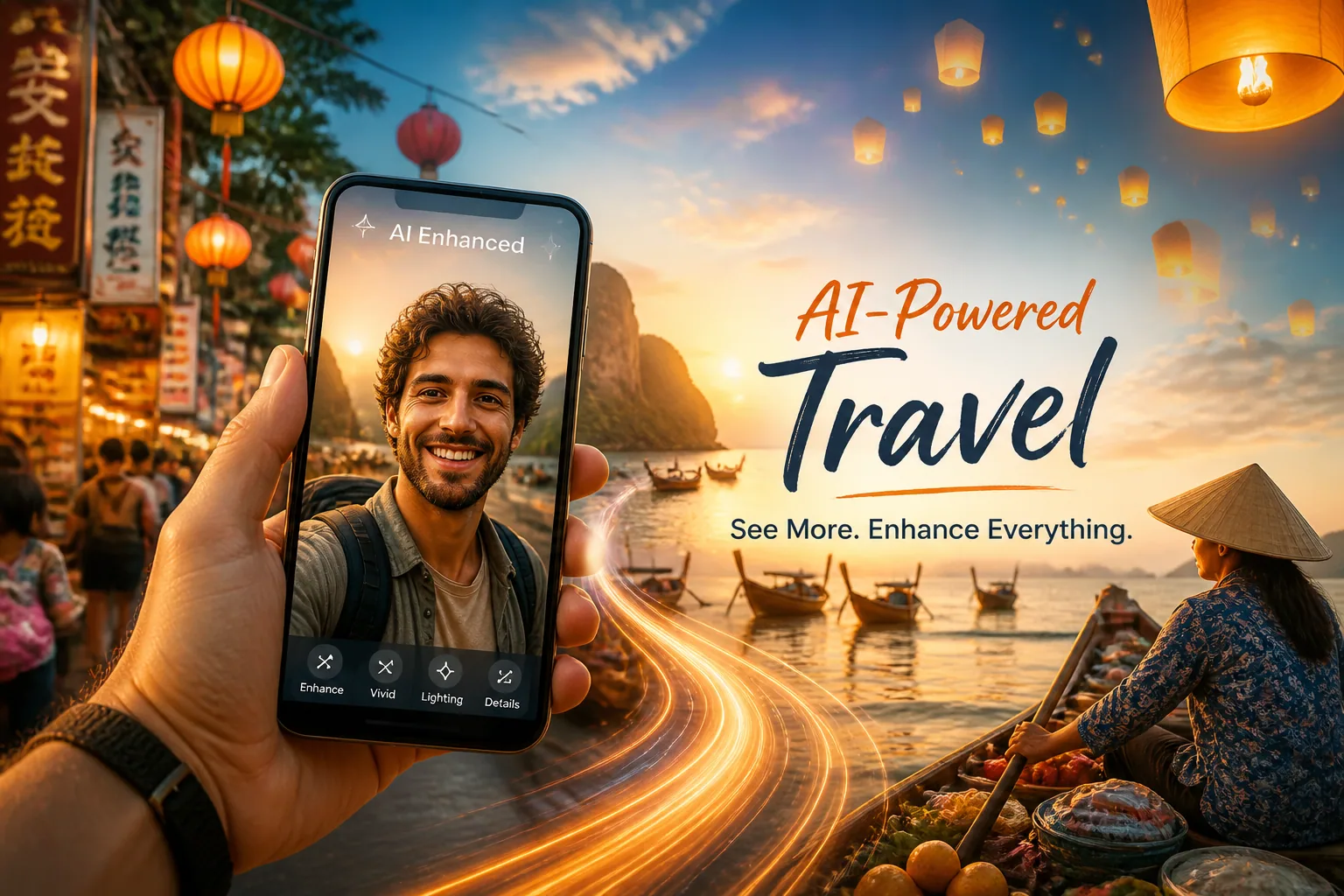
How to Use AI Selfies for Travel Storytelling: From Virtual Postcards to Immersive Memories
AI selfies are quickly becoming more than a novelty. For travelers, digital nomads, and creators, they are turning into a new visual storytelling format that sits somewhere between a portrait, a postcard, and a memory. Instead of using AI as a simple beauty filter, you can use it to capture the mood of a destination, the emotional tone of a trip, and the little atmospheric details that make a place feel alive. That is where the real opportunity is: not in making every image look perfect, but in making it feel like somewhere you have actually been.
This matters because travel imagery has always shaped desire. Recent research shows that travel photos with implied motion, like rippling waves or falling leaves, can increase viewers’ intention to visit by strengthening mental imagery. Other studies on AI-generated destination photos suggest that the way a scene is presented, including its context, style, and visual cues, can meaningfully shape travel perception and willingness to go. In other words, the right AI portrait can do what a great travel photo has always done: make someone feel the place before they arrive.
At the same time, people are already comfortable with AI in the visual workflow. A recent survey reported that nearly 90% of working photographers use AI in some capacity, with travel, landscape, and portrait among the most common genres. So the question is no longer whether AI belongs in travel storytelling. The real question is how to use it well, and how to keep it honest, atmospheric, and respectful.
Why AI Selfies Are Becoming a New Travel Storytelling Format
Traditional travel content often splits into two extremes. On one side you have polished destination photos that look beautiful but generic. On the other, you have casual phone snapshots that feel personal but may not communicate much beyond “I was here.” AI selfies sit between those two poles. They let you stage a travel memory with intention while still using your own face, your own style, and your own emotional point of view.
That is what makes them powerful for storytelling. A good AI travel portrait can function like a virtual postcard, but one that is tailored to your narrative. You can show anticipation before the trip, the arrival moment, the first exploration, and the reflective return home. You can create a sequence that feels like a visual journal instead of a random collection of images.
This format also works well for the way people consume travel inspiration now. Short-form videos and visual feeds dominate discovery, especially among younger travelers. Statista notes that while only about 10% of Americans planning a summer vacation in 2024 used AI specifically for travel inspiration or information, the number rises among Millennials, and 44% of Gen Z travelers rely on short-form social media videos for inspiration. That means your AI travel visuals need to do more than look impressive. They need to carry a story quickly, emotionally, and clearly.
Move Beyond Filters: Using AI to Capture the Feeling of a Place
The biggest mistake people make with AI selfies is treating them like a cosmetic effect. A smoother face, brighter eyes, and a trendy background are not enough. If the goal is travel storytelling, the image should communicate the feeling of a destination, not just the fact that a destination exists.
Think of a place in terms of sensory signals. A coastal town is not only a beach. It may be salt on the air, pale sunlight, wind-tossed hair, faded painted shutters, and a color palette that echoes water and stone. A mountain village is not only peaks in the distance. It may be thin morning mist, wool textures, warm window light, and an earthy quiet that feels almost still. When you prompt AI portraits this way, you get images that carry atmosphere instead of decoration.
This is also where AI can be more interesting than a filter. You are not just modifying an existing selfie. You are building a scene around yourself, and that scene can suggest the emotional temperature of the trip. For example, a portrait in a crowded market at golden hour can communicate curiosity and discovery. A quiet portrait by a train platform at dusk can communicate transition and movement. The point is to make the image behave like a memory, not an advertisement.
How to Prompt Destination Essence Through Backgrounds, Light, and Local Details
If you want your AI selfies to feel specific, start with the setting. Backgrounds are doing a lot of narrative work, so they should not be vague. Instead of simply saying “Paris” or “Thailand,” describe what kind of place you are in and what time of day it is. An image can feel much more believable when the prompt includes narrow, concrete details such as a tiled alleyway, a harbor edge, a stone terrace, market awnings, rooftop laundry lines, or temple courtyards.
Lighting is just as important. Travel memories are often stored in light: morning softness, harsh noon brightness, rainy reflections, warm dusk, and the glow of lanterns or storefronts after dark. If you want a portrait to feel lived-in, let light shape the emotional tone. Backlight can make a departure feel dreamy. Side light can create texture in old streets and weathered walls. Low evening light can turn an ordinary scene into something intimate and cinematic.
Local details make the image feel anchored rather than generic. A ceramic cup, woven basket, ferry ticket, street sign, spice market texture, or hand-painted wall can be enough to place the scene. The key is subtlety. You are not trying to cram every symbol of a city into one frame. You are suggesting place through a few carefully chosen clues.
Using Architecture, Landscapes, and Cultural Color Palettes in AI Portraits
Architecture is one of the easiest ways to make an AI portrait feel like travel. A person standing beneath carved stone arches, beside colorful balconies, in front of a minimalist whitewashed wall, or near terraced rooftops instantly gains spatial context. Built environments tell viewers where they are, and they also tell them what kind of cultural and historical atmosphere the place carries.
Landscapes work in a similar way, but they tend to shape mood more than identity. Ocean horizons create openness. Forests create quiet. Desert light creates starkness and heat. Rice fields, cliffs, vineyards, or alpine passes all bring their own emotional register. When you place yourself inside a landscape instead of in front of a simple stock-like backdrop, the selfie starts functioning like part of a travel story rather than a profile image.
Color palettes matter more than many creators realize. Every place seems to have its own visual language, whether it is the saffron, indigo, and terracotta often associated with South Asian streets, the muted blues and whites of coastal towns, the greens and golds of tropical interiors, or the rust and cream tones of historic stone cities. A travel portrait becomes much more memorable when its palette feels borrowed from the environment instead of imposed on it.
This is where AI can be especially useful for creators who care about cohesion. You can design a series of portraits that all share the same regional palette, even if each one captures a different stage of the journey. That makes the whole sequence feel like it belongs to one trip, one memory, and one visual language.
Adding Motion: Animated AI Selfies That Simulate Presence and Atmosphere
Still images are powerful, but subtle motion can make a travel memory feel much more immersive. Research on camera motion effects suggests that gentle push-ins, pull-backs, side pans, and vertical rise reveals can make content more cinematic without overpowering the subject. Other work on AI-driven depth and motion, such as Adobe’s MovingStills concept, shows how still photos can be turned into convincing 3D motion by estimating depth and separating foreground from background.
For travel storytelling, this opens up a beautiful middle ground between a photo and a video. A portrait can remain mostly still while the environment breathes around it. Ocean ripples can move behind you. Lantern light can flicker. Leaves can drift. A scarf can lift in the wind. Market fabrics can sway slightly. These micro-movements create presence. They make the viewer feel like they are standing inside the scene rather than looking at it from a distance.
Cinemagraph-style effects are especially useful here because they preserve focus. The subject remains recognizable, but one or two elements animate enough to create a sense of lived experience. A glowing window, steam rising from tea, or a train platform sliding by in the background can say more about a trip than a highly polished, fully animated scene ever could.
Bringing in Local Lore, Symbols, and Traditional Arts Respectfully
One of the most exciting parts of AI travel storytelling is the ability to weave in local symbolism, folklore, and artistic references. But this should be done carefully. A destination is not a costume rack, and culture is not interchangeable decoration. The goal is not to flatten a place into a set of tourist clichés, but to let the image reflect something meaningful about its traditions and creative identity.
A respectful approach starts with specificity and context. If you include a traditional textile pattern, a festival lantern, a regional motif, or a style of dress, it should connect to the place in a real way. Culture-in-travel photography competitions often look for distinctive elements such as local dress, rituals, festivals, and daily life practices as signs of valid travel imagery. That is a helpful reminder that cultural detail is not just ornamental. It is part of the story.
You can also reference local arts without turning them into stereotypes. Think in terms of form, craft, and atmosphere. A ceramic pattern may inspire the border of the frame. A mural style may influence the color treatment. A traditional architectural curve may shape the composition. These choices can honor a place’s visual language while still keeping the image personal and contemporary.
How to Avoid Stereotypes and Represent Places Authentically
Authenticity is not just about getting the geography right. It is about avoiding the lazy shortcuts that reduce places to one-note aesthetic tropes. Too often, travel content repeats the same visual vocabulary: identical sunset poses, overused rooftop shots, anonymous “exotic” markets, and hyper-saturated edits that erase local character. Those images may look attractive, but they often tell viewers more about platform trends than about the destination itself.
To avoid stereotypes, ask whether your image could belong to almost anywhere. If the answer is yes, it probably needs more specificity. Add details that are native to the setting. Include textures, street life, weather, signs of use, and the irregularities that make a place feel inhabited. This is where the recent trend toward “less perfection and more human” becomes useful. The more your image feels like a real moment rather than a glossy travel ad, the more believable it becomes.
Ethical travel photography guidance also applies here. If identifiable people are present, consent matters. Respect local customs, especially in religious or sacred spaces. Avoid voyeurism. Give subjects agency over how they are represented. Even when the subject is your own AI-generated likeness, the surrounding environment should still be treated with care and cultural awareness.
Building a Travel Narrative Arc: Preparation, Journey, Discovery, Reflection
The strongest travel stories usually have a shape. AI selfies can help you build that shape visually. Instead of generating one glamorous image, consider creating a sequence that follows the rhythm of a trip.
Preparation is the first act. This can be a portrait with a suitcase, a map, a train ticket, or a notebook, with a mood that suggests anticipation. The journey comes next, which might show you in transit, in an airport lounge, at a station platform, or in a car with shifting light. Discovery is where the destination comes alive, through market scenes, historic streets, beaches, paths, rooftops, or interior spaces filled with local detail. Reflection closes the story with a quieter portrait, perhaps at sunset, in a café, by a window, or looking back over a landscape.
This arc matters because it gives viewers an emotional progression. They do not just see where you went. They understand how the trip felt. That emotional structure is what turns an AI selfie sequence into a travel memory rather than a random set of location-themed images.
Combining Static Portraits and Animated Moments for Stronger Story Flow
A good travel narrative does not need every frame to move. In fact, the contrast between stillness and motion can make the whole sequence stronger. Use static portraits for the moments that should feel contemplative or iconic. Then add animated details to the scenes where atmosphere matters most. A still portrait in front of an old facade can be followed by a lightly animated shot with a fluttering curtain or moving cloud shadow. That contrast creates rhythm.
You can also think in terms of pacing. A series of mostly still images can be broken by one animated scene that acts like a breath. This keeps the story from feeling repetitive and gives the viewer something to remember. The result is closer to a travel montage than a single polished post.
For creators, this is where a tool like Selfie AI: AI Photo Generator can be especially useful, since it lets you create both custom portraits and animated videos from your own likeness in a range of travel-inspired settings. That makes it easier to build a consistent visual story without needing a full production setup. You can explore it here: https://findthe.app/selfie-ai-0xi7wd
How to Keep AI Travel Images Genuine, Spontaneous, and Emotionally Real
The best AI travel portraits do not look overly manufactured. They keep a little unpredictability. A strand of hair out of place, a slightly uneven expression, soft grain, imperfect symmetry, or a candid posture can make the image feel more believable. Real travel memories are rarely pristine, and your visuals do not need to be either.
This is especially important because travel imagery can easily fall into “too polished to trust” territory. If everything is perfectly centered, perfectly lit, and perfectly styled, the image starts to feel like an ad rather than a memory. To avoid that, leave room for accident and texture. Let the wind disrupt the composition. Let the light fall unevenly. Let the scene feel inhabited instead of posed.
Emotion is usually the strongest authenticity cue. Ask yourself what the image should feel like. Calm. Wonder. Fatigue. Relief. Loneliness. Curiosity. Once you choose that emotional note, the composition becomes more grounded. The most compelling travel stories are not always the most beautiful ones. They are the ones that feel true.
Common Travel-Instagram Tropes to Avoid in AI-Generated Visuals
AI makes it easy to repeat the same visual clichés that already dominate travel feeds. That is convenient, but not very interesting. If you want your content to stand out, avoid overused tropes like the endless beach-backlit silhouette, the random luxury suitcase shot, the exaggerated wanderlust pose, the fake candid laughing-over-the-shoulder look, and the “I’m alone in a perfect place” fantasy that removes all evidence of reality.
Also be cautious with destination imagery that is so broadly edited it could apply anywhere. Heavy golden-hour glow, extreme saturation, and generic bohemian styling can erase the actual identity of the place. The more specific your visual choices are, the less dependent you are on recycled travel aesthetics. The goal is not to create the most Instagrammable version of a trip. It is to create the most memorable and emotionally honest version.
Practical Prompt Ideas for Creating Immersive Virtual Postcards and Memories
If you want to get started, think in layers. First define the place. Then define the time of day. Then define the mood. Then define the motion, if any. A prompt might begin with something like a portrait of you standing in a narrow coastal street at blue hour, with painted shutters, damp stone, and warm interior light spilling from nearby doorways. Another might describe a desert town at sunrise, with long shadows, sand-toned walls, and a scarf moving in the wind.
You can also prompt by narrative stage. For anticipation, use language that suggests departure, packing, maps, or early morning travel. For arrival, use first impressions, local signage, transit platforms, or the threshold of a new place. For discovery, focus on markets, streets, viewpoints, meals, and human scale. For reflection, use quieter settings, soft light, and details that imply memory rather than activity.
If you want motion, be specific about the kind of movement you want. Mention ocean ripples, curtain movement, falling leaves, lantern flicker, slow camera push-in, or a gentle side pan. The clearer the prompt, the more likely the result will feel intentional rather than random. And if your goal is a set of immersive virtual postcards, keep the sequence cohesive through shared colors, repeated motifs, and a consistent emotional tone.
In the end, AI selfies are not replacing travel memories. They are giving us a new way to narrate them. Used thoughtfully, they can preserve atmosphere, suggest movement, honor place, and make a trip feel alive long after it ends. The best results come from a simple principle: do not ask AI to make your travel story prettier. Ask it to make your travel story truer.