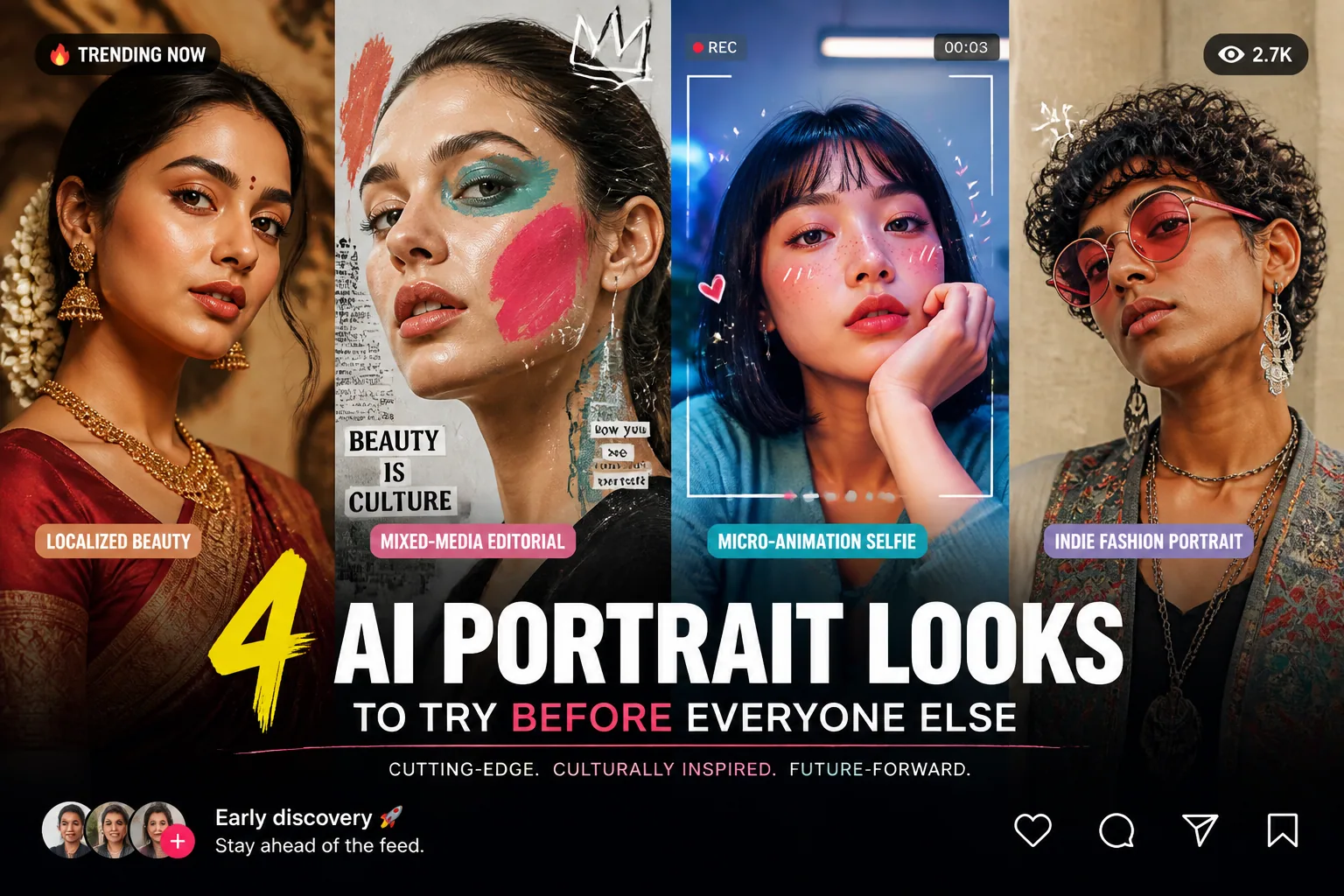
How to Spot & Use Niche AI Portrait Trends Before They Go Mainstream
The fastest way to stand out with AI portraits is not to copy the biggest look on the feed. It is to notice the smaller signals early, before everyone else starts using the same aesthetic. That matters because portrait trends now move incredibly fast, especially on TikTok and Reels, where motion-friendly content already outperforms static images by a wide margin. In 2025, short-form video content achieved about five times more engagement than static image posts, and on TikTok the average engagement was roughly 2.5% for video versus 0.5% for static images, according to Selfie AI research on animated portraits: https://selfieai.me/blog/stepping-into-motion-how-animated-ai-portraits-are-shaping-the-future-of-visual-storytelling
That is why niche AI portrait trends matter before saturation hits. The earlier you spot an emerging AI portrait trend, the easier it is to build a visual signature that feels fresh, culturally aware, and naturally shareable. The goal is not to chase every new look. It is to recognize which underrated portrait styles are starting to resonate in specific communities, then adapt them in a way that feels personal rather than copied.
Why Niche AI Portrait Trends Matter Before Saturation Hits
Mainstream AI portrait looks tend to become visually predictable very quickly. Once a style gets popular, the same lighting, the same polished skin, the same cinematic background, and the same editorial pose start appearing everywhere. The result is that what once felt premium starts to feel templated.
Niche trends work differently. They often emerge from smaller cultural circles, regional creator communities, indie fashion pages, experimental artists, or short-form video formats where novelty gets rewarded. Because these styles are more specific, they feel more alive. They usually carry a stronger point of view, whether that point of view comes from local beauty standards, handmade textures, motion effects, or fashion references that are not yet overexposed.
There is also a practical reason to pay attention now. Platforms are rewarding portraits that look like they belong in motion, or at least feel like they could move. TikTok’s AI Alive feature, for example, turns static photos into moving visuals and includes C2PA metadata so viewers can tell the image is AI-generated. That kind of transparent motion-friendly evolution shows where visual culture is heading: image styles that are not just pretty, but interactive and format-aware. Source: https://selfieai.me/blog/how-animated-ai-portraits-are-changing-personal-branding-on-emerging-platforms
So if you want your portraits to feel early, the real advantage is trend timing. Not using the most popular style. Using the one that is about to become popular, while it still feels like you discovered it first.
How to Spot an Emerging AI Portrait Trend Early
An emerging AI portrait trend rarely announces itself with one viral post. More often, it shows up as repetition across smaller spaces. You might see the same lighting pattern on a few TikTok creators, or a similar color palette in Reels from a regional fashion cluster, or a recurring prop in indie beauty edits. That is usually the first clue.
A good way to spot a trend early is to look for patterns in the edges of the internet rather than the center. Check creator communities in specific countries, small fashion accounts, fan edit pages, and experimental AI art posts. If the same look appears in more than one niche space, it is probably moving from isolated experimentation into early adoption.
Another signal is portability. A style that can work as a still image, a story frame, a profile picture, and a short looping animation has a much higher chance of spreading. That is why trends such as animated profile photos and story restyling are becoming important. Meta AI, for instance, rolled out tools in February 2026 that let people animate profile pictures with effects like waving, confetti, and animated backgrounds, while also restyling Stories and Memories with prompts or style presets. Source: https://about.fb.com/news/2026/02/animate-facebook-profile-picture-meta-ai/
You should also pay attention to emotional specificity. If a portrait style feels too generic, too global, or too perfect, it will probably blend into the mainstream quickly. If it carries local beauty cues, handmade imperfection, or a strong identity marker, it is more likely to survive long enough to build momentum.
Trend #1: Local Beauty AI Style and Hyper-Regional Aesthetics
One of the strongest underrated portrait styles right now is the local beauty AI style. This is the opposite of a globally standardized beauty template. Instead of smoothing everyone into the same polished face, it borrows cues from a specific region’s makeup habits, hair styling, jewelry, posing language, and skin finish.
This trend matters because it makes portraits feel culturally located. A hyper-regional aesthetic can include warmer skin tones, a particular lip shape, a local bindi or head wrap, specific eyebrow styling, familiar fabrics, or a background that reflects the environment where the look would naturally exist. The image feels more rooted, less generic, and much harder to confuse with every other AI portrait online.
Tools that focus on preservation-first cultural detail are especially relevant here. Clar1ty.art describes itself as a preservation-first AI enhancement platform for Asian portraits and heritage imagery, emphasizing skin texture, traditional clothing, and facial features rather than flattening them into a universal beauty standard. Source: https://www.clar1ty.art/faq
A similar idea appears in TruTones.ai, which focuses on bias-free portrait generation for people of color by preserving skin tone, facial features, cultural identity, and consistent character accuracy without Eurocentric distortion. Source: https://trutones.ai/
If you want this style to work, the key is not over-directing the AI into costume. The image should feel like a contemporary portrait first, with local detail woven into it naturally. Think beauty counter in a specific city, not a travel brochure.
Trend #2: Mixed-Media Portrait Mashups That Feel Handmade
Mixed-media portrait mashups are one of the most visually interesting underrated portrait styles because they disrupt the usual polished AI look. Instead of a single seamless image, they combine ultra-realistic portrait photography with doodles, collage elements, 3D chibi doubles, editorial text panels, sticker graphics, or painted overlays.
This style feels especially current because it looks handmade in a digital way. It has the clarity of AI but also the messiness of a real creative process. That combination makes it feel more personal, and often more shareable, than a perfect studio portrait.
A recent example of this direction is the Gen Z chibi mixed-media AI portrait trend, which combines street-style photography with 3D chibi doubles and graphic elements to create images that feel both editorial and playful. Source: https://techketchups.com/the-gen-z-chibi-mixed-media-ai-portrait-trend-how-to-create-a-viral-railway-station-photo-with-one-prompt/
There is also a related momentum around miniature stylization. The Mini-Me AI trend shrinks the subject into a stylized miniature version placed in oversized everyday scenes like a coffee mug, bookshelf, or palm. That kind of image lands well because it feels conceptually clever at a glance and works well as a still shareable format. Source: https://flovaly.com/blog/ai-mini-me-trend
The reason mixed-media portraits are gaining traction is simple. They break the expectation that AI must always aim for realism. Instead, they remind people that image-making can be playful, layered, and expressive. That opens the door for more distinctive personal branding.
Trend #3: Micro-Animation Selfie Formats for Reels and TikTok
The micro-animation selfie is one of the most promising emerging AI portrait trends because it fits how people actually consume content now. It is not a full cinematic video. It is a subtle movement inside a portrait, like blinking, hair motion, a shifting light bloom, a background ripple, or a gentle camera drift.
These tiny animations work because they make a still image feel alive without turning it into a full production. For Reels and TikTok, that can be enough to trigger a pause, a replay, or a save. In a feed full of motion, a portrait that moves just a little can feel more polished and more emotionally sticky than a flat image.
This trend is also helped by platform behavior. Facebook’s Meta AI update in 2026 included profile picture animation, waving, confetti, and animated backgrounds, plus prompt-based restyling for Stories and Memories. That is a strong signal that motion inside portrait formats is becoming normal, not novel. Source: https://about.fb.com/news/2026/02/animate-facebook-profile-picture-meta-ai/
If you want to make a micro-animation selfie feel intentional, keep the movement restrained. One moving element is often more compelling than five. A slight head tilt, a blinking eye, a floating light particle, or a soft fabric sway can be enough to make the portrait feel premium and current.
Trend #4: Indie Editorial Portraits with Raw Fashion Energy
Indie editorial portraits sit between high fashion and documentary realism. They are styled, but not overproduced. They often use sharper contrast, more direct flash, less smoothing, and poses that feel like they were captured in motion rather than staged in a studio.
This is one of those underrated portrait styles that feels fresh because it resists the overly glossy AI look. Instead of perfect skin and cinematic fog, you get energy. A slightly messy collar, a strong side light, a concrete wall, an unguarded expression, or a cropped frame that feels like it came from a fashion zine can make the image more compelling.
Indie fashion circles and art directors often like this look because it signals taste without trying too hard. It reads as intentional, current, and slightly underground. That makes it ideal for creators who want to look visually ahead without looking like they are copying a luxury campaign.
It also benefits from content recycling across formats. A strong indie editorial portrait can work as a cover image, a carousel slide, a profile avatar, or a motion-treated Reels frame. That flexibility gives it more longevity than trend looks that only work in one context.
Trend #5: Cultural Texture-Led Portraits That Break the Global Template
Texture-led portraits are built around the small details that make a face and image feel real. That can mean visible skin texture, natural hair coils, fabric grain, jewelry marks, traditional garments, weathered walls, or ambient color cast from a local environment.
These portraits break the global template because they do not try to homogenize identity. Instead, they preserve the details that tell a more specific story. That is especially powerful for creators who want their images to reflect ancestry, heritage, or place without turning them into literal costume portraits.
Gennit.AI’s cultural portrait generator points in this direction with its “You Around the World” template, which reimagines a person in multiple countries by changing hairstyle, clothing, and background while keeping core facial identity stable. Source: https://www.gennit.ai/blog/ai-cultural-portrait-generator
This kind of work feels fresh because it respects variation. It says the portrait should not erase where someone comes from. It should highlight it. That is why these images often feel more human and more algorithmically interesting than the same airbrushed global face repeated everywhere.
What Makes These Underrated Portrait Styles Feel Fresh vs. Mainstream AI Looks
Mainstream AI portraits usually share a few predictable traits: symmetrical lighting, smooth skin, cinematic haze, luxury fashion framing, and a broadly universal beauty ideal. They are pleasant, but they are also easy to scroll past because they have become familiar.
Underrated portrait styles feel fresh because they introduce tension or specificity. A local beauty AI style has regional identity. A mixed-media portrait mashup has visual collision. A micro-animation selfie adds motion. An indie editorial look adds rawness. A texture-led portrait adds realism and cultural grounding.
In other words, these styles work because they create a point of view. Instead of saying, this is an attractive portrait, they say, this is an image with context. That context is what makes the picture more memorable, more discussable, and often more likely to be saved.
Another reason they feel different is that they adapt better to platform behavior. On TikTok and Reels, a visual that feels like it belongs to a subculture or emerging aesthetic usually performs better than one that looks overused. The algorithm does not reward sameness forever. It rewards engagement, and engagement often comes from novelty.
How to Recreate Each Trend Inside Selfie AI
If you want to test these looks quickly, Selfie AI is a practical place to start because it can turn ordinary selfies into portraits across many styles and also supports animated video output. It lets you upload a few selfies to create a personal AI model, then generate custom scenarios and higher-resolution results through its prompt and style features. Product link: https://findthe.app/selfie-ai-0xi7wd
For local beauty AI style, start with a prompt that names the region, the makeup cues, and the setting. Be specific about hair texture, jewelry, fabric, and environment. For example, ask for warm natural skin finish, region-specific beauty styling, soft directional daylight, and a background that reflects an everyday urban or neighborhood setting rather than a studio backdrop.
For mixed-media portrait mashups, use contrast in your prompt. Pair realism with collage elements, sketch overlays, sticker accents, or poster-like frames. A good prompt might ask for an editorial street portrait with hand-drawn doodles, layered paper texture, and a bold color block behind the subject. The more clearly you describe the contrast, the more likely the AI is to create that hybrid feeling.
For a micro-animation selfie, keep the base image clean and then animate one or two small gestures. Ask for blinking, gentle hair motion, subtle light movement, or a slow camera push-in. The point is to make the image feel alive, not flashy. If you are posting to Reels or TikTok, subtlety often looks more premium than exaggerated movement.
For indie editorial portraits, specify direct flash, hard shadow, off-center composition, and raw fashion energy. Add props like a reflective bag, oversized sunglasses, a magazine, a metro card, or a coffee cup if you want the image to feel like a real city portrait rather than a fashion fantasy.
For texture-led portraits, prioritize detail language. Mention skin texture, fabric weave, natural curls, imperfect light, grain, and culturally grounded clothing or accessories. The more the prompt values detail over polish, the better this style usually lands.
Prompt Tweaks, Lighting Setups, and Props That Make the Difference
The difference between a generic AI portrait and a trend-forward one often comes down to small prompt tweaks. Instead of writing only what the subject looks like, write how the image should feel and where it should belong. That gives the model more visual direction.
Lighting is especially important. Soft daylight can make a local beauty AI style feel intimate and real. Direct flash can make an indie editorial portrait feel candid and fashion-forward. Side lighting can help texture-led portraits feel dimensional. Backlight or rim light can make a micro-animation selfie feel more cinematic without becoming too dramatic.
Props matter too, because they anchor the image in a recognizable world. For mixed-media portraits, use graphic objects like notes, frames, paper cutouts, or stickers. For cultural portraits, use subtle accessories that belong to the setting. For editorial looks, use objects that imply movement or lifestyle, such as a jacket slung over one shoulder, headphones, a tote bag, or a street object.
A useful rule is this: the prop should reinforce the aesthetic, not explain it. If the image needs a long explanation, it is probably too forced. If the prop feels like it naturally belongs in the scene, the trend read will be stronger and more believable.
Examples from Early Adopters in Fashion, Art, and Short-Form Video
Early adopters rarely announce themselves as trendsetters. They simply post images that feel slightly ahead of the feed. In fashion, that might look like an editorial portrait with raw flash and local styling details instead of a polished luxury setup. In art, it may look like a mixed-media self-portrait where the face is paired with drawings, scanned textures, or miniature doubles. In short-form video, it might be a micro-animation selfie that uses barely perceptible movement to create a hypnotic loop.
What all of these examples have in common is restraint. They do not overstate the trend. They hint at it. That is often why they work so well early on. The audience senses that the image belongs to a developing visual language, even if they cannot name it yet.
Creators in regional communities are especially important here because they often shape these aesthetics before global audiences notice them. That is why it helps to watch smaller fashion accounts, local makeup creators, and experimental portrait artists rather than relying only on the biggest influencer pages.
How to Test Trends Without Looking Like You’re Chasing Them
The easiest way to look trend-chasing is to copy the most obvious version of a style too quickly. The better approach is to test one visual idea at a time and adapt it to your own identity.
Start with a single variable. If you are trying a local beauty AI style, keep the pose and framing simple, and change only the beauty cues. If you are experimenting with mixed-media portraits, keep the clothing familiar and let the collage elements do the work. If you want a micro-animation selfie, do not pile on extra effects. Let the movement itself be the novelty.
You can also avoid chasing by building a visual series instead of posting one isolated trend image. A series makes the look feel intentional. It gives you room to refine the style and makes the audience think you are developing a signature rather than copying a one-off viral idea.
Finally, post timing matters. If a trend is already everywhere, it is usually too late to be seen as early. But if you are seeing the same cues in smaller communities and have a clear angle that fits your own face and brand, that is the right moment to test.
If you want search visibility while these formats are still growing, build content around phrases that match how people are already discovering them. The most useful terms right now include emerging AI portrait trend, underrated portrait styles, local beauty AI style, micro-animation selfie, mixed-media AI portrait, cultural portrait generator, AI chibi portrait, and animated AI portraits.
You can also capture long-tail searches by pairing style terms with use cases, such as AI portrait ideas for TikTok, AI portrait trend for Reels, how to make a cultural AI portrait, or how to create a mixed-media selfie edit. Those longer queries often attract users who are ready to experiment, not just browse.
The best SEO strategy is to write for the trend before it peaks, while still using language that real creators would search for. That keeps the content useful now and discoverable later.
Final Take: Build Your Signature Look While the Trend Window Is Still Open
The next wave of AI portrait aesthetics is not about making everything louder. It is about making images more specific. The most compelling emerging AI portrait trend is usually the one that feels rooted in a place, a subculture, a texture, or a tiny movement that others have not overused yet.
If you want to stay ahead, keep watching the margins. Look at regional creators, indie fashion edits, mixed-media experiments, and subtle motion portraits. Those are often the places where tomorrow’s mainstream style starts as today’s niche idea.
Use Selfie AI to test quickly, refine your prompts, and build a look that feels like yours before the trend window closes. The smartest move is not to wait until everyone is doing it. It is to create the version people will later recognize as early.