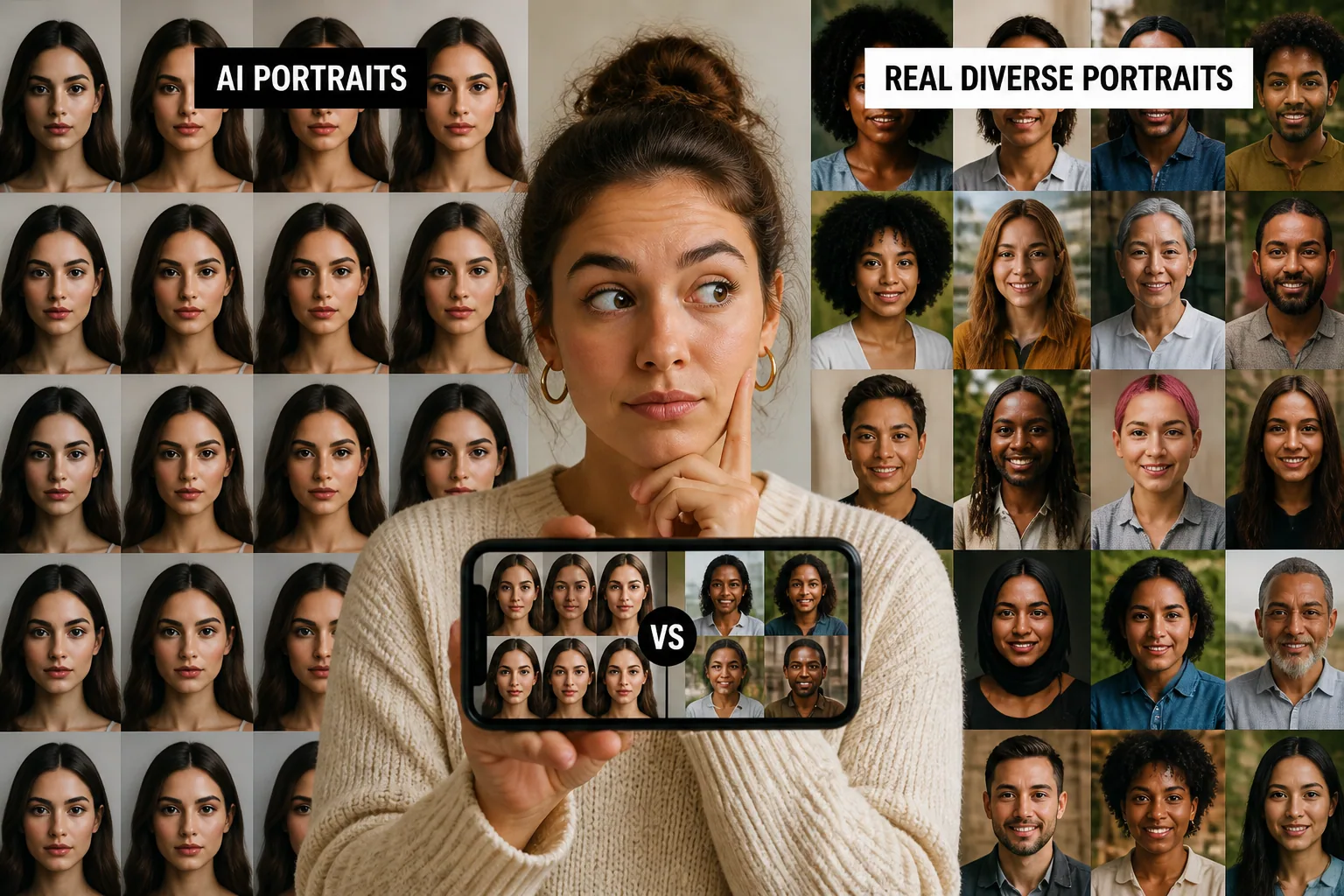
How AI Portraits Are Reinforcing Beauty Standards and How to Create an Authentic Aesthetic Instead
AI portrait tools can be exciting because they promise speed, polish, and endless creative possibilities. But they also come with a quieter problem: many of them tend to reproduce the same narrow version of beauty again and again. The faces may change, but the underlying pattern often does not. Lighter skin, slimmer features, youth, symmetry, Eurocentric styling, and highly smoothed textures can become the default. Over time, that creates a visual language that can feel less like self-expression and more like a filter for conformity.
That matters because portraits are never just pictures. They shape how people see themselves, how brands present identity, and how culture decides what looks normal, attractive, professional, or trustworthy. Research keeps showing that AI image systems can amplify these biases. One study of 26,400 synthetic faces found that AI models systematically associate attractiveness with positive traits like trustworthiness and intelligence, while also showing gender bias, especially for non-White women (doi.org). Another audit of Stable Diffusion models found that skin tones were not only stereotyped, but also homogenized, with the newest version producing darker and less variable skin tones in patterned ways (ojs.aaai.org).
So if you want portraits that feel credible, personal, and inclusive, the goal is not just to generate something flattering. It is to generate something honest. That means learning how these systems default, spotting when a portrait is flattening your identity, and using prompts, references, and settings more intentionally.
Why AI Portraits So Often Start to Look the Same
A lot of AI portraits begin from the same visual assumptions because the models are trained on large datasets that already contain dominant aesthetic patterns. If a model sees more polished studio portraits, more light skin, more young faces, more conventionally attractive features, and more heavily edited imagery, it will often treat those traits as the safe route to a “good” portrait. The result is not always obvious bias in a single image. Instead, it is repetition. The same jawline, the same glow, the same soft-focus finish, the same generic beauty.
This is why many AI portraits seem to blur together. Even when users prompt different identities, occupations, or moods, the model can preserve the same visual formula underneath. A study on neutral prompts found a more than 96% “default white” bias in outputs, along with gendered skews depending on the model used (arxiv.org). In other words, even when the prompt appears neutral, the system is not neutral at all.
This sameness also comes from style presets. A preset often packages beauty choices into one neat aesthetic: soft lighting, idealized skin, symmetrical features, crisp jawlines, and a camera-ready finish. Those choices may look attractive at first glance, but they can flatten facial uniqueness and hide the features that make a person identifiable.
How Datasets and Style Presets Encode Beauty Bias
Training data teaches AI what is normal. Style presets teach AI what is desirable. When those two things overlap, beauty bias becomes very hard to notice because it feels like a design choice instead of a social one. The model is not simply making portraits prettier. It is often pushing portraits toward the same culture-bound idea of prettiness.
Research in image generation has shown that attractiveness can be treated like a proxy for moral and intellectual value. That means a more attractive output may be more likely to look trustworthy or competent, which is a serious structural issue when images are used for profiles, branding, or public-facing identity (doi.org). In practical terms, a tool can quietly reward faces that resemble dominant beauty standards and punish those that do not.
This bias does not stop at facial shape. Skin tone is frequently affected too. In an audit of Stable Diffusion models across stigmatized identities, researchers found that outputs were systematically linked to skin tone patterns, and the latest model reduced diversity in skin tones by about 30% relative to earlier versions and even more relative to human face datasets (ojs.aaai.org). That means the model may be narrowing the range of visible human variation right when users expect it to expand creative possibility.
The Hidden Defaults: Race, Skin Tone, Gender, Age, and Body Norms
AI portrait systems often encode a cluster of defaults at once. Race is one of the most visible, but it is not the only one. Gender presentation, age, facial fullness, body size, and even the perceived “health” of the skin can all become part of the same idealized template.
In dermatology image research, the problem showed up in a stark way. Across four major platforms, 89.8% of generated images depicted light skin, while only 10.2% depicted dark skin. Dark-skin representation was typically under 9% except in one platform that aligned more closely with U.S. census demographics (pubmed.ncbi.nlm.nih.gov). Although that study focused on medical imagery, it is a strong reminder that image generators do not automatically reproduce the diversity of the real world. They often compress it.
Gender bias can be just as strong. The same dermatology study found poor diagnostic accuracy overall, but the representation imbalance itself is telling because it suggests that lighter skin is still treated as the visible default. Another study on AI-generated faces found racial homogenization, with nearly all Middle Eastern men depicted as bearded, brown-skinned, and in traditional attire even when those traits were not requested (pubmed.ncbi.nlm.nih.gov). That kind of output does not just miss nuance. It hardens stereotype into style.
Age is also a hidden bias. AI portrait systems often drift toward youth, smoothness, and perfection, which can make older faces appear less polished or less likely to match the model’s idea of beauty. Body norms follow a similar pattern. Even when the user wants a natural portrait, the system may subtly reshape posture, neck length, face fullness, or proportions to conform to a narrow ideal.
What Uniform AI Beauty Does to Self-Image and Online Culture
When the same face style keeps appearing in feeds, profiles, and branded visuals, it changes expectations. People start to internalize the idea that a good portrait should look a certain way. In that environment, imperfections become liabilities, and distinct features can feel like problems to be corrected rather than parts of identity to preserve.
That effect is not theoretical. A survey of 300 young women in urban Pakistan found that greater use of AI filters on platforms like TikTok, Instagram, and Snapchat was strongly correlated with body dissatisfaction and preference for Eurocentric features (sciencedirect.com). Even awareness of digital manipulation did not significantly reduce the effect. That is important because it suggests people can know an image is artificial and still absorb the beauty norm it promotes.
On a cultural level, uniform AI beauty narrows representation. If AI portraits increasingly define what looks professional, stylish, or attractive, then the gap between real human variation and the polished online image world keeps growing. Over time, this can make online identity feel less authentic and more performative. People may begin to choose the version of themselves that the model prefers instead of the version that feels true.
How to Spot When an AI Portrait Style Is Flattening Your Identity
The first step is learning to read the output critically. A portrait may look beautiful while still erasing individuality. Here are some signs that a style is flattening your identity:
The skin has been over-smoothed until texture disappears. Freckles, pores, scars, lines, and natural tonal variation are reduced to a glossy surface. The face becomes more symmetrical than reality, with features subtly moved toward a generic ideal. Hair texture changes or gets cleaned up into a more socially accepted look. Skin tone shifts lighter, warmer, or more uniform than in the original reference. Age cues vanish, especially around the eyes, mouth, and hands. Facial features that are culturally specific or personally distinctive become softened or replaced with model-like neutrality.
You may also notice stereotype drift. For example, an AI portrait may turn a person into a “professional” version of themselves that looks less ethnic, less expressive, or less textured than the original. Or it may exaggerate certain cues, like making a person appear more feminine, more masculine, younger, slimmer, or more traditionally attractive than they are. If the output feels interchangeable with many other AI portraits, that is a sign the model is defaulting to sameness.
Prompting for Realism, Texture, Proportion, and Personal Features
If you want a more authentic aesthetic, your prompt needs to do more than request beauty. It should protect the details that make the person recognizably human. That means using language that preserves texture, proportion, and individuality instead of asking for generic perfection.
Try specifying real visual qualities. For example, mention natural skin texture, visible pores, subtle asymmetry, realistic lighting, authentic facial proportions, and the person’s actual age range. If you want a portrait that feels grounded, ask for a documentary-style look, natural coloration, and minimal retouching. If you care about preserving identity, name the features that should stay visible, such as freckles, smile lines, dimples, curly hair texture, monolids, fuller cheeks, a wider nose bridge, or deeper skin undertones.
It can also help to describe what you do not want. Ask for no skin whitening, no over-retouching, no exaggerated jawline, no eye enlargement, and no loss of cultural hair texture. This is especially useful because many systems still interpret “beautiful” as “standardized.”
Research suggests that prompt refinement can make a measurable difference. In a study on text-to-image stereotypes, refining prompts with LLM guidance reduced the Social Stereotype Index by about 61% in geocultural categories, 69% in occupational categories, and 51% in adjectival categories (arxiv.org). While that study was not limited to portraits, it shows that prompt wording can meaningfully shift bias rather than simply decorating it.
Using Reference Images Without Erasing Authenticity
Reference images can be powerful, but they should be used carefully. If the reference is already heavily filtered, the model may inherit the same aesthetic distortions. If the reference is too generic, the model may smooth out the very traits you were trying to preserve.
Choose references that show the real person clearly and naturally. Look for unfiltered selfies, candid photos, or portraits with honest lighting and visible texture. If you are building a brand identity, use references that reflect the diversity you actually want to show, not just the most polished samples from your archive. The point is to guide the AI toward recognition, not erasure.
It also helps to compare outputs from multiple references. If one image keeps turning the face into a lighter, younger, or more symmetrical version of the person, that is a sign the model is overriding identity. In those cases, a more balanced reference set can anchor the generation in reality rather than idealization.
Settings, Style Controls, and Editing Choices That Support Inclusion
Sometimes inclusion is less about the prompt and more about the controls around it. Strength, stylization, guidance, and editing settings can all affect how much the model drifts from the source. Lower stylization often preserves more of the original face. Moderate guidance can help prevent wild reinterpretation. If the platform allows it, reduce facial beautification and face-smoothing features.
Post-generation editing matters too. Many users add finishing touches that push portraits back toward the same beauty standard the model already prefers. Instead, use editing to restore authenticity: skin texture, hair edges, natural shadows, realistic eye shape, and true tonal depth. If a portrait loses identity in generation, the fix should not be more glamor. It should be more truth.
This is where tools matter. A product like Selfie AI: AI Photo Generator can be useful when you want to create personalized portraits from your own selfies and keep experimenting with styles, especially if you want custom scenarios and varied categories. You can explore it here: https://findthe.app/selfie-ai-0xi7wd
AI Tools and Models Making Progress on Diverse Representation
Not every system performs the same way. Some tools are clearly better than others when it comes to diversity, and that difference is worth paying attention to. In the dermatology imagery study, one platform aligned more closely with U.S. census demographics for skin tone representation, while the others remained heavily tilted toward light skin (pubmed.ncbi.nlm.nih.gov). That suggests representation is not fixed. It can improve when the system is trained or prompted differently.
There is also evidence that prompt design can help bring outputs closer to real-world proportions. In a medical imagery protocol, researchers modified prompts to include demographic proportions and produced AI-generated images whose skin tone distribution matched U.S. population demographics, unlike baseline outputs from DALL-E-3 and Midjourney, which over-represented lighter skin (pmc.ncbi.nlm.nih.gov). The takeaway is simple: if a model is not inclusive by default, it may still be coaxed into better representation through more deliberate instruction.
That said, progress should be measured carefully. Better diversity in one category does not guarantee fairness in another. A tool may improve skin tone representation while still distorting age, gender presentation, hair texture, or facial structure. The best practice is to test multiple outputs across multiple prompts and compare how consistently the model respects identity.
How Creators and Brands Can Show Credible Diversity in Visual Identity
For creators and brands, the goal is not just to avoid offensive outputs. It is to build a visual identity that feels believable. Credible diversity means people can see real variation in face shape, skin tone, age, style, expression, and cultural presence without the imagery feeling forced or tokenized.
Start with your source material. If your reference pool only contains one kind of face, your AI output will probably do the same. Choose references that reflect a real audience or community rather than an idealized stock image version of it. Then make sure the final set of portraits does not all converge on the same light, smooth, highly symmetrical look.
Brands should also avoid using AI portraits as a shortcut to universal polish. The most credible visual identities often show small differences: different textures, varied age ranges, different levels of formality, and a mix of expressions that feel human. If every image looks generated by the same beauty machine, the brand may appear less trustworthy, not more.
A Practical Checklist for Generating AI Portraits That Feel Like You
Before you generate, ask yourself whether the prompt protects identity or just beautifies it. Include specific features you want preserved. Add texture words like natural skin texture, visible pores, real hair texture, and authentic lighting. Mention age honestly instead of asking the model to make you younger. Keep skin tone descriptions grounded and avoid vague requests that the model may interpret as whitening.
After generating, compare the result to the original. Did the face become more generic? Did the skin lighten? Did the hair texture change? Did the features become more symmetrical or less culturally specific? If yes, revise the prompt and settings instead of accepting the first flattering result. Try different tools if needed, because some models are simply better at preserving identity than others.
For brand work, test consistency across multiple subjects. If one person in a diverse set keeps getting more polished than the others, the system may be encoding bias. Finally, keep a human standard in mind. The best portrait is not the one that looks most AI-made. It is the one that still feels like a real person.
The Future of AI Portraits: From Idealized Faces to Authentic Expression
The future of AI portraits does not have to be more polished sameness. It can be more expressive, more representative, and more honest. That future depends on both better models and better habits. Models need more diverse data, better evaluation, and less dependence on narrow beauty assumptions. Users need to become more intentional about what they ask for and what they accept.
The research already shows that AI systems can amplify lookism, racial homogenization, skin-tone bias, and gendered beauty norms. But it also shows that changes in prompts, datasets, and tool design can reduce those harms. That is encouraging because it means the problem is not inevitable. AI portraits do not have to flatten identity. They can help people see themselves in new ways without losing the features that make them real.
In the end, authentic aesthetics are not about rejecting AI. They are about refusing to let AI decide that only one kind of face deserves to look beautiful. If you use the tools carefully, compare outputs critically, and keep your real features visible, you can create portraits that feel less like a mask and more like you.