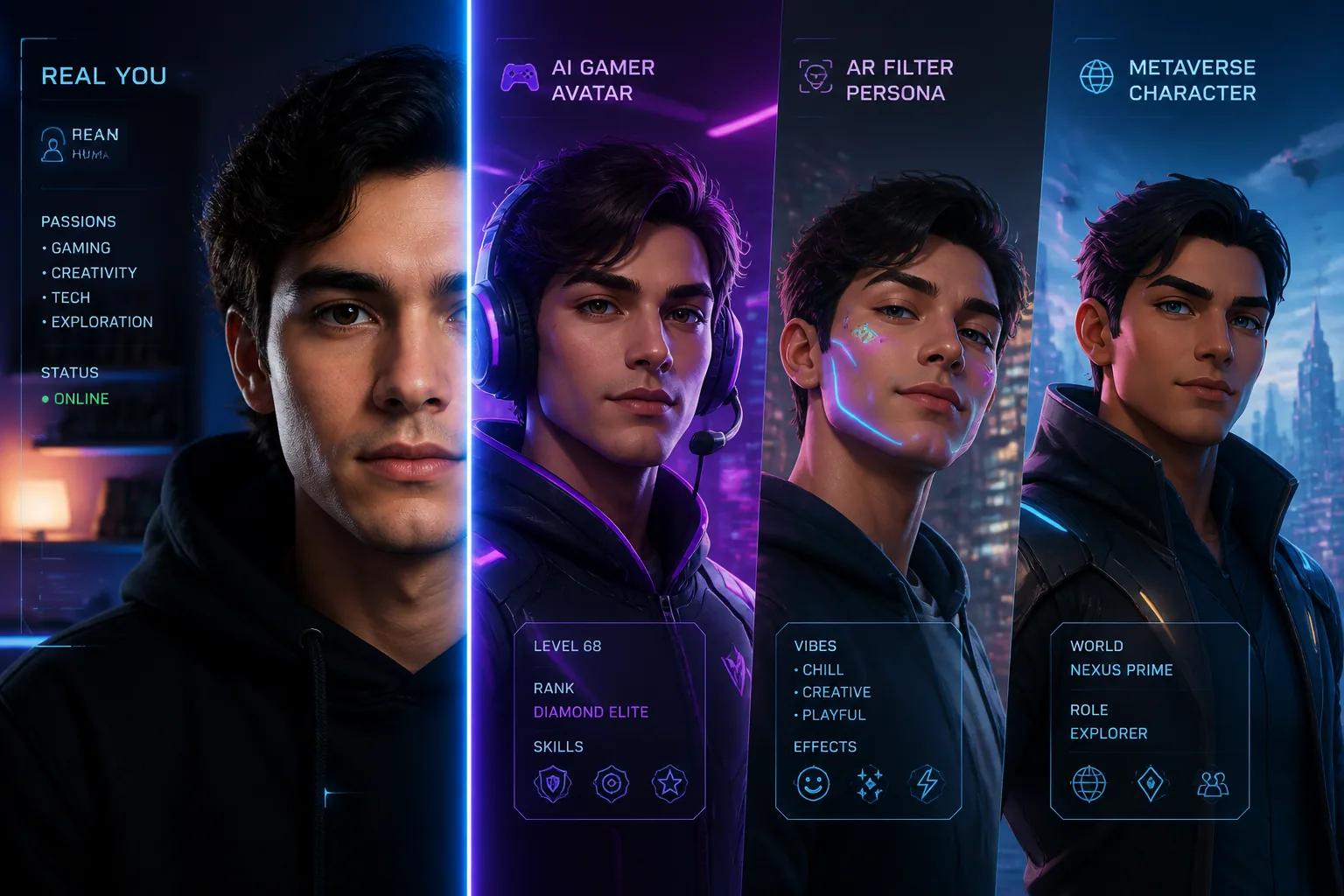
How AI Portraits Are Powering Your Virtual Presence: From Gaming, AR Filters, and Metaverse Avatars
AI portraits are no longer just a fun novelty. They are quickly becoming the visual layer of digital identity, shaping how people show up in games, virtual meetings, social apps, streaming platforms, and immersive worlds. In the same way a profile photo once defined your online presence, AI-generated portraits and avatars are now turning into the default face of the internet’s more interactive future.
What makes this shift interesting is that avatars are not only getting more realistic, they are also getting more useful. They can look like you, sound like you, move like you, and in some cases even speak for you. That is why AI portraits are becoming central to the broader avatar boom, where users want digital representations that feel personal, expressive, and portable across platforms.
Why AI Portraits Are Becoming the New Digital Identity
The rise of AI portraits reflects a simple change in what people expect from digital identity. A static photo is enough for a contact card or a social profile, but it falls short in environments where interaction matters. In gaming, virtual events, and creator platforms, users want a presence that can adapt to context while still remaining recognizable.
AI portraits help solve that problem. They let users create a version of themselves that can be stylized for different settings without losing the core features that make them feel authentic. That balance between realism and flexibility is one reason avatar culture keeps accelerating. It is also why virtual identity is moving from something you display to something you actively use.
The market signal is strong too. According to a 2025 forecast, the interactive AI avatar segment is expected to approach US $6 billion by 2032, driven mainly by demand for real-time, expressive, and responsive avatars across enterprise and consumer use cases. Source: https://www.perxona.ai/news/enterprise-ai-avatar-use-cases-real-deployments-2026
What’s Driving the Avatar Boom in Gaming, AR, VR, and Virtual Worlds
Gaming has always been an avatar-first medium, so it makes sense that it would help normalize AI portraits. Players have long used characters to experiment with identity, status, and self-expression. The difference now is that AI tools make personalization faster and more convincing, allowing users to generate faces, outfits, and personalities without starting from zero.
AR filters and VR environments are pushing the trend further. In augmented reality, people want their face to remain central even as they experiment with different effects. In virtual reality and metaverse-style environments, the pressure is even greater because the avatar is often the entire social body. If the avatar feels generic or disconnected from the user, the experience loses emotional weight.
This is why the boom is not just about aesthetics. It is about presence. The more a digital persona can mirror facial cues, gestures, and tone, the more credible it becomes in social interaction. That is also why brands and platforms are investing in more lifelike systems that can support entertainment, collaboration, and commerce at once.
How AI Selfies Turn Into Avatars Across Platforms
The process of turning a selfie into an avatar has become surprisingly accessible. Most systems begin with a handful of photos that give the model enough visual information to learn a person’s face, proportions, and distinctive details. From there, AI can generate portraits in different styles, settings, and levels of realism.
Some platforms go beyond still images and create animated or speaking avatars, which is where the technology starts to feel less like image editing and more like identity modeling. VentureBeat reported that Akool’s Streaming Avatars let users upload a photo and a voice recording to generate personalized avatars that behave like extensions of large language models, making interactions feel more familiar and engaging. Source: https://venturebeat.com/games/akool-enhances-content-creation-with-genai-models-to-create-lifelike-avatars/
That voice layer matters because identity is not purely visual. When an avatar can reflect both how you look and how you sound, it becomes much easier to use in creator content, customer engagement, online learning, and live conversation. This is one reason avatar tools are moving from novelty to infrastructure.
Creating an Avatar That Still Looks and Feels Like You
The challenge with AI portraits is not generating something attractive. The real challenge is generating something recognizable. If an avatar is too stylized, it may look impressive but fail to feel like you. If it is too literal, it may expose every small imperfection and feel less polished than people want.
A good avatar usually lands somewhere in the middle. It should preserve the traits that make your face distinct, such as eye shape, hairline, smile, skin tone, or facial structure, while allowing enough creative freedom to fit the intended use case. A business portrait should feel more grounded and professional. A gaming or social avatar can be more expressive, dramatic, or stylized.
This is where tools like Selfie AI: AI Photo Generator can be especially useful. It transforms ordinary selfies into AI-generated portraits and animated videos in styles ranging from professional business looks to beach scenes, superhero transformations, historical eras, and custom scenarios. You can explore it here: https://findthe.app/selfie-ai-0xi7wd
The best avatar workflows also respect consistency. If you plan to use the same identity across multiple platforms, choose a style system and stick to it. The more consistent your face, color palette, pose language, and image quality, the more easily people will recognize you wherever you appear.
Where AI Avatars Show Up Today: Streaming, Meetings, Social Spaces, and More
AI avatars are already embedded in everyday digital life. Streamers use them to protect privacy, maintain energy, and create a more cinematic presence. Remote teams use them to make meetings feel less flat and more visually engaging. Social platforms use them to help users stand out in crowded feeds.
Beyond individual use, businesses are also applying avatars in scale-heavy content workflows. HeyGen shared a customer story showing how Ratava scaled 98% of its video output using AI avatars, with a 10x speedup in production and a 3x increase in personalized video open rates for clients. Source: https://www.heygen.com/customer-stories/ratava
That kind of result explains why avatars are becoming practical assets instead of just creative experiments. They reduce production friction, support localization, and make it easier to tailor messages for different audiences without reshooting everything from scratch.
In the entertainment space, virtual influencers are also showing how far this can go. Time reported that the AI influencer Aitana López, a hyper-realistic virtual persona, reportedly earns around €10,000 per month from brand deals, while the typical income for such virtual influencers is closer to €3,000. Source: https://time.com/6993650/ai-generated-women-miss-ai-beauty-pageant-contestants/
Privacy, Likeness, and Ownership: What Users Need to Watch
The more realistic an avatar becomes, the more important privacy and ownership become. A recent scholarly review in Frontiers in Virtual Reality found that avatars mirroring users’ faces, voices, or gestures can collect both explicit biometric data and inferred personal traits, and that EU and US data protection laws still have gaps in how they handle these newer forms of sensitive data. Source: https://www.frontiersin.org/journals/virtual-reality/articles/10.3389/frvir.2025.1520655/full
This is not a minor issue. If a platform is trained on your face and voice, it may be learning more than just how you appear. It may also infer age, mood, personality, or behavioral patterns. That creates new questions about consent, retention, reuse, and whether a likeness can be reused after a user stops participating.
Legal frameworks are starting to catch up. The MDPI publication on digital identity and metaverse privacy notes that the California Privacy Rights Act, in effect since 2023, classifies precise geolocation and biometric data as sensitive personal data, which has direct implications for avatar platforms handling user information. Source: https://www.mdpi.com/2078-2489/15/10/624
Users should be especially careful when uploading selfies, voice clips, and identity documents to services that do not clearly explain ownership, storage, and deletion. If your avatar is going to represent you publicly, you should know who can access it, where it is used, and whether it can be exported or removed later.
The Cross-Platform Challenge: Can One Avatar Work Everywhere?
A future-proof avatar should ideally travel across platforms, but that is still harder than it sounds. Gaming engines, social apps, meeting software, and metaverse environments all use different technical standards, rendering systems, and personalization limits. A portrait that looks great in one place can feel distorted or off-model in another.
The biggest obstacles are consistency, compatibility, and permissions. Some platforms allow only fixed templates. Others support live animation but not detailed facial control. Some focus on stylized identity, while others require more realistic rendering. That means users often have to maintain multiple versions of themselves, which fragments the idea of a single digital identity.
This fragmentation is why the avatar market is moving toward modular identity systems. The goal is not just one perfect portrait, but a set of identity assets that can be adapted to different contexts without losing recognizability. Until standards mature, users and brands will need to think in terms of avatar families rather than one universal face.
How Brands and Marketers Are Using AI Avatars as Virtual Touchpoints
Brands are now using AI avatars as a way to humanize digital communication at scale. Fashion companies in particular have moved quickly. The Drum reported that brands like L’Oréal and H&M are using digital twins and AI-generated model clones in e-commerce, advertising, and social content, bringing generative avatars into their content pipelines. Source: https://www.thedrum.com/news/how-brands-are-moving-beyond-the-real-weird-with-synthetic-humans
This makes sense for marketers because avatars can function like always-on brand faces. They can present products, localize messaging, and create repeatable visual identities across campaigns. They can also help brands test styles and concepts before committing to full production.
At the same time, trust remains a major barrier. Time noted that 89% of enterprise marketers surveyed in a Linqia poll said they do not plan to work with AI avatars or digital clones in 2026, citing authenticity and audience trust concerns. Source: https://time.com/7329699/ai-influencers-tiktok-granny-spills/
So the opportunity is real, but the execution has to be careful. The strongest brand uses will likely be transparent, clearly disclosed, and tied to practical value such as faster video production, better localization, or more interactive customer experiences.
What’s Next: Real-Time, Emotional, and Voice-Responsive Avatars
The next stage of AI portraits is less about still imagery and more about behavior. Real-time avatars are beginning to track facial expressions, lip movement, gaze, and speech in ways that make interactions feel immediate. As these systems improve, the avatar will become less like a mask and more like a responsive interface for the self.
Voice-driven personalization is especially important here. Once avatars can respond with matching speech patterns, pace, and tone, they start to feel emotionally coherent. That matters in customer support, education, social hangouts, and even therapy-adjacent or coaching environments, where tone can change the entire experience.
This trajectory fits the larger market picture too. The forecast toward a nearly US $6 billion interactive avatar segment by 2032 suggests that users and companies are not only interested in appearance, but in responsiveness. The winning avatars will likely be the ones that can express intention, not just likeness.
How to Build a Future-Proof Virtual Presence
If you want a virtual presence that lasts, start with clarity. Decide what your avatar is for. Is it for gaming, public social profiles, creator content, meetings, or brand marketing? The intended use should shape the level of realism, formality, and motion you need.
Next, protect your identity. Use tools that clearly explain how your images and voice are stored, and avoid sharing more data than necessary. Since avatars may encode biometric and inferred traits, privacy should be treated as part of the design process, not an afterthought.
Finally, think like a publisher, not just a user. Build a consistent visual identity, create a few context-specific versions, and keep your assets organized so they can move across platforms as standards evolve. The strongest virtual presences will be the ones that feel personal, adapt well, and remain under the user’s control.
AI portraits are not replacing identity. They are expanding it. As gaming, AR filters, virtual meetings, streaming, and metaverse platforms continue to converge, your digital face may become one of your most important assets.