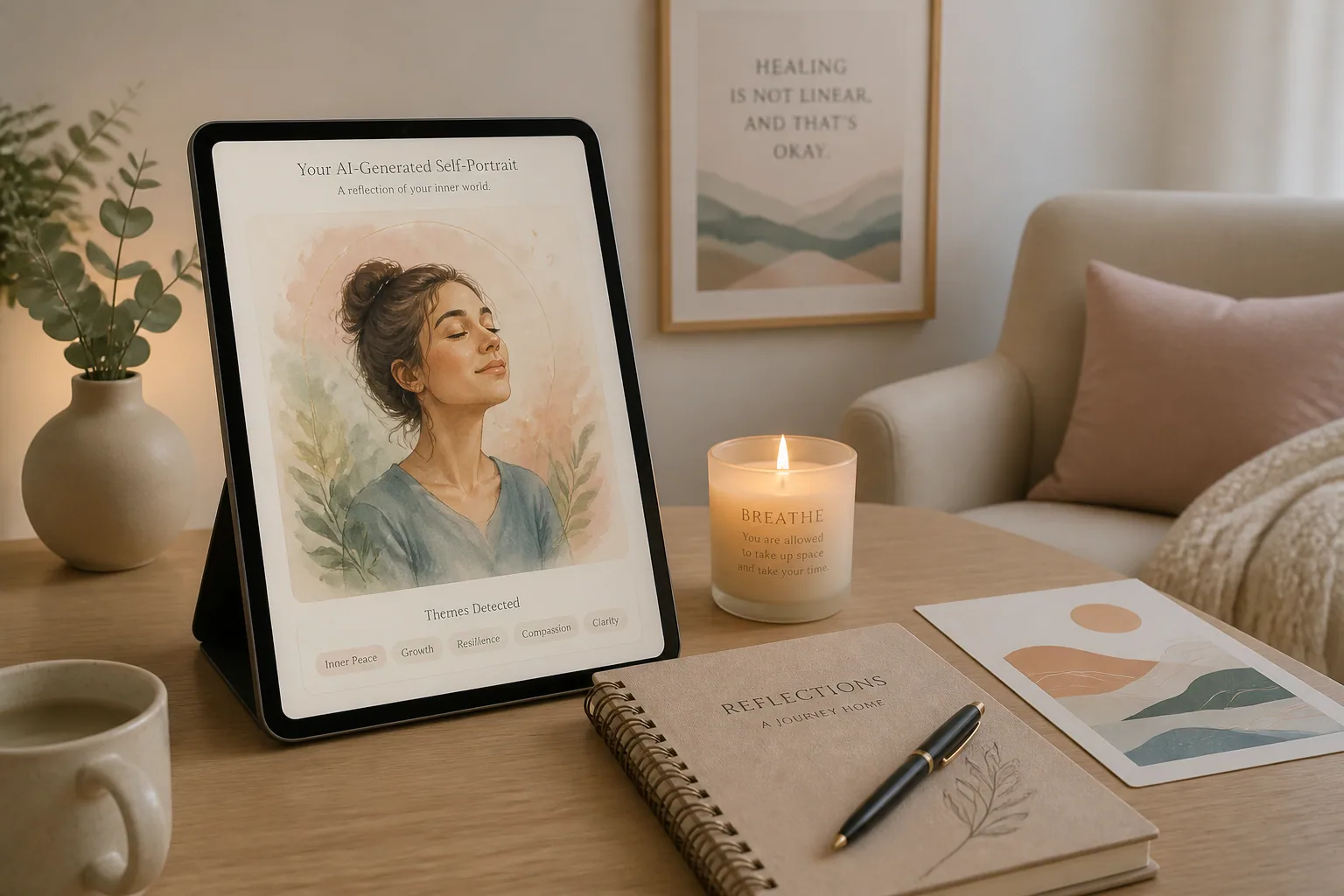
Healing Through the Mirror: How AI Portraits Are Entering Therapy and Digital Wellness
AI-generated portraits, avatars, and animated self-images are starting to appear in therapy-adjacent spaces for a simple reason: people often find it easier to reflect on themselves when there is a little distance. A mirror can feel immediate, but an AI portrait can feel like a container. It can soften direct self-judgment, create a safer layer for exploration, and help someone try on identity, posture, expression, or narrative without having to perform it perfectly in real life. That makes these tools interesting for trauma work, body image support, identity exploration, grief rituals, and guided self-reflection.
This does not mean AI portraits are therapy in themselves. They are tools, and tools can support healing or complicate it depending on how they are used. The strongest early signals from research suggest that the emotional value of avatars comes from personalization, trust, and thoughtful integration with human support. In other words, the portrait matters, but the relationship around the portrait matters just as much.
Why AI Portraits Are Showing Up in Healing Spaces
Wellness practices increasingly borrow from digital media because people already use visual tools to think, remember, self-soothe, and narrate their lives. AI portraits fit neatly into that pattern. They can be used as a visual journaling prompt, an identity exploration exercise, a grounding object, or a symbolic representation of a desired self-state. For some people, especially those who struggle to verbalize internal experiences, an image can make reflection feel less overwhelming and more concrete.
Research on avatars in e-mental health points to several useful functions, including online peer support, virtual replications of traditional psychotherapy, augmentation of face-to-face treatment, serious games, and communication with autonomous virtual therapists. The same review also found that avatars can reduce communication barriers and encourage identity exploration, which helps explain why they are becoming relevant in healing contexts https://pmc.ncbi.nlm.nih.gov/articles/PMC5114267/.
There is also a practical reason practitioners are paying attention: in a 2025 study of 77 psychotherapists, perceived usefulness was the strongest predictor of whether therapists intended to use avatar technology in therapy. Prior digital experience also influenced ease-of-use perceptions, which suggests adoption is less about novelty and more about whether clinicians can see a meaningful therapeutic purpose https://pubmed.ncbi.nlm.nih.gov/41440162/.
What AI Self-Portraits Can Offer in Trauma, Body Image, and Identity Work
In trauma-informed settings, safety and pacing matter more than visual realism. A self-portrait does not need to be photorealistic to be emotionally useful. In fact, a slightly stylized portrait can sometimes feel less exposing and therefore more tolerable. The goal is not to force a perfect likeness, but to create an image that feels accessible enough for reflection without activating shame or overwhelm.
For body image work, AI portraits can be used carefully to explore the gap between how someone sees themselves, how they wish to appear, and how they feel in their body. That gap can be informative, but it can also be risky if the tool reinforces appearance ideals. Studies on avatar embodiment show why this needs caution. In one virtual reality study, embodying a thin-ideal avatar with strong embodiment was linked to more positive actual body image, but ideal body image itself did not change substantially https://pubmed.ncbi.nlm.nih.gov/35012380/. Another study found that men’s avatars were often thinner than their actual bodies and similar to their ideal body size, but more muscular than both, and that avatar-body discrepancies predicted greater body change concerns https://pubmed.ncbi.nlm.nih.gov/24394638/.
That means an AI portrait can either support body acceptance or intensify dissatisfaction, depending on the frame. A helpful use is not to chase an idealized body, but to notice what features the person selects, avoids, edits, or gravitates toward. Those choices can reveal hopes, protective strategies, identity aspirations, and embedded beliefs about worth, gender, age, safety, and visibility.
Identity work is another promising area. Avatars have long been used to lower social barriers and support self-exploration. When a person can choose hair, expression, clothing, posture, age presentation, or environment, they may discover parts of themselves that feel easier to access in symbolic form. For some users, especially LGBTQ+ participants, custom avatars may feel more affirming than pre-existing ones. A small pilot study found that participants preferred creating their own avatar in VR therapy, with trends toward stronger physiological responses when using custom avatars https://arxiv.org/abs/2409.00383.
Early Use Cases, Pilot Programs, and Therapy-Adjacent Experiments
The current landscape is still early, but there are enough pilot-style findings to show a pattern. Avatar systems seem most promising when they are highly configurable, when they supplement human care, and when they are used for a clear emotional task rather than as a gimmick. A focus group study involving patients with depressive disorders and mental health professionals in the UK, Spain, and Romania found that users preferred highly configurable avatars because they increased trust, and they wanted those avatars to supplement rather than replace face-to-face interaction https://pubmed.ncbi.nlm.nih.gov/22954882/.
That preference for control matters in healing. A person who has experienced trauma may need the ability to stop, revise, or reject an image that feels off. A person exploring identity may need to test multiple versions of self-representation without committing to a single label. A person working with grief may need a symbolic image that can be visited but not mistaken for a replacement.
Some avatar interventions even point to behavior change support. A systematic review of 15 studies using avatars for health interventions found that when an avatar’s body size changed in response to user behavior, participants showed better outcomes than with static avatars or non-avatar controls, especially in areas such as exercise efficacy https://innovationcenter.msu.edu/wp-content/uploads/2021/07/Enhancing-Healthy-Behaviors-Through-Virtual-Self-A-Systematic-Review-of-Health-Interventions-Using-Avatars.pdf. While that does not prove therapeutic benefit for mental health, it does suggest that responsive visual feedback can strengthen engagement and self-regulation.
Another emerging frontier is postmortem avatars, or AI simulations of deceased individuals. These are being discussed for grief therapy and imaginal exercises such as the empty chair technique, but they also raise serious questions about consent, governance, and emotional risk https://arxiv.org/abs/2604.11499. This area is still highly experimental, and it deserves far more caution than enthusiasm.
Designing AI Portraits That Feel Safe, Grounding, and Authentic
If the goal is healing rather than spectacle, the portrait design process should begin with emotional safety. A useful question is not only “What do you want to look like?” but also “What would feel calm, familiar, and non-triggering to look at?” This can shift the process from appearance optimization to nervous-system-aware creation.
A safe portrait often shares a few features. The expression is neutral or gently warm rather than overly exaggerated. The styling is recognizable but not hypersexualized or unrealistically perfected. The background is simple enough not to overwhelm. The image resembles the client enough to support recognition, but not so exactly that it feels invasive. Some people may prefer softer lighting, muted color palettes, or simplified features that reduce self-criticism.
When working with body image concerns, it can help to avoid prompts that push immediately toward “ideal” versions of the self. Instead, ask for grounded versions: rested, supported, strong, open, protected, curious, or calm. The therapeutic emphasis is on state, not status. A portrait can reflect inner steadiness without promising transformation into a different body.
For clinicians or guides, a useful practice is to review the image together and ask what feels true, what feels off, and what emotions arise when the person sees it. This turns the image into a dialogic object rather than a verdict. If the portrait triggers shame, grief, discomfort, or dissociation, that is information, not failure. It may be a sign to simplify the image, reduce realism, or stop using portraits altogether.
For people who want a practical tool to experiment with personalized self-images, Selfie AI: AI Photo Generator offers a way to create AI-generated portraits and animated videos from a few selfies, with custom scenarios and a secure workflow that keeps users in control of their content https://findthe.app/selfie-ai-0xi7wd. In a healing context, features like custom prompts and animation can be useful when they are used intentionally and with clear emotional boundaries.
How Therapists and Guides Can Use Image Reflection Prompts
AI portraits become more meaningful when paired with structured reflection. Without reflection, they can stay at the level of novelty. With reflection, they can reveal personal narratives about worth, visibility, protection, and belonging.
A simple sequence is to look, name, and notice. First, ask the client to look at the image briefly. Then invite them to name three things they notice without evaluating them. Finally, ask what the image seems to need, fear, or want. This helps shift attention from appearance judgments to emotional meaning.
Useful prompts include: What feels familiar in this image? What feels unfamiliar? If this portrait could speak, what would it say about how it has survived? What part of you does this image protect? What would make this image feel safer? Which details help you recognize yourself, and which details feel like a performance?
For body image reflection, prompts can focus on relationship rather than correction. How do you feel when you see yourself represented this way? Does this image invite compassion, comparison, resistance, or relief? What does your mind assume about this image that it also assumes about you? What would a kinder version of this portrait include?
For identity exploration, ask what the portrait makes possible. Does it express a side of you that is usually hidden? Does it feel like a future self, a protected self, a playful self, or a social self? Does it connect to a memory, a role, a culture, or a desired boundary? These questions keep the focus on self-understanding instead of optimization.
Using Animated AI Portraits for Visualization, Inner Child Work, and Journaling
Animation can add a new layer to healing work because movement changes how an image is experienced. A still portrait may feel like an object to evaluate, while a subtle animated portrait can feel more relational and alive. That can support visualization practices, guided meditation, and ritualized journaling.
In visualization exercises, a gently animated self-image can represent an internal resource. For example, a portrait might breathe slowly, blink softly, or move through a calming background. The point is not realism for its own sake, but creating a stable focus for attention. This can be useful during grounding routines or between therapy sessions as a reminder of safety cues.
For inner child work, the image can serve as a symbolic bridge. Some people may create a younger version of themselves, or an image that evokes tenderness, protection, and continuity. Animation can make the image feel less frozen and more emotionally reachable. That can help the person imagine offering care, witnessing pain, or speaking to the younger self without rushing into intense exposure.
Journaling pairs well with animated portraits. One approach is to watch the animation for one minute, then write down any words, sensations, or memories that arise. Another is to use the image as a cue for a dialogue journal, where the self-image answers questions from the present-day self. Questions like “What do you need right now?” or “What are you trying to protect me from?” can open deeper reflection without forcing a narrative.
Because animation can intensify emotional presence, it should be introduced gradually. Some clients will find it soothing; others may find it uncanny, overstimulating, or too intimate. The safest approach is to let the person choose the pace, the duration, and the degree of movement they are willing to tolerate.
Consent, Privacy, Bias, and Other Ethical Questions
Ethics is not an add-on in this area. It is the core of responsible use. A content analysis of 13 national and international mental health organizations identified five ethical themes for AI use in mental health: client welfare, competence and supervision, justice and inclusion, professional integrity, and governmental or institutional oversight https://onlinelibrary.wiley.com/doi/abs/10.1002/jcad.70044. Those themes are especially relevant when the tool involves a person’s face, body, identity, or grief.
Client welfare means asking whether the image will help or harm. Competence and supervision mean that clinicians should use these tools only if they understand their limits. Justice and inclusion mean being attentive to race, gender, disability, age, body size, and cultural representation. Professional integrity means not overstating what the technology can do. Oversight means remembering that the emotional stakes of AI-mediated self-representation may require policy, documentation, and careful boundaries.
Bias is a major concern. AI image systems may flatten skin tones, sexualize bodies, soften wrinkles, or encode narrow beauty standards. In therapeutic contexts, that can be damaging. If a portrait repeatedly edits a person toward culturally biased ideals, the tool is not neutral. It is participating in value formation.
A separate concern is deceptive empathy. Ethical critiques of AI counseling tools have highlighted problems such as lack of contextual understanding, algorithmic bias and cultural insensitivity, poor handling of crisis situations, and diminished agency for clients https://ojs.aaai.org/index.php/AIES/article/view/36632. The same concerns apply to portrait tools when they are framed as emotionally intelligent or healing by default. An image cannot hold responsibility. A human practitioner must.
Privacy matters too, especially when users upload selfies to create a personal model. People should understand how their images are stored, processed, shared, and deleted. They should also know whether avatars or portraits can be reused for training, marketing, or other downstream purposes. In a healing setting, informed consent should include both emotional and technical transparency.
Best Practices for Mental Health Professionals and Wellness Creators
If you are a therapist, coach, or wellness creator, the safest rule is to treat AI portraits as adjunctive tools, not replacements for care. The research on avatar preferences strongly suggests that users value configurability and supplementary use rather than substitution for human connection https://pubmed.ncbi.nlm.nih.gov/22954882/.
Start with a clear purpose. Are you using the portrait for grounding, identity exploration, self-compassion, grief ritual, or body image reflection? The purpose should shape the image style, the prompt language, and the debrief process. Without a clear purpose, the tool can drift into cosmetic experimentation, which may be less helpful and potentially triggering.
Set boundaries around when not to use the tool. Avoid introducing AI portraits in moments of acute crisis, active dissociation, severe body dysmorphia without support, psychosis-related visual disturbance, or any situation where self-image changes may destabilize the client. In those cases, the priority is stabilization and clinical judgment.
Use shared language that emphasizes choice. People should be able to stop, remake, delete, or ignore an image. They should also be able to decide whether a portrait is private, shared in session, or used in journaling only. The more control they have, the more likely the image will feel safe.
Finally, document thoughtfully. If you use AI portraits in a professional setting, keep notes about the purpose, the consent process, the client’s response, and any adverse reactions. That supports supervision, continuity, and ethical accountability.
Where AI Portrait Healing Tools May Be Headed Next
The most likely future is not full automation, but more personalized, multimodal support. We may see avatars that adapt to emotional state, portraits that shift gently over time, and guided visual tools integrated into therapy platforms, meditation apps, and digital journals. The research suggests that responsiveness and configurability will matter more than realism alone.
At the same time, the field will need stronger safeguards. Postmortem avatars, highly realistic self-simulation, and emotionally responsive image systems all raise difficult governance questions. The central issue is not whether AI can create meaningful portraits. It can. The issue is whether those portraits are used in ways that honor autonomy, reduce harm, and support human relationships rather than substitute for them.
For now, the healthiest frame is modest and intentional. An AI portrait can be a mirror, but it should be a mirror with edges. It can help someone see themselves differently, but it should never decide who they are. In therapy and digital wellness, the most powerful use of these tools will likely be the most human one: careful, collaborative, and grounded in consent.