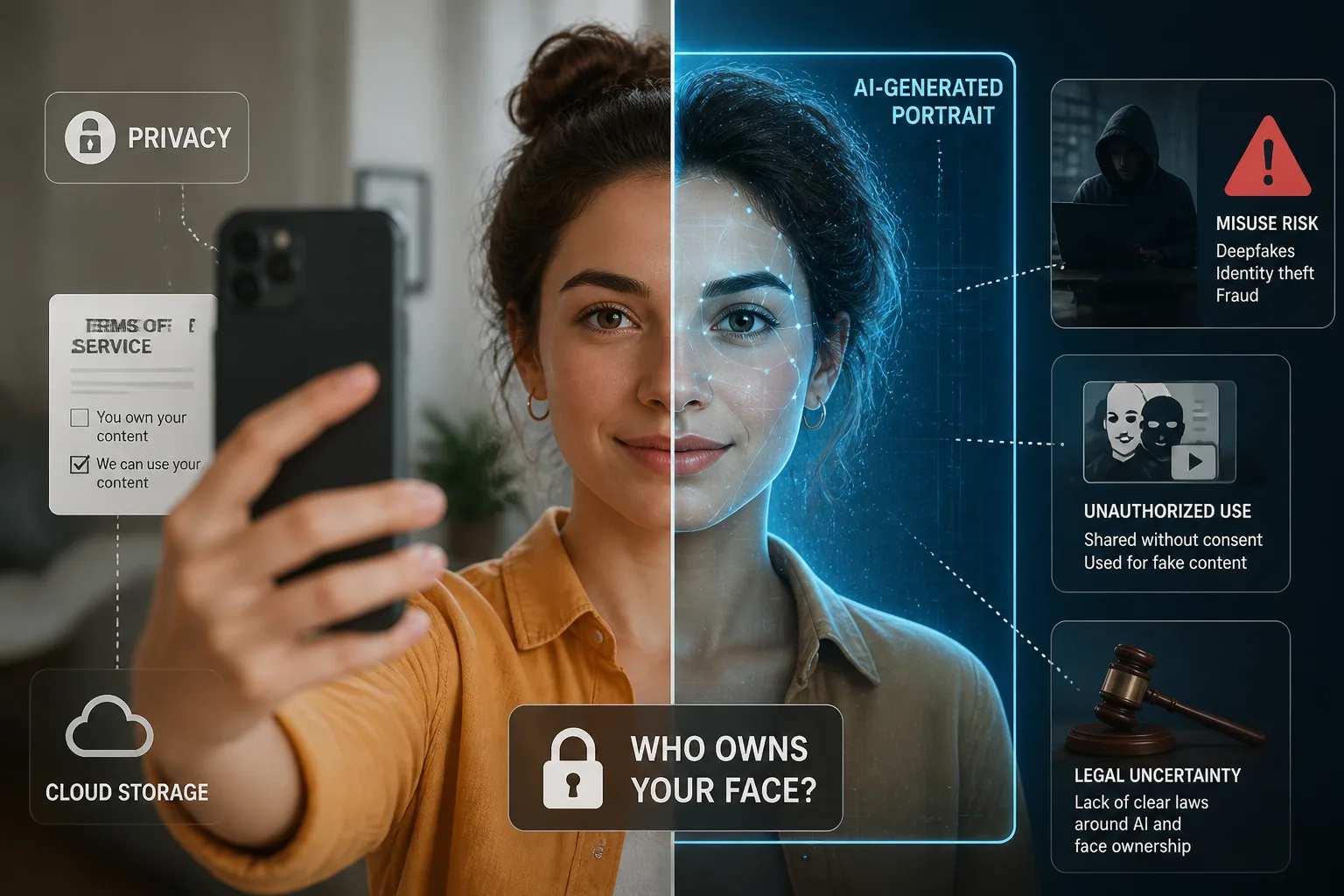
AI Selfies in 2026: Who Owns Your Face, Your Data, and the Images Apps Create?
AI selfie apps have become fun, fast, and surprisingly powerful. In a few taps, you can turn a casual selfie into a polished headshot, a fantasy character, or a short animated portrait. But in 2026, the real question is no longer just what the app can create. It is what happens to your face, your data, and the rights around both after you upload the photo.
That question matters because the legal and ethical landscape has changed quickly. Courts and regulators are drawing sharper lines around copyright, biometric data, synthetic likenesses, and platform responsibility. At the same time, app terms of service are still often written in a way that hides how long your images are kept, whether they are used for training, and who else may receive them.
If you use AI portrait tools for profile photos, content creation, or just for fun, it is worth understanding the difference between owning your original selfie, licensing it to an app, and controlling what happens to an AI-generated image that looks like you.
Why AI Selfies Raise Bigger Privacy Questions in 2026
A normal photo upload used to raise simple storage questions. AI selfie apps raise much deeper ones. Your selfie is not just an image file. It can also be source material for facial analysis, model training, template generation, identity mapping, and synthetic output creation. In other words, one upload can become many things inside the system.
That is why privacy in this category is not only about whether an app says it is secure. It is also about whether the app can infer biometric features from your face, whether it keeps faceprints or embeddings, whether it shares data with third parties, and whether it can reuse your content later in ways you did not expect.
This concern is especially urgent in 2026 because enforcement has started to catch up with the technology. Laws around deepfakes, synthetic content, and facial recognition are no longer theoretical. They are being tested in court, in agency actions, and through state and international regulations.
What Happens to Your Photo After You Upload It
When you upload a selfie to an AI generator, several different processes may begin at once. The app may store the original file on its servers. It may create technical representations such as embeddings or face maps. It may send the image to a third-party provider for processing. It may also use the photo, or features derived from it, to improve its models unless the company explicitly says it does not.
This is where the terms of service matter. A user often assumes the app only needs permission to process the image once. But many policies include broad language that allows retention, analysis, sublicensing, product improvement, moderation, and service operation. Those words can cover far more than basic image generation.
The practical question is simple: does the app need your selfie only to generate a portrait, or does it keep the data to power future products and model improvements? If the policy is vague on retention, vague on training, or vague on sharing, that is a red flag.
Original Photo vs AI Output: What Do You Actually Own?
Ownership is not one thing here. Your original selfie is usually your content, but uploading it does not automatically mean you still control every copy, derivative, or technical version created from it. Meanwhile, the AI-generated output may be treated very differently under copyright law depending on how much human authorship is involved.
That distinction became even clearer in March 2026, when the U.S. Supreme Court declined to hear a case that effectively confirmed a simple rule: purely AI-generated images without human authorship are not eligible for copyright protection. In plain English, if the machine made the image on its own, there may be no copyright to claim in the output itself. Source: https://www.pcgamer.com/software/ai/ai-generated-images-still-cant-be-copyrighted-as-us-supreme-court-declines-to-hear-case/
That does not mean the image is free of all legal protection or restriction. It means copyright is not always the right tool. Your face may be protected by privacy, biometric, publicity, or synthetic likeness laws instead. So the key issue is not just who owns the image file. It is who has the right to use a person’s identifiable likeness and under what conditions.
Data Ownership, Licensing, and Model Rights Explained in Plain English
Many apps say you “retain ownership” of your content, while also granting the company a license to use that content. Those two phrases can coexist, but they do not mean the same thing. Ownership says the content is yours. Licensing says you are giving the platform permission to do certain things with it.
A broad license can still be very powerful. It may let the app host, reproduce, modify, distribute, create derivative works, or use the content to operate and improve services. If the language includes model training, it may even allow your image to help improve future AI systems, sometimes in ways that are hard to reverse once the data has already been used.
Model rights are another layer. A company may argue that the model it trained is its own proprietary asset, even if the training data included user uploads. That creates a tension between user expectations and platform claims. Users may believe they are renting a creative tool, while the company sees itself as building a long-term data asset.
The cleanest rule of thumb is this: if the app gets broad rights, it may legally use your photo far beyond the moment of generation. If you do not want that, look for narrow processing licenses, clear deletion rights, and an explicit opt-out from training.
How 2025-2026 Regulations Are Changing Image Rights and Consent
The legal environment in 2026 is much less permissive toward silent reuse of faces and synthetic content. In the U.S., the TAKE IT DOWN Act was signed on May 19, 2025, and its platform notice-and-removal obligations for non-consensual intimate imagery and deepfakes became effective on May 19, 2026. That matters because platforms now have stronger duties to remove harmful synthetic content quickly once it is reported. Source: https://ailawguide.org/blog/deepfake-laws-and-ai-content-regulation-2129943001862662016
New York also moved in the same direction. Its synthetic performer law, SB 8420-A, took effect on June 9, 2026 and creates civil remedies when a person’s likeness is used in synthetic or AI-generated content without consent. That is a strong signal that a face is not just another piece of data. It can be a protected personal and commercial interest. Source: https://ailawguide.org/blog/deepfake-laws-and-ai-content-regulation-2129943001862662016
Internationally, the rules are tightening as well. China’s mandatory AI labeling rules took effect on September 1, 2025 and require synthetic or manipulated content, including images, to be clearly labeled. The upcoming EU AI Act goes further through Article 50(4), which requires disclosure when content is AI-generated or altered, with full effect from August 2, 2026. Source: https://ailawguide.org/blog/deepfake-laws-and-ai-content-regulation-2129943001862662016
European draft proposals from February 2026 also point in the same direction by adding presumptions of harm in unlawful deepfake interference cases and clarifying that consent in one context does not automatically carry over to every other context. In practice, that means permission to use a photo on a social account does not necessarily mean permission to create synthetic versions of that image. Source: https://rm.coe.int/cdpc-aicl-2026-02-discussion-paper-deepfakes-2775-1074-9970-v-1/48802ab5ea
Biometric Data, Facial Likeness, and the New Legal Risk Zone
Once a selfie is processed by AI, it may stop being just a picture and become biometric data. That is because facial analysis can extract unique identifiers, map geometry, and create reference points tied to a person’s identity. Biometric data is sensitive because it can be used for recognition, tracking, profiling, and impersonation.
This is why state biometric laws matter so much. Illinois’s Biometric Information Privacy Act remains one of the strictest laws in the U.S., and by early 2026 more than 13 states had biometric privacy laws with different rules on consent, retention, and penalties. That patchwork makes compliance complicated for companies and makes user rights vary depending on where you live. Source: https://www.facefinder.id/en/blog/is-face-search-legal
Recent enforcement and litigation show how serious this can get. In June 2026, a class action alleged that Amazon’s Ring feature, known as Familiar Faces, collected and retained biometric facial recognition data from visitors and passersby without consent, including face-prints and profile creation for people who had not opted in. That case highlights a major modern problem: your face can be processed even if you never signed up for the service. Source: https://arstechnica.com/tech-policy/2026/06/amazon-owned-ring-should-pay-americans-for-scanning-their-faces-lawsuit-says/
Australia has also shown that facial recognition can sometimes be lawful in limited contexts. In February 2026, the Administrative Review Tribunal ruled that Bunnings Group’s use of facial recognition inside stores was legal under certain exemptions in the Privacy Act 1988 because of repeated theft, threats, and violence incidents. That does not make facial recognition risk free. It shows how consent, necessity, and context can change the result. Source: https://www.gadens.com/legal-insights/facial-recognition-technology-on-trial/
How to Read an AI App’s Terms of Service Without Missing the Red Flags
You do not need to be a lawyer to spot problem language. Start with the parts that say what the company can do with your uploads. The most important clauses usually cover ownership, licensing, retention, deletion, training, derivatives, and dispute resolution.
Watch for phrases like “worldwide,” “perpetual,” “irrevocable,” “transferable,” and “sublicensable.” Those terms often signal a very broad license. If the app says it can use your content to “improve services” but does not clearly exclude model training, your selfie may be part of future development.
Also look for silent defaults. Some apps make training opt-out only through a separate settings page, or only after you create an account. Others bury important terms in linked policies that can change later. If the company can update the terms without meaningful notice, your rights can shrink over time.
A good policy is usually more specific, not more poetic. It should tell you whether photos are stored, for how long, whether they are used for training, whether they are shared with vendors, and how to delete them completely.
What Privacy Policies Reveal About Storage, Training, and Third-Party Sharing
Privacy policies often reveal more than the terms of service because they describe data flows in a more technical way. This is where you can learn whether the company stores raw images, derived face data, usage logs, device identifiers, or AI model outputs.
Training disclosures are especially important. In March 2026, the FTC filed a complaint against OkCupid’s parent company, Match Group, alleging that roughly three million user photos were shared with a third-party facial recognition company for AI training without telling users or offering opt-out, despite the company’s own privacy policy. That case is a reminder that vague privacy promises are not enough. Source: https://wrightlawaz.com/newsroom/articles/2026/ftc-ai-training-data-disclosure-2026/
Third-party sharing also matters because once data leaves the original app, control becomes weaker. Vendors may process the content for hosting, analytics, moderation, or model improvement. If the policy does not clearly list categories of recipients, your selfie may circulate farther than you expect.
The safest approach is to favor apps that plainly say what is collected, why it is collected, how long it is kept, and whether it is used for model training. If you cannot find those answers, assume the app is giving itself more room than you would like.
Case Studies: Deepfakes, Impersonation, and Style-Copying Conflicts
The misuse scenarios are no longer hypothetical. A person’s likeness can be turned into a fake endorsement, a manipulated video, or an intimate image that never existed. With deepfakes, the harm is often not only reputational. It can also be emotional, professional, and financial.
That is why disclosure laws matter. When content is altered or synthetic, people need to know what they are seeing. China’s labeling rules and the EU’s upcoming disclosure obligations are designed to make that distinction more visible. Without labeling, the line between authentic and generated content gets too blurry for safe public use.
Style-copying creates a different kind of conflict. A model may produce portraits that resemble a brand, a photographer’s signature look, or even a platform’s trademarked visual style. The UK High Court’s 2025 Getty Images v Stability AI decision showed that AI outputs can raise trademark issues when a model produces Getty-style watermarks in certain cases. Source: https://www.lawcases.net/cases/getty-images-v-stability-ai-ltd-2025-ewhc-2863-ch/
This is important for users because it shows that AI output is not just a neutral image. It can create legal risk if it copies recognizable marks, commercial branding, or a real person’s likeness without permission.
How Ethical AI Apps Are Handling Consent, Deletion, and Security
Not every app is built the same way. The better ones are trying to reduce risk with clearer consent flows, shorter retention windows, stronger deletion tools, and more transparent storage policies. Some also avoid using user uploads for training unless the user explicitly opts in.
Ethical apps should make consent specific, not assumed. They should tell users when a selfie is processed, when it is stored, and when it is deleted. They should also distinguish between content needed to generate the image and content retained for analytics or service improvement.
Security matters just as much. If an app can generate highly realistic portraits, it should also be able to protect the source photos and output files with strong access controls. The more personal the content, the more important encryption, minimal retention, and limited vendor access become.
This is one reason a tool like Selfie AI: AI Photo Generator can be attractive for users who want a more controlled experience. The product emphasizes secure processing, full control over content, and personalized model creation, which is exactly the kind of promise people should look for before uploading selfies. You can learn more here: https://findthe.app/selfie-ai-0xi7wd
Best Practices to Protect Your Selfies, Identity, and Digital Likeness
Start by treating every selfie upload like a data-sharing decision, not a casual filter use. Upload only what you are comfortable losing control of, because once a photo is processed, copied, or logged, the original context can be hard to recover.
Use the app’s privacy settings before you upload, not after. If there is an opt-out for training, disable it immediately. If there is a delete button, test it. If there is an account deletion option, confirm whether it also deletes stored images, outputs, and biometric templates.
Be careful with highly sensitive photos, especially images of children, medical situations, workplace badges, legal documents, or intimate content. Those images can create special privacy, consent, and safety issues if they are retained or used to generate synthetic versions.
It also helps to choose tools that are clear about watermarking, sharing, and commercial rights. If you plan to use AI portraits professionally, read the terms like a license agreement, because in many ways that is exactly what it is.
What to Do If Your Face or AI Portrait Is Misused
If your likeness appears in a deepfake, impersonation, or non-consensual synthetic image, act quickly. Save screenshots, record URLs, and preserve timestamps. Then report the content to the platform using its abuse or impersonation tools.
For intimate deepfakes or other harmful synthetic content, the TAKE IT DOWN Act has made notice-and-removal processes more important than ever. Once reported, platforms may have legal obligations to remove covered content faster than they used to. If the misuse involves a commercial or repeated publication of your face, you may also have state or civil claims depending on your jurisdiction.
If the issue is biometric misuse or unauthorized facial recognition, document where and how the image was used and whether you ever consented. In some cases, a biometric privacy law, synthetic likeness law, or consumer protection claim may apply. The exact remedy depends on the facts, but the first step is always evidence preservation.
The bigger lesson is simple. In 2026, your face is not just a photo. It is identity data, biometric material, and often a commercial asset in the eyes of platforms and regulators. The more you understand how AI apps treat that data, the better you can decide when to upload, when to opt out, and when to walk away.