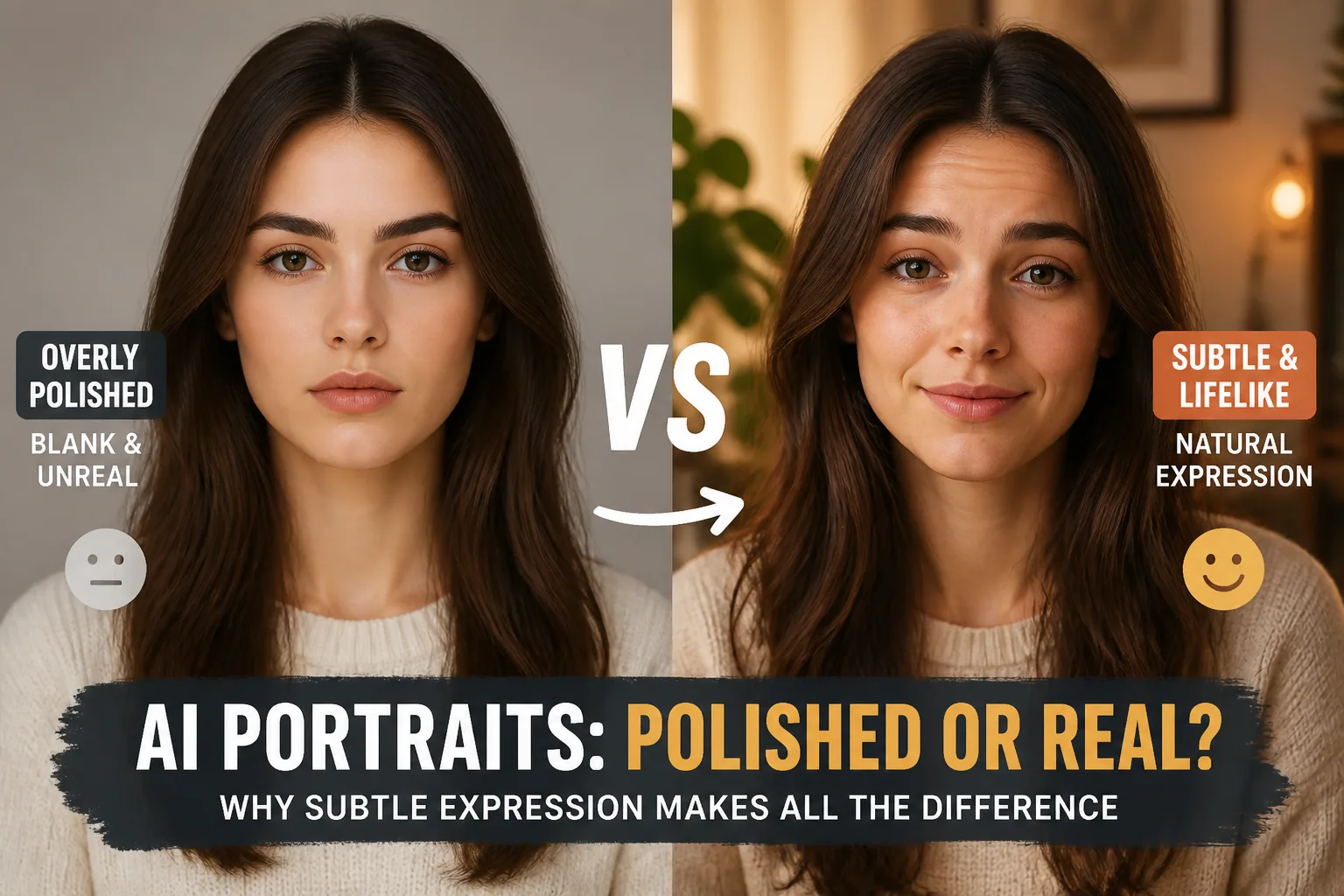
AI Selfies & Facial Expressions: Why Micro-Emotions Make Portraits Feel Real (and How to Capture Them)
The difference between an AI portrait that feels alive and one that looks polished but oddly empty often comes down to tiny facial cues. A slight tension in the brows, a softened gaze, a barely visible smile, or a subtle parting of the lips can completely change how a face is read. These micro-emotions influence whether a portrait feels warm, confident, trustworthy, charismatic, or just technically impressive. If you create selfies, profile photos, brand visuals, or animated avatars, learning how to capture these small signals can make your results look far more human.
This matters because people do not read faces in a vacuum. We instantly judge eyes, brows, mouth shape, cheek movement, symmetry, and timing. Research shows that high-spatial frequency detail around the eyes and mouth can increase perceived trustworthiness, while eyebrow region detail in other frequency ranges can increase perceived dominance (https://pmc.ncbi.nlm.nih.gov/articles/PMC3944200/). In other words, the smallest features often carry the biggest emotional weight.
Why Micro-Emotions Matter in AI Portraits
A portrait is not just a likeness. It is a social signal. Before someone reads your bio, your caption, or your brand story, they read your face. That first impression is shaped by the tiny cues that tell the brain whether a person feels approachable, competent, sincere, or intense.
This is why many AI images feel slightly off even when the lighting, styling, and skin detail are excellent. The face may be too neutral, too symmetrical, or too evenly posed. Humans are used to constant low-level movement in real expressions, so a perfectly frozen face can feel lifeless. Even when an image is technically beautiful, missing micro-emotion can make it feel like a mannequin rather than a person.
The uncanny effect becomes stronger when realism mismatches appear, meaning the face contains cues that do not fully match ordinary human patterns. A qualitative synthesis of uncanny valley research notes that these mismatches often reduce familiarity and warmth while increasing eeriness (https://www.sciencedirect.com/science/article/pii/S2451958823000210). For AI portraits, that usually means the face is close to right, but not emotionally coherent.
What Counts as a Micro-Expression in a Selfie or Portrait
Micro-expressions are not the same as dramatic expressions. They are the subtle, often brief shifts that suggest feeling without shouting it. In a selfie or portrait, that may include slightly raised or relaxed brows, a soft squint, a tiny asymmetry in the smile, tension at the mouth corners, visible teeth or no teeth, a gentle cheek lift, or a relaxed jaw.
Think of them as emotional texture. A face with no texture looks staged. A face with just enough tension and softness looks lived in. That is why a half-smile can feel more authentic than a full grin, and why parted lips can make a pose feel more spontaneous, even when the image is AI-generated.
These details are powerful because the brain is extremely sensitive to facial nuance. The mouth area in particular is highly diagnostic for trustworthiness judgments, while eyebrow position and surrounding upper-face cues contribute more strongly to dominance impressions (https://pmc.ncbi.nlm.nih.gov/articles/PMC6186410/). So when you adjust one small region, you may be changing the whole personality of the portrait.
How Eyes, Brows, and Lips Change Emotional Perception
The eyes are often called the window to the soul, but in portrait perception they are also the fastest route to emotional interpretation. Softer eyes can imply calmness or warmth. A direct stare can suggest confidence. Slight narrowing can convey focus. Raised outer eye corners or exaggerated brow lift can, however, push a face toward tension, threat, or unease rather than friendliness.
Research on eyebrow and lateral canthal height found that raised eyebrows and elevated outer eye corners were rated lower in trustworthiness, femininity, and attractiveness, while scoring higher in dominance, threat, and disgust, especially among female respondents (https://pure.eur.nl/en/publications/understanding-the-impact-of-eyebrow-and-lateral-canthal-height-on/). That means even subtle eye-area changes can redirect the emotional read of a face very quickly.
The mouth has its own emotional vocabulary. A slightly upturned mouth corner reads differently from a broad grin. A small, natural mouth opening can feel more candid than a tight-lipped pose. In older adult users of virtual humanoid agents, smaller mouths combined with greater mouth height increased credibility and trustworthiness perceptions, showing how mouth geometry shapes emotional trust (https://doi.org/10.1145/3758871.3758899).
Together, eyes, brows, and lips create a full-face message. If the eyes say relaxed but the mouth says tense, the portrait may feel ambiguous. If the brows are highly lifted while the mouth is neutral, the image can read as surprised or even unnatural. The strongest AI portraits are the ones where these cues agree with each other.
Which Expressions Signal Trust, Warmth, or Charisma
Trust usually comes from openness and softness. Warmth often comes from small, approachable signals. Charisma tends to come from a balance of confidence and ease. The trick is not to force a big smile, but to align the micro-expression with the emotional goal of the image.
For trust, focus on relaxed brows, gentle eye openness, and a mouth that is softly neutral or faintly smiling. A face that looks too intense can feel guarded, while one that looks too flat can feel detached. Small mouth curvature matters a lot, because viewers use the mouth area heavily when judging trustworthiness.
For warmth, lean into softened eyes, a hint of cheek lift, and visible but restrained friendliness. Warmth often benefits from a little asymmetry, because real human smiles are rarely perfectly mirrored. That tiny irregularity can make a portrait feel more authentic and less generated.
For charisma, a portrait can combine eye contact with slight expression energy. That might mean a subtle brow lift, a calm but engaged gaze, and a mouth that suggests intention rather than passivity. Too much intensity, though, can shift charisma into tension. The goal is controlled expression, not overperformance.
Using Real Selfies to Capture Better Subtle Expressions
If you want AI portraits to feel human, your source selfies matter a lot. The model learns from the expressions you provide, so the input should contain the kind of nuance you want to see in the output. If every selfie is flat, filtered, or overly posed, the generated face may inherit that same emotional blankness.
Try taking source selfies in natural light with small variations in expression. Do not only use the biggest smile you can make. Include a relaxed face, a slight smile, a soft glance away from camera, and a direct look with calm eyes. These give the model more emotional range to work with.
It also helps to capture moments between poses. Some of the most believable expressions happen in transition, when the face is not fully “on.” A tiny lift in the brows or a half-second mouth relaxation can produce a more realistic base for generation than a staged grin.
If you are using a product like Selfie AI: AI Photo Generator, this is especially useful because you can upload a few selfies to create a personalized AI model and then explore different styles and scenarios while preserving your core likeness. You can learn more here: https://findthe.app/selfie-ai-0xi7wd
Prompt Engineering for Micro-Emotions in AI Images
Prompting can help nudge an image toward a more believable emotional read, but it works best when the prompt is specific and restrained. Instead of asking for a generic “happy face,” describe the exact quality of expression you want. For example, you might ask for “a subtle closed-mouth smile, relaxed brows, soft eyes, natural asymmetry, and a calm confident look.”
The best prompts often include both emotional intent and physical cues. Emotional intent tells the model the mood. Physical cues tell it how that mood should appear. If you only describe personality, the result may be vague. If you only describe facial parts, the result may look mechanical.
Useful prompt language includes phrases like: slight smile, gentle eye contact, softened gaze, parted lips, relaxed forehead, natural cheek lift, subtle brow tension, candid expression, and realistic asymmetry. If you want a professional portrait, add “approachable but confident.” If you want social content energy, add “warm and lively without exaggerated emotion.”
Avoid stacking too many emotional descriptors. A prompt that says cheerful, seductive, fearless, friendly, dreamy, and powerful at once will confuse the expression. Pick one primary emotion and one supporting trait. Clarity almost always generates better facial coherence.
How to Create Natural Expressions in Animated AI Portraits and Videos
Animated AI portraits make expression timing even more important. A static face can hide minor issues, but motion exposes them immediately. If the lips move without the eyes responding, or the brows lag behind the mouth, viewers notice the mismatch and the image becomes uncanny.
Research on virtual characters shows that even skilled animation becomes more uncanny when upper facial expressions lag or are missing during speech or emotional communication, especially for emotions like fear, sadness, disgust, and surprise (https://vbn.aau.dk/en/publications/facial-expression-of-emotion-and-perception-of-the-uncanny-valley/). Another study found that asynchrony between mouth movement and eye or eyebrow motion increases uncanniness in dynamic faces (https://pmc.ncbi.nlm.nih.gov/articles/PMC10714471/).
That means animation should not only move the mouth. It should also include small coordinating motions in the cheeks, brows, and eyes. Real speaking faces are full of tiny delays and micro-adjustments. When those are absent, the portrait can feel robotic.
For the best results, keep motion subtle. Gentle blinking, slight head movement, soft smile shifts, and small eyebrow changes usually work better than dramatic facial acting. The goal is to simulate life, not stage a performance.
Avoiding Common Pitfalls: Blank Faces, Overacting, and Uncanny Results
One of the biggest mistakes in AI portraits is the blank resting face. While a neutral expression seems safe, it often reads as emotionally unavailable. There is a difference between calm and empty. Calm still contains softness, contact, and subtle tension. Empty looks disengaged.
The opposite problem is overacting. Too much smile, too much brow lift, too much eye widening, or too much symmetry can make the face look artificial. Research suggests that faces generated by diffusion-based AI models can sometimes be judged as more trustworthy than GAN-generated faces or even some real faces, but that does not mean they are always more believable in every context (https://pubmed.ncbi.nlm.nih.gov/42411878/). Trust and realism are related, but not identical.
Another issue is symmetry overcorrection. Real faces are naturally a little uneven. Overly perfect balance can feel sterile or uncanny. Small differences in eye openness, cheek lift, or mouth angle often make portraits more convincing, not less.
Finally, avoid expressions that do not match the context. A formal profile photo should not have the same energy as a tropical vacation selfie. The emotional read must fit the setting, or the image will feel off even if the face itself is well rendered.
Cultural Differences in Reading Facial Expressions
Not every viewer reads facial cues the same way. Cultural background influences how people interpret eye contact, smile intensity, openness, and facial restraint. A look that feels confident in one context may feel overly direct in another. A subtle smile that signals friendliness to one audience may be read as politeness or hesitation somewhere else.
This is important for creators and brands because AI portraits often travel across platforms and audiences. If your content is meant for global viewers, it is usually safer to aim for balanced, moderate expressions rather than highly coded facial signals. Moderate warmth and restrained confidence tend to translate more easily across cultures.
In practical terms, that means avoiding extremes. Do not rely too heavily on very wide smiles, intense eye contact, or dominant brow positions unless they clearly fit your message. When in doubt, choose expressions that are calm, open, and slightly approachable.
How to Keep Expression Realistic and Consistent Across Edits
Consistency matters when you are refining an AI portrait series. If one image shows a soft smile and the next suddenly shows a hard stare, the visual identity may feel unstable. Keeping expressions realistic across edits helps your audience recognize the same person, mood, and brand voice.
A good workflow is to define your baseline expression first. Decide whether the face should read as friendly, confident, thoughtful, playful, or aspirational. Then keep the same emotional foundation while changing outfit, scene, or angle. This preserves identity while allowing variation.
When editing, make only one or two expression changes at a time. Adjust the brows slightly, then review the effect. Soften the eyes, then check whether the face still looks natural. Small edits are easier to control than major emotional rewrites.
It also helps to compare images side by side. Look for consistency in mouth corners, eye openness, cheek lift, and jaw relaxation. If the emotion changes too much from one version to another, reduce the intensity and re-center the face around a more neutral but still alive expression.
Best Use Cases for Social Media Creators, Brands, and Personal Profiles
For social media creators, micro-emotion makes profile photos feel more human and more clickable. A subtle smile with engaged eyes can invite attention without looking try-hard. This is especially useful on platforms where first impressions happen fast.
For brands, expressive realism can build trust. A founder portrait, team headshot, or brand ambassador image with controlled warmth can make a business feel more approachable. The goal is to look competent without feeling distant.
For personal profiles, the right expression can help define how others perceive you before they ever speak to you. A calm, confident selfie can support professional networking. A softer, friendlier portrait can help on dating apps or social channels. A more energetic expression can fit creators who want charisma and visibility.
For animated avatars, subtle expression quality is even more important. Because motion amplifies facial flaws, the avatar must have believable eyes, brows, and mouth behavior from the start. When done well, the result can feel surprisingly natural and engaging.
A Simple Workflow for More Human-Looking AI Portraits
If you want a practical process, keep it simple. First, capture source selfies with a range of subtle expressions. Second, choose the emotional direction you want the final portrait to express. Third, use prompt language that describes both mood and facial behavior. Fourth, generate several versions and compare them for softness, balance, and realism.
Next, check the eyes, brows, and mouth separately. Ask yourself: do the eyes look alive, do the brows support the intended emotion, and does the mouth feel natural rather than forced? If one area is off, adjust that region instead of changing everything at once. Small refinements usually produce the most believable results.
Finally, remember that the most realistic AI portraits are not the most intense ones. They are the ones that feel emotionally coherent. A tiny half-smile, a relaxed brow, or a subtle gaze shift can say more than a dramatic expression ever will. When the micro-emotions are right, the whole portrait becomes more trustworthy, warmer, and more human.