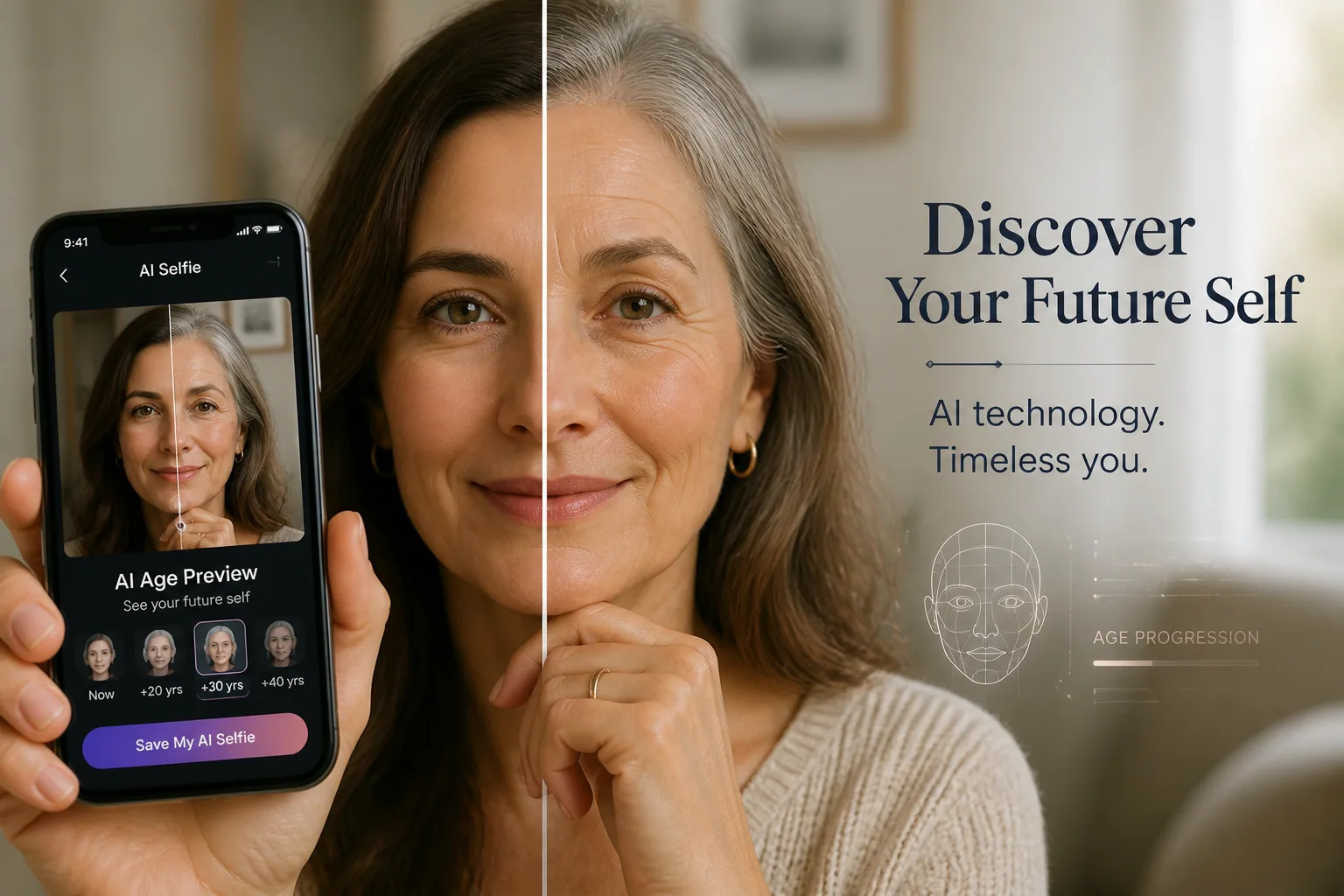
AI Selfies & Aging: How Generative Portraits Help You Visualize and Prepare for the Future
AI aging portraits are having a real moment because they sit at the intersection of curiosity, identity, and self-care. A single image can make the future feel strangely close. One minute you are looking at a playful filter, and the next you are confronted with a version of yourself that seems older, softer, more lined, and sometimes more emotionally resonant than expected. That mix of novelty and reflection is a big part of why people keep experimenting with aging selfies and generative portraits.
There is also something deeply human about wanting to see what time might do. Aging is usually experienced gradually, in mirrors, photos, and small changes that are easy to ignore. AI compresses that process into a visual snapshot. It can make future-facing questions feel more immediate: How do I want to age? What habits matter now? What kind of legacy am I building? When used thoughtfully, these tools can move beyond entertainment and become a prompt for mindfulness, wellness, and better long-term thinking.
Why AI Aging Portraits Fascinate Us Right Now
Part of the appeal is psychological. Humans are naturally drawn to comparing the present self with the future self, but that future self is usually abstract. AI portraits make that abstraction concrete. They turn aging into something visible, personal, and emotionally charged. That can feel exciting, amusing, unsettling, or all three at once.
The timing matters too. We live in an era where image generation is everywhere, and people are becoming more comfortable using AI for self-expression. Aging portraits are especially compelling because they are not just about beauty or novelty. They tap into questions about time, mortality, family resemblance, and the stories we tell ourselves about who we are becoming. For many adults, that makes them more meaningful than a standard face filter.
There is also a social element. Sharing an older version of yourself can spark conversations with friends or family about aging, health, and memory. It can even create a bridge between generations. Seeing a future self image beside a parent or grandparent photo often creates a surprising sense of continuity. The technology may be new, but the desire behind it is old: to understand where we come from and where we might be headed.
How AI Aging Selfies Actually Work
Most aging selfie tools use a combination of facial analysis and generative modeling. The system first identifies key facial landmarks, such as the eyes, nose, mouth, jawline, and contours of the cheeks. Then it applies learned patterns about how faces tend to change over time. Depending on the tool, it may generate a subtle age progression or a more dramatic, stylized transformation.
In physical terms, aging affects the face in predictable ways. According to the National Institute on Aging, skin loses collagen and elastin as it ages, making it thinner, less elastic, and more fragile. Those changes contribute to wrinkles, dryness, and age spots: https://www.nia.nih.gov/health/skin-care/skin-care-and-aging. Cleveland Clinic also notes that after age 50, bone loss becomes more pronounced and can lead to slack skin and sagging around features like the mouth, while fat loss under the skin can make cheeks and temples look more sunken: https://health.clevelandclinic.org/what-you-need-to-know-about-aging-skin.
AI tools try to simulate those visible changes by altering texture, facial fullness, skin tone, hair density, and sometimes posture or expression. Some models are trained to create realistic aging effects, while others are more artistic. That means the output is not a scientific forecast. It is a visual interpretation informed by patterns, probability, and style choices.
This is an important distinction. An aging portrait does not know your genetics, your health history, your lifestyle, or the specific ways your face will change. It is a model of resemblance, not destiny. Still, even imperfect simulations can be powerful because they make abstract biological processes easier to imagine.
Realistic Prediction vs Artistic Interpretation
Not all AI aging portraits are trying to do the same thing. Some tools are built for realism, aiming to approximate likely age-related facial changes. Others are more like digital art filters, with exaggerated wrinkles, dramatic lighting, or aesthetic choices that make the image feel cinematic rather than predictive.
That difference matters because people often read realism into images automatically. A portrait that looks highly polished can seem more accurate than it is. In reality, the image may reflect the training data and style preferences of the model more than it reflects your true future appearance. This is especially relevant when the tool creates an older face that still follows conventional beauty norms, or when it smooths away features that do not match its learned patterns.
Research suggests AI systems estimating facial age are not perfectly reliable, especially for older faces. A study found higher error rates for older faces compared with younger ones, and also noted that smiling faces are often rated older than neutral faces, with AI showing more bias than humans in these effects: https://pubmed.ncbi.nlm.nih.gov/PMC9800363/. In other words, even systems that seem confident can still distort age in subtle ways.
So the best way to use these portraits is not as a literal prediction, but as a prompt. They can inspire reflection without pretending to offer certainty. That makes them more useful, and also more honest.
What an Older Version of You Can Reveal Emotionally
One of the most interesting effects of seeing an aging portrait is emotional. People do not just notice wrinkles or gray hair. They often respond to the expression, the gaze, and the feeling that the image carries. An older version of yourself can look familiar, but also strangely distant, which creates a powerful emotional tension.
That tension can lead to insight. Some people feel compassion toward the future self they are seeing, almost as if they are looking at an older family member or a version of themselves who has lived through a lot. Others feel surprise, grief, humor, or even discomfort. These reactions are meaningful because they reveal how we relate to time, appearance, and change.
There is also a phenomenon that researchers have begun to explore in augmented reality aging experiences. One study reported increased feelings of “temporal presence,” meaning users felt as though they were more present in their future selves. That reduced the psychological distance to aging, but it also produced stronger emotions such as fear or sadness and could negatively affect body image: https://www.tandfonline.com/doi/abs/10.1080/0144929X.2026.2660871 This suggests that age-progressed images can be emotionally intense, not just entertaining.
That intensity can be valuable when used with care. Sometimes a future-self portrait is less about appearance and more about recognition. It can remind you that your future self is not a stranger. It is still you, and choices made now will shape that person’s quality of life.
Using Future-Self Portraits for Health and Self-Care Motivation
Aging portraits can be surprisingly useful as a motivational tool. When people can visualize their future face, healthy habits may feel more concrete. Exercise, sleep, hydration, skin care, stress management, and sun protection stop being abstract recommendations and start feeling like investments in a real person: the future you.
This is not about fear-based messaging. It is about connection. If a portrait helps someone think, “I want to take better care of the person I will become,” then it has done something meaningful. That perspective can support behavior change more effectively than vague advice because it gives the future self emotional weight.
There are practical wellness angles too. Seeing signs of aging represented visually can motivate people to pay attention to skin health, including moisture, gentleness, and protection from sun damage. It can also encourage broader self-care, because the face often becomes a symbol for overall well-being. Even small habits may feel more relevant when linked to a visible long-term picture.
At the same time, it is worth keeping the emotional response balanced. If a future-self image triggers anxiety, shame, or unhealthy body concerns, it may not be the right tool at that moment. The goal is to build a healthier relationship with time, not to punish yourself with a scary forecast.
Ethical Questions: Consent, Bias, and Emotional Impact
AI-generated portraits may seem harmless, but they raise real ethical questions. One major issue is consent. If a system is trained on images without proper permission, or if it generates likenesses that resemble identifiable people, it can create problems around ownership and privacy. That concern becomes even more sensitive when users generate aging images of loved ones, children, or public figures.
Bias is another serious issue. AI models can reproduce stereotypes, underrepresent certain skin tones or facial features, or produce less accurate results for people outside the dominant patterns in the training data. That means some users may get flattering, realistic aging portraits while others get distorted or generic ones. Ethical research has highlighted concerns about consent, bias, authenticity, and misinformation in AI-generated imagery: https://arxiv.org/abs/2509.03071 and https://js.ugd.edu.mk/index.php/BSSR/article/download/7886/6053/14907
The emotional impact also deserves attention. A future-self image can be inspiring, but it can also be disturbing, especially for people who are anxious about aging, appearance, illness, or loss of control. Because these images can feel personal and emotionally intimate, they should be shared thoughtfully. What feels funny in a private app may not feel kind or appropriate in a group chat or social feed.
A good rule is simple: if the image could embarrass, mislead, or emotionally harm someone, do not share it without clear consent and context. Responsible use is part of what makes these tools worthwhile.
Creative Uses for AI Aging Portraits in Gifts and Memory Projects
Aging portraits are not only for personal reflection. They can also become creative materials for gifts, family storytelling, and memory projects. A playful future-self portrait can be part of a milestone birthday gift. Paired with a handwritten note, it can become a funny and surprisingly touching reminder that aging is also a shared family journey.
They can also be useful in legacy projects. Some families like creating visual archives that show different stages of life, including imagined future stages. That can open up conversations about values, longevity, and what people want to be remembered for. It is a simple but powerful way to connect art, memory, and identity.
For people working on journals, scrapbooks, or digital family histories, an aging portrait can serve as a creative anchor. It may not document the future literally, but it can represent a mindset: one of continuity, growth, and acceptance. In that sense, the image becomes less about predicting a face and more about preserving a conversation.
If you want a flexible way to explore these kinds of visual ideas, Selfie AI: AI Photo Generator can help create personalized AI portraits and animated videos in different styles, which makes it easy to experiment with future-self concepts alongside other creative transformations: https://findthe.app/selfie-ai-0xi7wd.
Tips for Creating Aging Portraits Responsibly and Thoughtfully
If you want better results and a better experience, start with clear intentions. Ask yourself whether you want realism, artistic interpretation, humor, or reflection. That intention helps you choose the right tool and set realistic expectations for the output.
Use high-quality selfies if the app requires them, but avoid uploading images you would not be comfortable storing or sharing. Read the app’s privacy terms, especially if it creates a personal model from your photos. Control over your images matters, particularly when you are dealing with a face that is uniquely yours.
It also helps to approach the result as one possible version of you, not a verdict. AI aging portraits are best used as conversation starters. You might compare several outputs, notice which ones feel most believable, and reflect on what those differences say about expression, self-image, and expectation.
Be thoughtful before posting publicly. Consider whether the image could invite misunderstanding, whether everyone pictured has given consent, and whether you are comfortable with the platform using your likeness for future processing. Responsible sharing keeps the experience fun without undermining trust.
Finally, pay attention to how the image makes you feel. If it inspires gratitude, curiosity, or motivation, that is a useful signal. If it creates distress, step back. The point is to learn something about your relationship with time, not to force a reaction.
What AI Can and Cannot Tell You About Your Future Face
AI can tell you something general about how faces tend to age. It can simulate reduced skin elasticity, deeper lines, changes in volume, and gray hair. It can even produce images that feel emotionally convincing. But it cannot tell you your actual future face with certainty.
Real aging depends on a wide range of factors, including genetics, sun exposure, stress, sleep, nutrition, health conditions, and lifestyle. Two people of the same age can age very differently. AI models do not know your personal biology, and they may also overfit to patterns in the data they were trained on. That is why the output should be seen as an approximation, not a forecast.
There is also a perception problem. Studies on AI-generated portrait detection suggest that people can often distinguish real portraits from AI-generated ones, with mean accuracy around 85.2%, but performance declines with the viewer’s age and with mobile-device viewing: https://doi.org/10.48550/arXiv.2603.24048. That reinforces the idea that these images are persuasive, but not identical to reality.
So what can AI tell you? Mainly this: time changes faces, but identity remains richer than appearance alone. The emotional power of an aging portrait comes from that contrast. It invites you to think not just about how you will look, but about how you want to live.
Final Thoughts: Turning Curiosity Into Reflection and Action
AI aging portraits are more than a trend. They are a small but revealing example of how technology can help us imagine ourselves over time. When used well, they combine art, science, and self-reflection in a way that is surprisingly meaningful.
They can help us understand the visible effects of aging, from skin thinning and wrinkles to facial volume changes. They can also reveal how we emotionally relate to the future, whether through curiosity, anxiety, tenderness, or motivation. And when shared responsibly, they can become tools for conversation, memory-keeping, and legacy work.
The key is balance. Enjoy the creativity, but do not confuse the image with destiny. Let it remind you that aging is real, personal, and ongoing. Then use that reminder to make choices that support the person you are becoming. In the end, the value of an AI aging portrait is not just in the face it shows you. It is in the questions it helps you ask.