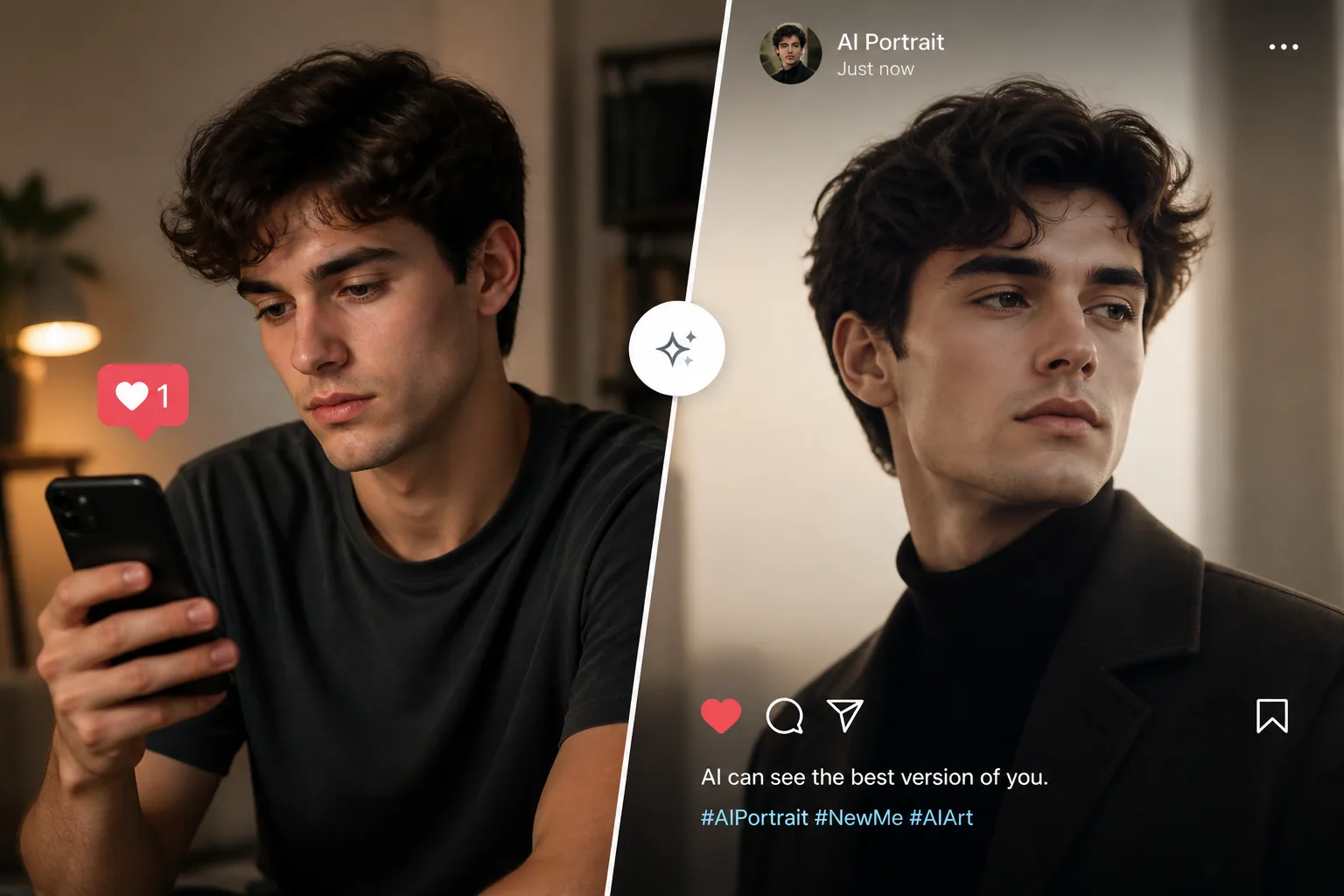
AI Portraits as Self-Esteem Boosters: How Your Digital Image Shapes Real-Life Confidence
AI portraits are becoming more than a social media trend. For many young adults, they are a new way to test identity, play with style, and see themselves from a fresh angle. That matters because the way we present ourselves online can shape how we feel offline. A portrait is not just a picture anymore. It can act like a mirror, a costume, a confidence experiment, or sometimes a source of pressure. The key question is whether AI-generated portraits help people feel more like themselves, or push them further away from who they are.
When used well, AI portraits can be a low-risk way to explore appearance without making permanent changes. They can help someone imagine different versions of themselves, from polished professional looks to creative fantasy styles. But there is also a real psychological tension here. The more perfect a digital self looks, the easier it is to compare it with the real one. That comparison can either support self-expression or damage self-esteem, depending on how the image is used and what it represents.
Why AI Portraits Feel More Personal Than a Filter
A standard filter adjusts a photo. An AI portrait often feels more like a reinvention. It does not just smooth a face or change lighting. It can generate a whole scene, a new outfit, a new mood, even a new identity style. That makes the result feel more personal, because the image is not only edited around you. It is built from you.
That sense of ownership matters. People often respond more strongly to images that reflect choice, intention, and creativity. When a portrait feels custom-made, it can feel less like a shallow edit and more like a self-expression tool. In that sense, AI portraits can function like digital styling, similar to trying on clothes, haircuts, or makeup, except with far more freedom and much lower stakes.
Still, the line between expression and distortion is thin. Research on AI beauty filters found that their use was significantly associated with lower appearance self-esteem, greater fear of negative appearance evaluation, and more negative body image, especially among users with higher body surveillance. You can read that study here: https://onlinelibrary.wiley.com/doi/full/10.1002/cb.70141 The issue is not simply that the image is artificial. It is that repeated exposure to idealized versions of the self can train people to monitor flaws more harshly.
The Psychology of Seeing Yourself Online
Seeing yourself online changes the way you think about yourself. Social platforms encourage self-observation, constant comparison, and quick judgment. You do not just look at a portrait and move on. You evaluate it. You ask whether it is attractive enough, professional enough, interesting enough, or authentic enough. Over time, that pattern can shape self-perception in subtle ways.
Psychology research helps explain why this happens. Self-discrepancy theory says distress grows when there is a gap between the actual self and the ideal self or ought self. When someone feels they should look more polished, more confident, or more socially approved than they really do, the result can be shame, disappointment, or guilt. A useful overview of this framework can be found here: https://pmc.ncbi.nlm.nih.gov/articles/PMC9087717/
That is one reason online self-presentation can feel so emotionally loaded. A portrait is not neutral when it becomes part of an identity story. If your online image feels too far from how you actually experience yourself, it may create tension rather than confidence. But if it feels aligned with your real personality and values, it can be affirming. The emotional effect depends less on perfection and more on congruence.
Polished vs. Realistic Selves: What Confidence Actually Grows From
Confidence does not usually come from looking flawless. It grows from feeling coherent. People tend to feel better when their outer presentation matches their inner sense of self. That is why an AI portrait can be helpful when it represents an authentic style you want to explore, rather than an impossible standard you feel pressured to meet.
The difference between polished and realistic is important. Polished can mean intentional, expressive, and well-crafted. Unrealistic means heavily detached from how you actually look or feel. Research on selfie behavior supports this distinction. A meta-analysis found that taking and posting selfies correlates with positive appearance-specific self-evaluations, while selfie editing correlates with more negative self-evaluations, both general and appearance-specific. The summary is available here: https://journals.sagepub.com/doi/pdf/10.1177/01461672231158252
That does not mean all editing is harmful. It means the psychological impact depends on why the image is being edited and how far the result departs from the person’s real self-image. A portrait that helps someone feel more expressive may build confidence. A portrait that tells someone they must look like a fantasy version of themselves may quietly erode it.
How AI Portraits Let People Safely Experiment With Identity
One of the most promising features of AI portraits is experimentation. Young adults often want to explore identity without making a permanent social commitment. AI makes that possible. Someone can test a more professional look, a bolder fashion style, a softer aesthetic, or even an entirely different persona without cutting their hair, changing their wardrobe, or facing real-world judgment right away.
This is especially valuable during periods of transition. Starting a new job, moving to a new city, graduating, dating, or rebuilding confidence after a difficult period are all moments when identity can feel fluid. AI portraits provide a sandbox for that process. You can see what feels energizing, what feels fake, and what feels surprisingly true.
Research on AI-generated and AI-enhanced images suggests that young adults often notice obvious AI alterations, but have a harder time detecting subtle ones. Even so, many express a preference for minimally edited or unaltered images, along with concern about the effect of AI manipulation on self-esteem and body image. That research is discussed here: https://papers.ssrn.com/sol3/papers.cfm?abstract_id=5492311 In other words, people are not necessarily rejecting creativity. They are asking for honesty and proportion.
That is where AI portraits can be healthiest. They work best when they are framed as creative identity exploration, not as a replacement for the real self.
What Science Says About Self-Image, Self-Esteem, and Authenticity
The science around digital self-image points to a simple but important idea: the more social media pushes people to compare, the more fragile self-esteem can become. A study using the Comparison-Emotion-Correction framework found that appearance comparison on social media can lead to state appearance anxiety, which then motivates corrective behaviors like selfie editing. The emotional impact of editing depends on the comparison context. You can find the study here: https://www.sciencedirect.com/science/article/pii/S0747563226001263
That helps explain why AI portraits can feel empowering in one context and exhausting in another. If someone creates an AI portrait after making a positive, self-directed choice, the result may feel playful and affirming. If they create it because they feel pressured to compete with others online, the same tool can intensify anxiety.
Another study found that AI-generated facial images were rated as more attractive than real photographs, with AI images averaging about 7.79 compared with 6.88 for human faces. That does not just show a preference for style. It reveals a bias that can raise the bar for what people think they should look like. The study is here: https://www.mdpi.com/2532-7518/6/2/5 When AI beauty becomes the norm, ordinary human variation can start to feel less acceptable than it should.
Authenticity also plays a big role. A mixed-methods study with 508 participants found that expression naturalness, facial proportion, and skin texture were the strongest predictors of whether AI-generated portraits are perceived as authentic. That means people are not just reacting to perfection. They are reacting to whether the image still feels human. The study reference is here: https://www.researchgate.net/publication/397086802_Which_Visual_Features_Influence_Perceived_Authenticity_in_AI-Generated_Portrait_Photography_A_Mixed-Methods_Study
When Digital Self-Expression Helps Mental Health, and When It Hurts
Digital self-expression can support mental health when it creates room for play, experimentation, and self-recognition. That is especially true when the user feels in control. Making a portrait that reflects a hidden side of your personality can be validating. So can seeing yourself in a style you always wanted to try. For some people, this kind of visual exploration can reduce self-consciousness and help them step into public life with more ease.
There is even experimental support for that idea. AI self-clone experiments suggest that when people see digital clones closely aligned with their own perception of self, speech anxiety can decrease and enjoyment in presentation tasks can increase. The paper is available here: https://arxiv.org/abs/2310.15112 That finding matters because it suggests confidence may rise when digital representations feel believable and self-congruent, not when they are unrealistic.
The harmful side appears when digital self-expression becomes constant self-correction. False self-presentation and social comparison have been linked with excessive social media use, which in turn is associated with poorer mental health outcomes. The greater the gap between actual appearance and online self, the more likely high comparison and low self-esteem become. More on that is here: https://pmc.ncbi.nlm.nih.gov/articles/PMC12109065/
So the emotional question is not whether AI portraits are good or bad. It is whether they are helping a person express themselves, or teaching them to reject themselves.
What Psychologists and Social Media Experts Are Warning About
Psychologists tend to warn about two linked risks. The first is comparison fatigue, which happens when people repeatedly judge themselves against enhanced images. The second is self-objectification, which happens when someone begins to view their body mainly as an image to manage. Together, these processes can make a person feel watched, evaluated, and never finished.
Social media professionals often point out that curated identity is now a basic part of online life. That does not mean all curation is deceptive. It means people should understand the psychological cost of over-curation. Once a persona is built for likes, shares, and approval, it can become harder to remember which parts are genuine preference and which parts are performance.
The strongest warning is about repetition. A single AI portrait is unlikely to define someone. But a constant diet of idealized self-images, especially if paired with social comparison, can slowly rewrite what feels normal. That is why the healthiest use of AI portraits includes reflection, not just generation.
How Creators Can Use AI Portraits Without Losing Themselves
Creators, influencers, and everyday users can use AI portraits in ways that protect identity instead of fragmenting it. The best rule is simple: let the image serve the person, not the other way around. If the portrait helps you tell a story, launch a project, explore a theme, or try a mood, it can be a useful creative tool. If it makes you feel like your real face is no longer enough, it is time to step back.
One practical way to stay grounded is to keep a visual range. Save both the AI-generated version and a more natural image of yourself. Looking at both can help maintain perspective. You can also ask whether the portrait reflects your values, your personality, or just an external beauty trend. That question matters because identity is more than aesthetics.
If you want to experiment with style while still keeping the process playful, a tool like Selfie AI: AI Photo Generator can be a good place to start. It lets users turn ordinary selfies into portraits and animated videos in different styles and settings, including professional looks, beach scenes, formal outfits, historical eras, and custom prompts. You can find it here: https://findthe.app/selfie-ai-0xi7wd. Used thoughtfully, that kind of platform can support creativity without requiring you to change who you are in real life.
Practical Tips for Balancing Creativity With Realistic Self-Representation
A healthy relationship with AI portraits starts with intention. Before generating an image, ask what you want it to do. Are you exploring a style? Building confidence for a specific setting? Creating content? Or trying to fix a self-image problem that needs more than a new portrait? Being honest about the goal helps prevent disappointment later.
A few practical guardrails can help. First, choose portraits that still resemble you in expression, age, and overall presence. Second, avoid using AI portraits as your only reference point for how you should look. Third, limit comparison by not turning every portrait into a ranking exercise. Fourth, pay attention to how you feel after using the tool. If the result leaves you energized, curious, or more self-accepting, that is a good sign. If it leaves you ashamed or obsessed, pause and reassess.
It also helps to keep the line between fun and identity clear. A fantasy portrait can be creative without being aspirational in a harmful way. A professional portrait can be polished without becoming a lie. And a confidence-building portrait works best when it feels like an extension of your real self, not a correction of it.
The Future of Self-Image in the Age of AI
AI will probably keep changing how people see themselves. Portrait tools are only one part of a broader shift toward editable identity, where appearance can be reshaped quickly and endlessly. That brings opportunity and risk at the same time. The opportunity is greater creativity, access, and self-exploration. The risk is that beauty, authenticity, and worth may become harder to separate.
The future likely belongs to people who can use these tools with emotional literacy. That means knowing when an image is helping you express yourself and when it is quietly replacing your own standards with someone else’s. The most confident users will probably not be the ones who generate the most perfect portraits. They will be the ones who use AI as a mirror for possibility, not as a verdict on their value.
In that sense, AI portraits can absolutely boost self-esteem, but only when they remain connected to authenticity. The goal is not to build a better fake self. The goal is to discover which parts of your real self deserve to be seen more clearly.