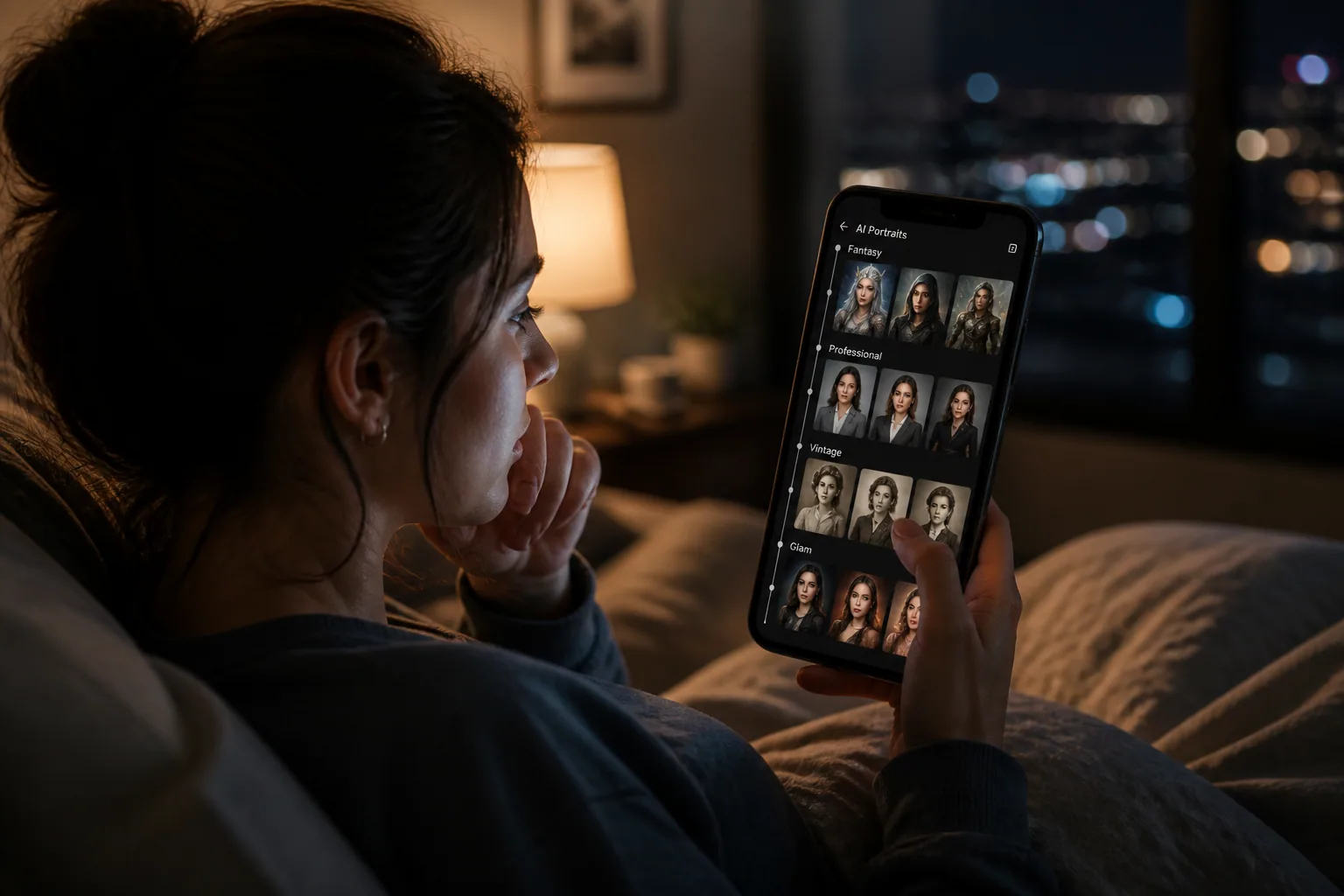
AI-Generated Selfies and Identity: How Saved Portraits Can Reshape the Way You See Yourself
AI-generated portraits can feel surprisingly personal. They are not just fun filters or one-off images. When you save them, revisit them, compare them over time, and organize them into little visual collections, they start to behave like a mirror, a diary, and a style archive all at once. For many people, that makes them emotionally sticky in a way ordinary photos do not. You are not only looking at how you look. You are also looking at how you might want to be seen, how you think you have changed, and what kind of self feels most like you today.
That is why AI selfies are more than entertainment. They can shape self-perception, confidence, identity, and even memory. They may help some people experiment safely with style or age, while for others they can intensify comparison, perfectionism, or appearance pressure. Understanding that difference matters, especially if you are someone who keeps a growing archive of portraits and returns to it often.
Why AI Portraits Feel More Personal Than Just Filters
A basic filter usually tweaks a single moment. An AI portrait, by contrast, often feels like a constructed version of you. It can show you in a new setting, a new era, or a new aesthetic, and that gives it a stronger identity charge. The image feels authored rather than merely edited. That makes it easier to attach meaning to it, especially when the portrait seems to match an inner self you already sense but rarely see reflected back.
This is one reason AI portraits can become emotionally memorable. They often look polished, stylized, and coherent in a way that real-life selfies do not. Instead of just asking, “How do I look today?” they invite a deeper question: “Which version of myself feels most true, aspirational, playful, or possible?” That identity layer is what gives them power.
The Psychology of Self-Perception in Digital Mirrors
Humans have always used mirrors, photographs, and reflected images to build a sense of self. AI portraits extend that tradition into a digital mirror that can be endlessly revised. Because the image is generated from your own face, it can feel both familiar and unfamiliar at the same time. That tension matters psychologically. It can create a sense of distance that makes self-exploration easier, but it can also intensify self-surveillance.
Research suggests that self-displaying images can shift how we mentally represent ourselves. Photos that include the self, such as selfies or portraits, tend to move autobiographical memory toward an observer-like perspective, meaning people may remember themselves more from the outside than through their own first-person experience. Source: https://onlinelibrary.wiley.com/doi/full/10.1002/acp.4150 That outside view can be useful for reflection, but it can also make appearance feel more central than lived experience.
There is also evidence that photographing events, especially when the self is included, can impair memory for visual details compared with simply experiencing the moment. The photo impairment effect appears even stronger for saving screenshots. Source: https://pubmed.ncbi.nlm.nih.gov/40195208/ In other words, the more we externalize the self into images, the more those images may begin to organize what we remember, how we compare, and what we consider significant.
How Curated Portrait Galleries Can Shape Identity Over Time
A curated AI portrait gallery does more than collect images. It creates a visual narrative. Over time, that narrative can influence what feels normal, flattering, expressive, or “like me.” Early digital photography research already pointed to this process, showing that people use photo archives to continuously reshape and communicate identity, selecting images that reflect desired styles and selves. Source: https://journals.sagepub.com/doi/pdf/10.1177/1470357207084865
The same logic applies to AI portrait archives. If you repeatedly save images with certain colors, expressions, hairstyles, or moods, you begin building a pattern. The archive becomes a kind of visual autobiography. You may start to notice that you gravitate toward soft lighting, sharp tailoring, bold makeup, vintage aesthetics, or athletic scenes. Those preferences are not random. They can reveal how you want to inhabit yourself.
Over time, the archive can also influence identity through repetition. The more you see a particular look linked to your own face, the more familiar it can become. Familiarity often reads as authenticity. That does not mean the look is your only true self. It means repeated visual exposure can make a style feel like an extension of you.
What Research Says About Self-Esteem, Self-Discrepancy, and Visual Self-Comparison
A key concept here is self-discrepancy, which refers to the gap between the self you feel you are, the self you wish you were, and the self you believe others see. AI portraits can widen or narrow that gap. When an image feels aligned with your ideal self, it can create confidence and motivation. When it feels too far from your lived appearance, it can create frustration or shame.
A recent systematic review of 37 academic articles found a consistent association between selfie behaviors, especially frequent taking, editing, and sharing, and body image concerns. The review also highlighted idealized self-presentation and ideal-self discrepancy as key mediators. Source: https://onlinelibrary.wiley.com/doi/10.1111/ijcs.70179 This matters for AI portraits because the same mechanisms may apply when the images become highly curated and repeatedly revisited.
The concern is not that portraits are automatically harmful. It is that they can turn self-evaluation into a constant comparison process. Each saved image becomes a reference point. Instead of asking, “Do I like how I look?” you may begin asking, “How close am I to the version of myself I saved last month?” That shift can quietly move self-worth from experience to appearance.
Other research suggests that taking and sharing selfies, or even just saving them, can affect self-esteem and social sensitivity. One study found that participants who took and shared selfies showed lower self-esteem and greater social sensitivity than those who simply took or saved images. Source: https://www.sciencedirect.com/science/article/abs/pii/S0191886917300715 The implication is clear: the image pipeline itself, not just public posting, can shape how people feel about themselves.
Do Long-Term Users Revisit Old AI Selfies and Change Their Preferences?
Yes, and that is one of the most interesting parts of AI portrait use. What you love today may not be what you love six months from now. At first, you might prefer the most realistic portraits because they feel validating. Later, you may gravitate toward more stylized, expressive, or abstract images because they capture mood better than realism does. Over time, your taste can shift from resemblance to symbolism.
That changing preference can be healthy. It may reflect growth in self-knowledge. You might notice that you are less interested in being conventionally attractive and more interested in being cinematic, soft, powerful, playful, or mysterious. Revisiting older AI portraits can help you see that your relationship to your image is not fixed. It evolves along with your values, confidence, and interests.
There is also a useful aesthetic clue in selfie research. In one study, people showed consistent pose biases when taking selfies, with standard selfies tending toward a left-cheek bias and mirror selfies a right-cheek bias, across genders and cultures. Source: https://pmc.ncbi.nlm.nih.gov/articles/PMC4411109/ That kind of pattern suggests people have unconscious visual preferences. When those preferences shift, it can be a sign that your sense of what feels like “you” is also shifting.
How Repeated Styles and Aesthetics Can Influence Your Sense of Self
Repeated exposure has a strong psychological effect. If your archive is full of dark academia portraits, elegant formalwear, futuristic neon scenes, or beach-day warmth, those aesthetics can start to feel associated with your identity. Not because the AI has uncovered a hidden essence, but because repetition builds association. The more often you see yourself in a style, the more that style may feel available as a self-description.
This can be empowering. A person who always felt unseen in everyday life may discover that certain colors, poses, or visual themes bring out a self they enjoy inhabiting. That kind of discovery can support self-expression, especially when it helps someone explore gender presentation, age presentation, or personality cues in a low-risk way.
But repetition can also narrow identity if the archive becomes too rigid. If you only save one look because it gets the strongest validation, you may begin to feel as though all other versions of yourself are less legitimate. A healthy archive leaves room for contradiction. You can be polished and casual, dramatic and ordinary, strong and soft.
When AI Portrait Archives Support Confidence and Self-Discovery
Used intentionally, AI portraits can support confidence in several ways. They can help people experiment with appearance without permanent changes. They can also reduce anxiety for users who want to preview a style before trying it in real life. For some, they even create a safer space to imagine a self that is not fully allowed in daily environments yet.
That is where a tool like Selfie AI: AI Photo Generator can fit naturally into the process. It lets you transform a few selfies into multiple styles, from professional portraits to vacation scenes, historical looks, and custom prompts, which can be useful if you want to explore identity through visual variety rather than a single fixed image. You can learn more here: https://findthe.app/selfie-ai-0xi7wd.
Confidence tends to grow when the archive is used as an experiment, not a verdict. If an image makes you feel seen, that feeling can be informative. It may reveal what kind of posture, clothing, expression, or atmosphere helps you feel most at home in your own image. That insight is valuable even if the portrait is clearly stylized or AI-generated.
When Saved Portraits Start Fueling Insecurity or Appearance Pressure
The same archive can become stressful if it turns into a scoreboard. If you find yourself obsessing over which portrait is prettier, more youthful, more popular-looking, or more socially acceptable, the process may be shifting from exploration to evaluation. At that point, the archive stops being a mirror for reflection and starts becoming a device for self-criticism.
The research on selfie behavior and body image concerns is relevant here. Frequent taking, editing, and sharing are linked with ideal-self discrepancy and body image distress. The more a person uses images to close a gap they feel they cannot close, the more likely the process is to produce frustration instead of comfort. That is why it helps to watch for signs of emotional narrowing, such as checking portraits compulsively, deleting anything imperfect, or feeling worse after scrolling through your own gallery.
If the archive is creating pressure, it may help to change the rules. Limit comparison sessions. Avoid rating images numerically. Keep a few pictures that feel meaningful rather than only the most flattering. And remember that a portrait can be aesthetically successful without being emotionally representative.
How to Use Style Journaling to Reflect on Your Evolving Self-Image
Style journaling turns a portrait archive into a self-reflection practice. The idea is simple: instead of only saving images, you write a few notes about what each image says to you. What mood does it carry? What version of yourself does it evoke? What do you like about it, and what does it leave out? Over time, those notes can reveal patterns in your preferences and your identity development.
A useful entry might include the date, the portrait style, what attracted you to it, and how you felt when you first saw it. Then you can revisit the same image later and note whether your reaction changed. That helps separate momentary emotion from longer-term preference. It also shows you that identity is not static, even when the face in the image stays the same.
Style journaling can be especially helpful for people who are visually oriented but unsure how to articulate what they want. Sometimes the archive is saying something before the words arrive. Writing about it helps translate visual taste into self-knowledge.
Smart Ways to Organize Your AI Portrait Portfolio by Mood, Era, or Identity Theme
Organization matters because it shapes interpretation. If you dump every portrait into one folder, the archive can feel like a chaotic stream of comparison. If you organize it by mood, era, or theme, it becomes easier to see the logic of your self-expression. Categories might include calm, romantic, professional, fantasy, retro, athletic, celebratory, or experimental.
You can also group portraits by identity questions instead of aesthetics alone. For example: “How I want to feel at work,” “How I imagine myself in winter,” “Versions of me that feel brave,” or “Looks I would never wear in daily life but enjoy imagining.” This approach encourages reflection rather than judgment. It also helps you notice that different portraits can serve different emotional purposes.
One practical rule is to keep your archive plural. A healthy portfolio should show range, not just optimization. When you allow multiple themes to coexist, you protect yourself from the idea that one image has to define you.
Reflection Prompts to Help You Compare Portraits Without Judging Yourself
Comparison does not have to be cruel. It can be informative if you ask the right questions. Try comparing two portraits with prompts like: Which one feels more relaxed? Which one feels more confident? Which one looks more like the way I want to present myself right now? Which one feels beautiful in a way that is honest rather than performative?
You can also ask what each image is doing emotionally. Does one portrait feel safe and one feel exciting? Does one feel like public presentation and the other like private imagination? Does one fit your current life and the other reflect a future you are testing? These questions move you away from ranking and toward understanding.
If you notice self-criticism creeping in, shift the prompt from “Which is better?” to “What does this image reveal about my values?” That small change can protect self-esteem while still allowing meaningful comparison.
Healthy Boundaries for Identity-Conscious Social Media Users
For people who share AI portraits publicly, boundaries are essential. Public feedback can intensify the emotional weight of an image, especially if likes and comments begin to stand in for self-worth. The more identity is tied to engagement metrics, the easier it is to confuse popularity with truth.
A few healthy boundaries can help. Keep some portraits private. Delay posting until you have checked how you feel without outside response. Avoid revisiting the same post repeatedly to monitor reactions. And set aside time when you enjoy the image as a personal artifact rather than a public performance.
It can also help to separate experimentation from endorsement. Just because you enjoy a portrait does not mean you need to become that version of yourself permanently. Digital identity is flexible. You are allowed to try on looks without turning them into obligations.
What Therapists and Mental Health Advocates Should Watch For
For therapists, coaches, and mental health advocates, AI portrait use is worth asking about in a nuanced way. The goal is not to pathologize image-making. The goal is to understand whether the practice is supporting self-exploration or amplifying body dissatisfaction, social comparison, and compulsive checking.
Warning signs may include frequent distress after viewing saved portraits, preoccupation with editing or rerendering, strong avoidance of unfiltered images, and reliance on idealized portraits to regulate mood. Given the research linking selfie behaviors to body image concerns and self-discrepancy, it can be useful to explore whether the client is chasing an imagined ideal at the expense of embodied self-acceptance.
At the same time, AI portraits can be clinically useful as a discussion tool. They may help clients articulate identity themes, gender expression questions, style preferences, or parts of the self that feel underdeveloped. In that sense, the image is not the endpoint. It is a conversation starter.
Using AI Portraits as Tools for Self-Expression, Not Self-Replacement
The healthiest relationship to AI-generated selfies is one where the image serves the person, not the other way around. That means treating portraits as expressive objects, not proof of worth. It means allowing them to inspire self-awareness without turning them into a replacement for lived identity.
If you save portraits, revisit them with curiosity. Notice what you consistently choose, what you avoid, and what surprises you. Let the archive tell you something about your tastes, your moods, and your hopes. But do not let it flatten your identity into a single perfect face. You are not one portrait. You are the person who keeps changing across many portraits.
Used well, AI portraits can help you see yourself with more nuance. They can show you how your self-image evolves, how your aesthetic preferences mature, and how identity is often built through repetition, imagination, and reflection. The goal is not to become your best image. The goal is to use images to better understand the real, changing, unfinished self beneath them.